Yesterday I posted about our trip to Valley Star Farms, today I have a few more photos to share from that visit. By the time I finish this post, we could officially call October "Winter Squash Month" here on the Hawksbill Cabin blog.
We bought a few smaller, decorative squashes while we were there. I've since learned that you can eat these if you prepare them properly - I never would have guessed, since they are so hard, and I don't expect to try it. We also bought a couple of larger varieites...a Long Island Cheese, the pale orange one, and a Turban, the bright orange one. As is tradition, Mary made a tableau to display them while I search for recipes.
Two highlights I should point out: the pottery collection comes from a variety of mid-Atlantic and southeast craftspeople, including some from the "Jugtown" disctrict in North Carolina; and the print here (featuring Page County Beef!) comes from local artist Wes Porter.
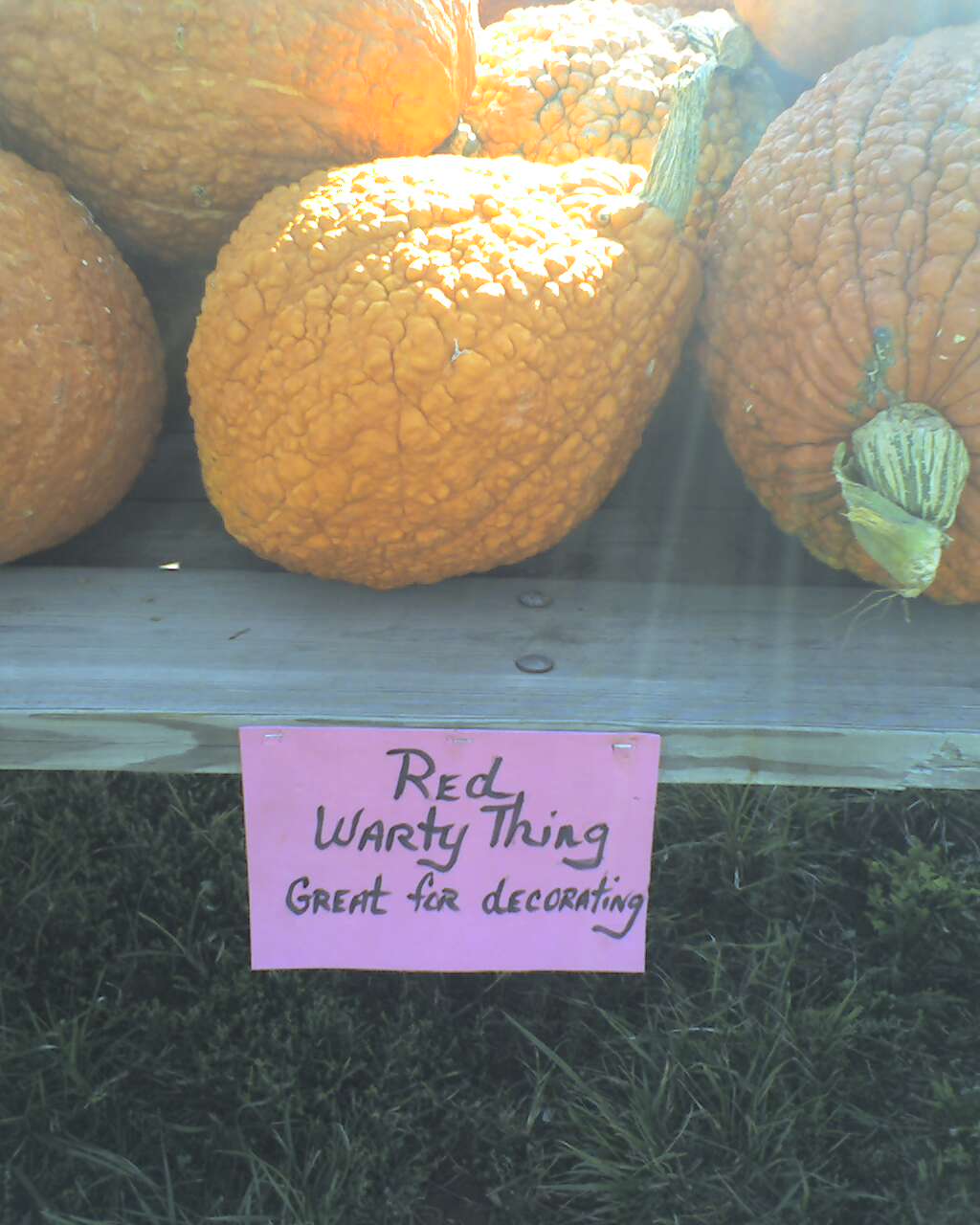
For the rest of the post, I thought I'd add a few close-ups of some of the other pumpkin varieties Valley Star has for sale, including Cinderella and "orange warty thing."
"Green Acres" it ain't, but we love owning and visiting the Hawksbill Cabin, near Stanley and Luray, Virginia, and a wealth of outdoor activities, including: the "World Famous" Shenandoah River, Shenandoah National Park, Skyline Drive, Luray Caverns, and Massanutten Resort. From time to time we'll post about other stuff, too. As the number of blog posts grows, we've added a few navigation tools in the right column to facilitate getting around the site.
Ramble On
Thursday, October 21, 2010
Wednesday, October 20, 2010
On the Fall to-do List: Buy a Punkin

We finally made our must-do stop at Valley Star Farms in Luray to buy some pumpkins. It's a simple pleasure and honestly one of my favorties every year. Here are a couple of shots from the stop, showing the wide variety that are always on hand there. Tomorrow, I'll have some close-ups!If you are interested, here is a link to the farm's website: http://www.valleystarfarm.com/
Tuesday, October 19, 2010
It's Okay to Like Nick Lowe
Mary, good friends James and Chris, and I ventured down to the Birchmere last night to catch one of my all-time favorite artists, Nick Lowe, who's on a short US tour with a band right now. The show features his excellent late work, and even includes a couple of songs that haven't yet been released - and woven in are a few classics that are absolute musts.
I kept a playlist, but I know I missed one song from the three songs he opened solo with, and there were a few on the list I've got to go back and get titles for. So I will post that, but it will be a few days.
He's brought a great band with him on the road, featuring Geraint Watkins (keyboards), Robert Trehern (drums), Johnny Scott (guitar) and Matt Radford (bass). Watkins performed as an opening act, and there were some in the crowd that were familiar with his work. A highlight was his dramatic reading of the lyrics to Johnny B. Good - followed by a boogie-woogie piano version of the classic.
As I mentioned, Nick's tour is promoting three albums that were recently re-released - they've even been released on vinyl now for the first time, as that format makes a come back. The records are The Impossible Bird, Dig My Mood, and The Convincer, and songs in the show included Lack of Love, Has She Got a Friend, and a personal favorite (Mary sang along), Indian Queens.
Midway through Indian Queens, Nick pointed out something about the song, "You know I made this song up," just before the part about working the rigs off Galveston.
By my count, there were 19 songs in the almost two hour show. Some past favorites that made it into the playlist were Ragin' Eyes, Heart, Cruel to Be Kind, and I Knew the Bride (When She Used to Rock n Roll). Of course, What's So Funny (about Peace, Love and Understanding) was the closer, and then we got Every Day I Write the Book in the encore.
It was a great show, and even geezers like myself got out early enough to not miss bed time. If anything, my status of a fan was solidified seeing Old Nick live.
Monday, October 18, 2010
Pruning Plans for the Old Apple Tree
“The old adage tells us a bird should be able to fly through your apple tree without its wings touching a branch.”
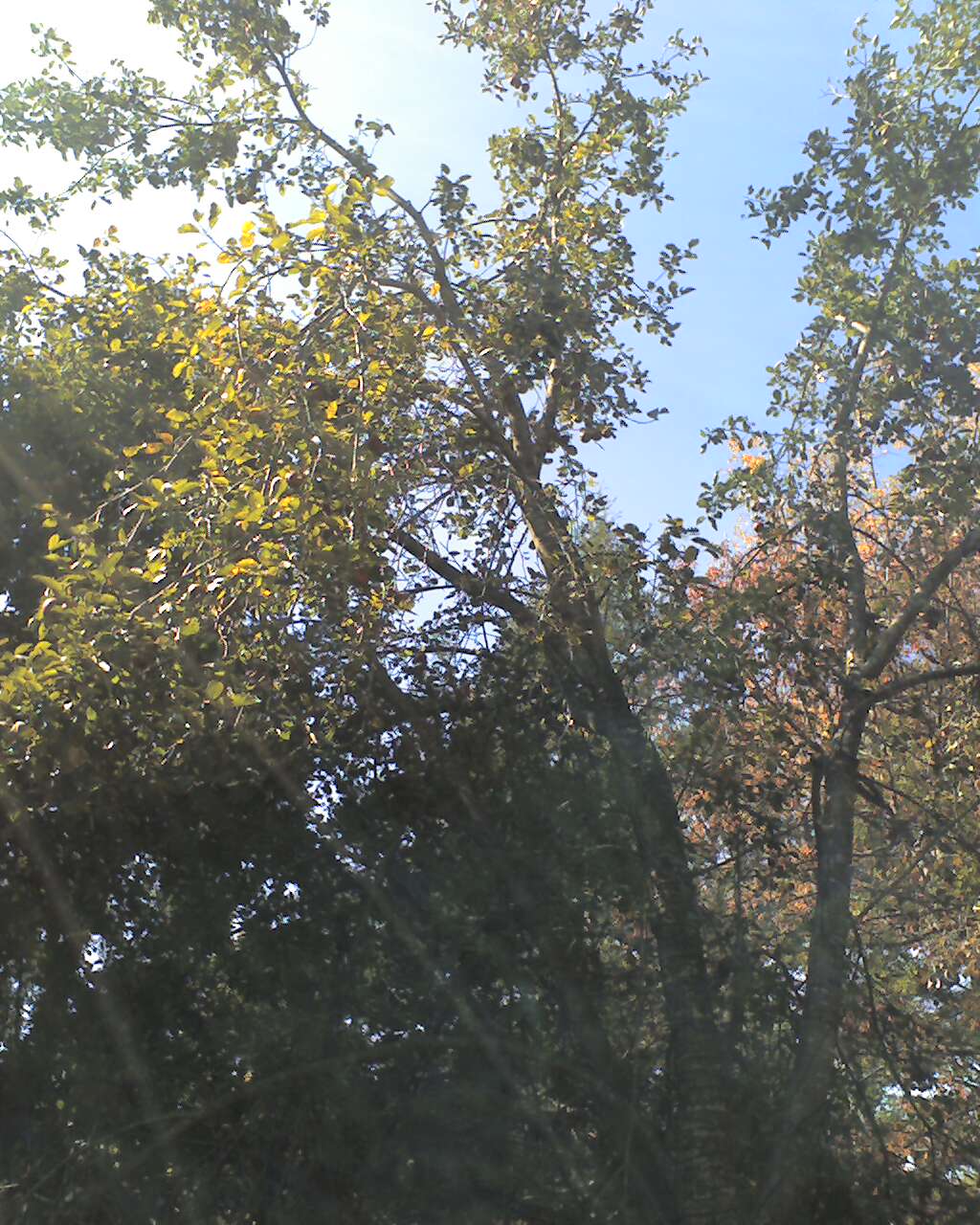
I’ve been thinking about our apple tree again, and found the above quotation on a gardening site. Because of the damage our tree suffered during last winter’s storms, we postponed the overdue pruning that I was planning for it. I was getting that organized for last March, but we lost one of the three main trunks at that time.
You can also see the bore holes where the birds – sapsuckers, mainly – have drilled into the old trunk. I’ve seen a pair of woodpeckers flying around the yard this fall, stopping on neighboring oaks and dogwoods, before lighting on this tree and making their way around it.
I’d been given a referral to Clyde Jenkins – he of the basket weaving craft I wrote about last week – as a source of insight about taking care of this neglected tree, as well as how to go about identifying the variety of apples we’re growing. With that in mind, I walked around the tree taking some preliminary photographs I can put together in a letter to him, where I will ask his advice and potentially hire him for a consultation.
I’m sure this tree has been around for sixty years or more, since the house was built. It seems like it would be worth a couple of years of effort to save it, cultivating it back into a prized specimen. After all, it reacted with a robust fruiting season this year after all it went through.
I’ve been thinking about our apple tree again, and found the above quotation on a gardening site. Because of the damage our tree suffered during last winter’s storms, we postponed the overdue pruning that I was planning for it. I was getting that organized for last March, but we lost one of the three main trunks at that time.
Later, as the tree leafed out and the apple blossoms set, we found additional damage and took down a second trunk. So, all in all, we pruned back two thirds of the tree to make it safe.
You can also see the bore holes where the birds – sapsuckers, mainly – have drilled into the old trunk. I’ve seen a pair of woodpeckers flying around the yard this fall, stopping on neighboring oaks and dogwoods, before lighting on this tree and making their way around it.I’d been given a referral to Clyde Jenkins – he of the basket weaving craft I wrote about last week – as a source of insight about taking care of this neglected tree, as well as how to go about identifying the variety of apples we’re growing. With that in mind, I walked around the tree taking some preliminary photographs I can put together in a letter to him, where I will ask his advice and potentially hire him for a consultation.
I’m sure this tree has been around for sixty years or more, since the house was built. It seems like it would be worth a couple of years of effort to save it, cultivating it back into a prized specimen. After all, it reacted with a robust fruiting season this year after all it went through.
Friday, October 15, 2010
Page County Heritage Festival, 2010 - Part 2
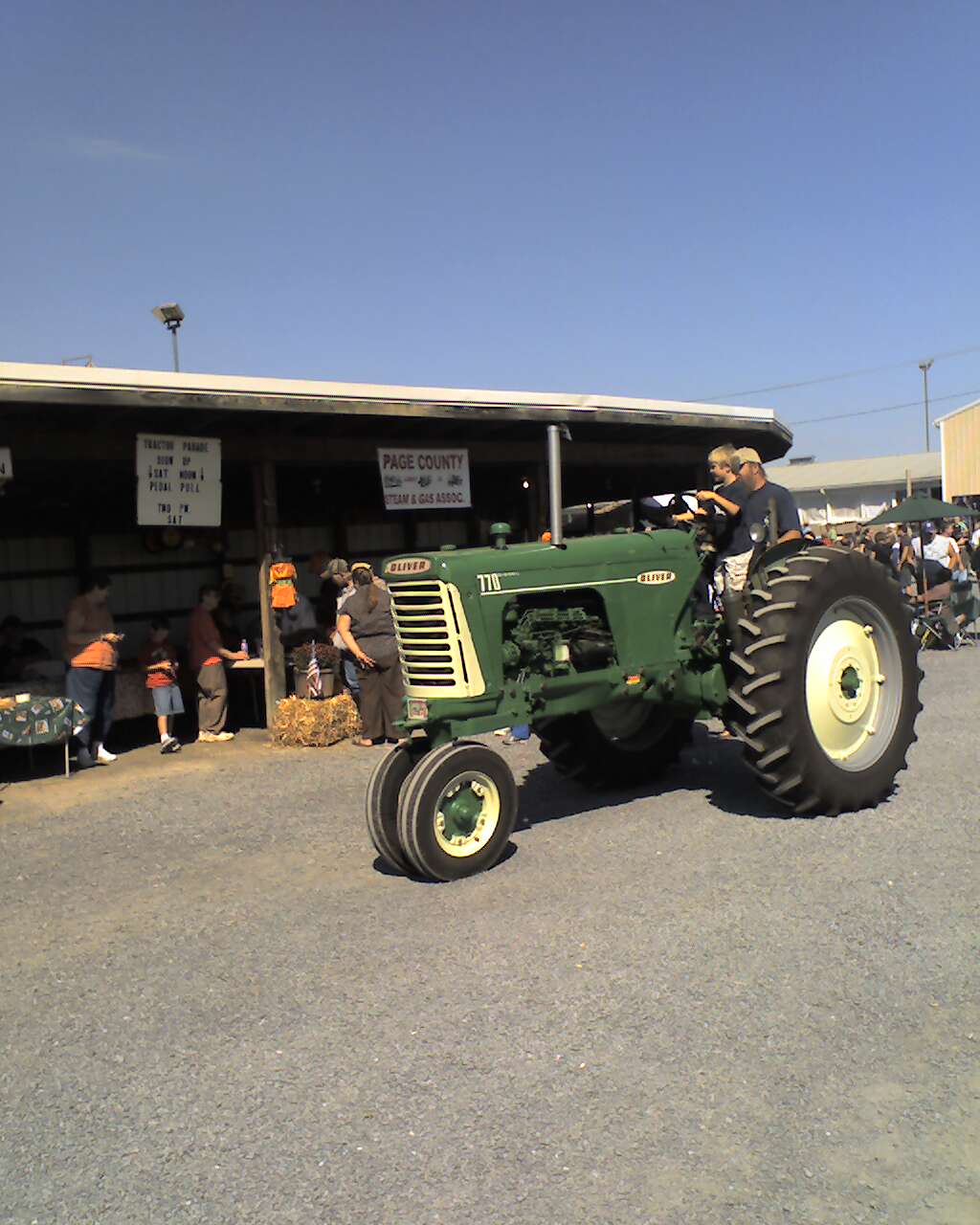
A quick post to highlight the tractor and steam engine portion of the Heritage Festival that was held last weekend. Everytime we've been to the fest, there are upwards of a hundred, or more, vintage tractors of all types assembled into a display right at the fairgrounds entrance. I've shown more photos in previous years - this time, only one focused shot on the group of Ford tractors I found.Of course, there were John Deeres and Allis-Chalmers (there is quite a following of these distinctive orange machines in Page County!), and quite a few others besides. Although it happened after we left the fairgrounds, there was a tractor parade scheduled - I'm pretty sure that the Oliver shown here was going to participate.
There are usually several steam machines on display too. I particularly like to stop and watch the portable sawmills that are powered by these vehicles. We watched a couple of quarter-sawn planks get turned out (on our way to the Methodist Men's pulled pork sandwich booth).
Thursday, October 14, 2010
Page County Heritage Festival, 2010 - Part 1
It’s one of the annual events we look forward to in Page County – the Heritage Festival. It’s a two-day event held on Columbus Day weekend, featuring craft demonstrations and an antique tractor show, meant to connect us with the past, showing how farm work was done in the County’s “early days.” There is also a wide range of musical entertainment – including clogging, and of course, there’s a lot of food to sample.
Mary and I missed it last year, but we made a point of visiting this year, even getting there early on the first day. We ran into our neighbor Bobby in the parking lot, who started out the conversation with the remark, “Yep, I’ve got to get me a candy apple and an elephant ear,” before moving into some other hot topics about the community and our neighborhood.
I have a few photographs to share about the tractor and steam engine portion of the show in a separate post, but today I wanted to pass along some photos of basket weaver Clyde Jenkins and his Stanley-based team doing demonstrations of white oak basket weaving. This was the first time we’d wandered around to where this group was working. Mr. Jenkins’ card advertises these as an “heirloom of quality hand crafted in the Shenandoah Valley of Virginia,” while noting that his group is a basket supplier for Colonial Williamsburg.
I have heard, but didn’t verify, while we were at the basket weaving display, that Mr. Jenkins is an expert on heritage apple varieties. There were more than 20 local types on display in the same area where they were making baskets. It’s on my to do list to talk with him about our tree – both to find out what kind of apples we have and for tips on pruning it to save it.
In any case, it is easy to find out more about Mr. Jenkins and his basket weaving with a Google search – I’ve included a link to a Washington Post article below, as a matter of fact.
Other crafts on display at the festival included quilt making, wood working, wool spinning, soap making, apple butter making, and metal working – including black smithing. There’s plenty to learn here about how things were done, and the groups that work to keep the heritage alive.
The official web site for the festival can be found at http://luraypage.com/heritage . Tomorrow I’ll post some photos of the tractors and steam engines.
The Post article about Charles Jenkins is here: http://www.washingtonpost.com/wp-dyn/content/article/2007/07/19/AR2007071900639.html
Wednesday, October 13, 2010
Fall at Wisteria Vineyard
Mary and I were lucky with our schedules last weekend, and we headed out to the Hawksbill Cabin on Friday afternoon. Soon after we arrived, our neighbors Sally and Dan invited us to join them for the evenings on Main concert in downtown Luray, this time with Clarence “The Bluesman” Turner, at the BB&T performing arts center.
Although it turned out that Dan couldn’t join us when he was called out for a rescue at the Park, we enjoyed a great time hanging out with Sally and seeing the show. We also ran into our neighbors Sue and Moussa, from Wisteria Vineyard, and other friends Steve and his wife from volunteering and other community events. It was an excellent kick-off to a fine weekend, making us feel "at home".
With the holidays coming up, I figured we needed to have some wine around for potential visitors and host gifts during the festivities, and I wanted to make a stop by the vineyard for this. Since they are so close by, only a mile and a half away on the roads – probably a half mile away if we could cut straight through the intervening properties – we went late Sunday afternoon, thinking that they’d be less busy with drive-in visitors at that late hour. Judging from the parking lot, the tasting room had seen steady traffic all weekend.
There were still some visitors checking things out, including the new two “paths” for tasting at Wisteria, the Sweeter Path, and the Dryer Path. These highlight some of the new vintages, including: Pinot Gris, Steel Chardonnay (completed in steel barrels, Wisteria also has a traditional oak Chardonnay), Velvet (a semi-sweet Rose’), and Sweet Daisy – a late harvest ice wine (and Wisteria makes a $1 donation for each bottle to the local SPCA). I decided to add a few bottles of each of these to complete my case…the balance was in the traditional Norton red, our native Virginian grape.
There was a lot of news to collect, including the unveiling of the artwork that opens this post, a graphic that greets vineyard visitors with a stylized map of the farm. A trip out into the vines, or a walk to Hawksbill Creek, makes a great addition to an afternoon here.
Sue shared the news about two awards their wines recently received – as a new winery, this is pretty impressive stuff. The steel Chardonnay won a bronze medal in the Virginia Governor's Cup competition, and the Norton won a bronze in the Atlantic Seaboard competition earlier in the summer! They were very encouraging, and still are, whenever we talk about setting up some kind of business in the Valley. We are still looking for the right thing to do…may have some news on this front off and on over the winter.
On Wisteria’s web page, the working farm aspect of the operation is featured – there is the flock of Romney sheep, two flocks of chickens, and then the three dogs, including “Sweet Daisy” – the boss of this pack. I’ve got a photo here of some of the sheep, including young Blackie, the lamb I included photos of in an earlier post. As dusk approached we went outside to enjoy the quality atmosphere, and later went for dinner with the proprietors and neighbor John.
We talked about some of the events they’ve recently held, including the live music nights, private parties, and the fund raiser for the local shelter a few weeks ago…it was on a week night, so Mary and I couldn’t join it, although my friend Steve and his wife did, and they told me it was a great success. These things not only make for a nice time, and they certainly contribute to the sense of community in our little neck of the woods.
Most of the visitors we’ve had this year were treated to a stop by Wisteria. It’s become a favorite thing to do for us. We’re looking forward to our next one!
Some web references:
Wisteria web site: http://wisteriavineyard.com/
Clarence “The Bluesman” Turner web site: http://bluesmanturner.com/
Tuesday, October 12, 2010
As Seen on GWNF's Storybook Trail: Fall Color
On Sunday morning, after breakfast at the Southern Kitchen in New Market, Mary and I made a stop by the Storybook Trail in the George Washington National Forest - we often do for the short little walk after enjoying the terrific fare over at the little diner.
There are touches of color up and down the mountains surrounding our Valley. The forecast for fall color, according to some, is that this won't be a great year for leaf color, but we found enough to enjoy there in the morning sunlight.
And one other thing - there was a little copperhead on the trail as we were walking back. Why it was still out on the path when we got there, who knows, since a large family group had come through with kids racing ahead, yelling and laughing - should have been enough to chase this little guy off. But no, Mary spotted it with her eagly snake detecting prowess and kept me from stepping on it.
It was clearly a hatchling from this year, and wasn't as big as the juvenile black rat snakes we sometimes encounter at the Hawksbill Cabin. I tried to get a photo, following its movement off into the brush - but the phone cam just couldn't capture the moment for us.
It was our first encounter with a venomous snake in the Valley. Back to fall color now:
Friday, October 8, 2010
Clarendon Construction - October 2010
One of my colleagues came by the office a few days ago, knowing my interest in the buildings going up across the way from us. He said, "Jim, some kind of conference going on over there, eh?" So I took a look, and yes, there were quite a number of workers completing tasks on the exterior upper stories.From the top down, there is a team that is working on the roof membrane, then another group that is working on the balcony. I think they have installed a safety rail, and also additional waterproofing membranes. A third team is working on exterior detail and fenestration, and the final team is working on restoring the historical storefront facades. A team just out of sight on the ground floor is working on waterproofing the site, what are potentially landscaping areas, but I can't tell yet.
While I was taking a walk the other day, since the two buildings on the south lot are nearing completion - I mentioned this last month - I decided to take my final update photos of them for this post. Here is the residential buidling, first, from the Clarendon Boulevard entry, and then a photo of the residential and office buildings together. They still have a few final steps to go, but there's nothing significant enough left that I'd notice the changes anymore. I want to move this category along to observing the final steps of the "north block" building - I'm using this material, combined with web research, and hopefully a couple of interviews, for a school project in my construction management class. So there will be quite a few more photos this month...I also will continue to track the air rights building going up over the church behind us.
Thursday, October 7, 2010
Need Advice: Apple Wood Smoke
I've been collecting downed limbs off of our tree over the course of the summer - you can see the stack I've set aside for drying here. My question for the experts...I noticed some lichen on the bark; do you think I can use it like this, or should I skin it down to the wood?
Also, I've noticed the recipes always mention "wood chips" - hey, where I am doing this, I have access to the real thing, and don't need to factory bagged stuff from Whole Paychecks. So I will prbably break these down one more time and use them as small logs - like my neighbor Dan does with the hickory he collects on his property (I'm am remembering some awesome ribs he made just now!)...
Speaking of the apple tree, it has really had a tough year. We lost two of the three main trunks this year due to the winter storms. But our remaining one outdid itself this year. I bet we got two or three bushels off of it.
There are so many, even the deer can't finish them. I've been contemplating collecting the ones on the ground in a five gallon bucket and passing them along to a friend raising some pigs - putting the wasted apples to use. I'll get right on it.
Return to Seneca Rocks: an Easy Day Hike
A few weeks ago, the day after my hiking group did our day hike in Dolly Sods Wilderness, we made a stop at Seneca Rocks in West Virginia. There's a blog post at http://hawksbillcabin.blogspot.com/2010/09/west-virginia-weekend-final-post.html. On Saturday, I talked Mary into a drive over there after our farmers' market visit and brunch at Main Street Bakery.
The drive is between 90 minutes and two hours each way from Stanley, via H-burg and US 33. It is scenic in parts, and the highway is a mountain road crossing Appalachian summits (all less than 4,000 feet) four or five times before you get to Seneca Rocks. There are a couple of little tourist attractions, restaurants and such, at the base of the rocks, and there are also climbing schools here, which was pretty interesting to check out.
After we grabbed lunch, we went over to the park to check things out. One of the reasons I wanted to come back here was that I wanted to take the foot path up to the observation platform, and I had learned during the last trip that it will close for reconstruction during October and be closed for up to a year - so time was of the essence.
This path climbs between 750 and 900 feet (the resources all state different altitudes for the path!) and is about three miles round trip. So it is similar to many SNP day hikes in that regard; although the layout of this one, with switchbacks and steps, make it somewhat easier despite the steepness. At the end there is an ample viewing platform (there were two parties of five on it when we got there) - and the trail is well travelled, very crowded while we were there mid afternoon.
I have a couple of photos, again of the rocks from the parking lot, of a view you catch of the stone ridge on the way up, the ridge at the top, and the stream that you cross twice from the visitor center before you get to the trailhead. Apparently this is a popular trout stream, with trails alongside managed by WV Trout Unlimited, although that pesky invasive algae (I forget the name at the moment) is present here.
So there are two interesting observations from this hike. That razorback ridge, so impressive from the ground, is only 10 to 20 feet wide - that's the first thing. In the shot I took of it, you have the entire width of it in the frame (along with my hand, where I tried to shield the phone cam from the sun). When we were at the platform, a lot of people were going on up to summit the left side of the rocks - I thought about this, but decided against it due to the sun's angle and the craggy footing. Still, I might like to try this in the future.
The second thing was the disregard for signs posted along the trail to not take shortcuts between the switchbacks. Despite them, we saw quite a few beople contributing to the erosion and damage on this trail by scooting off and climbing the hillside. I was shocked to see that a group of Mennonite kids on an outing were even doing this, they are usually more respectful of the environment when I encounter them on outings in the SNP.
I've discussed this with NPS employees in the past, why you don't see so much of this in the Park. The difference may be in the entry fees, that having paid a nominal fee to get in, you are reminded to take care of the resource...we see this closer in to Hawksbill Cabin, up on the nearby Storybook Trail in GWNF, where the local kids spray paint graffiti on the rocks.
The climbing schools were going full-tilt on our visit, there were a couple of dozen climbers making their way up the rocks on several routes. And as we were leaving, with the angled golden sun lighting up the rocks, you could see a crowd up on the summit.
Wednesday, October 6, 2010
The Pumpkin Expert
Over the last couple of weeks, our friends at Main Street Bakery have been promoting pumpkin season in their status updates:
“Pumpkins are definitely in now - Cinderella, Fairytale, Peanut, New York Cheese, etc.”
“The Pumpkin Patch on 340 is a great place to see all the groovy types of pumpkins that we will be cooking with - we have gotten about 350 pounds of pumpkins from here already this year!”
“The first three cooking pumpkins are here... all our seasonal pumpkin products are made with fresh pumpkins - never a can.”
After our trip to the Luray Page Farmers’ Market on Saturday, we made a brunch stop at the bakery, where we enjoyed the pumpkins on display – and slices of crab-corn quiche and some pastries. We had a nice lunch and visited a few minutes. The team was busy with final preparations for a wedding, packing up and loading their vehicles, while the display cases still had some very tempting items: carrot cupcakes and some lucky body’s birthday cake.
Also, linked on their FB page is a reference to the Valley Star Farm pumpkin patch on US 340, north of Luray. We’ve visited this farm a couple of times, and there are some past blog posts (one linked below) – the variety and presentation is amazing. They also have a corn maze with a scavenger hunt, and several other features that make for an entertaining fall outing.
I can’t begin to imagine what they’ll do with their pumpkins and squash at Main Street, but it’s something to look forward to – either to enjoy, or to take some inspiration from!
Here’s a link to the Main Street Bakery FB page: http://www.facebook.com/#!/pages/Luray-Virginia/Main-Street-Bakery-and-Catering/344293269151
…and here’s a link to a 2008 post about Valley Star Farm: http://hawksbillcabin.blogspot.com/2008/09/valley-star-farm.html
Tuesday, October 5, 2010
Squash Glamor
As I mentioned yesterday, this weekend was the last one for the Luray Page Farmers' Market. Even though it's the end of season, there was still a wide variety of produce available, and we picked up a few items to enjoy in the next few weeks.
In addition to the vegetables shown in the photo, we got a small loaf of rosemary/sea salt bread baked by a local farm, and I got two small briskets, about 3 pounds each. But today I want to post about the vegetables.
There are still tomatoes on the vines, even though there isn't enough sun to really finish them - Mary picked up a couple at the market even though she has about a dozen left in Alexandria. There is also some lingering eggplant - we got two; I'm planning to pair those up with a couple of small sirloins I have in the freezer. These steaks and the brisket are from Skyline Premium in Luray.
But on to the show stoppers - the squash. The big one on the left is a banana squash...we'll have to see why it is named that. But my plan for this big fellow is to make a batch of my version of curried squash soup - mixing the squash with apples. This is a fall tradition for me - the family loves it too. I think I have three pounds of squash in this one vegetable, which is about what the recipe (which is adapted from the Silver Palate cookbook) calls for. Except for the butter I'll use, this recipe can be completed as a true vegetarian dish if I substitute vegetable stock for the usual chicken stock.
Then we have the smaller acorn squash. I used to use the solid green version of this in the soup, but as I mentioned, I am going to branch out this year. Both Mary and David suggested simply roasting these, which sounds great, I want to go a little further out on the limb. I saw a couple of versions of stuffed squash in the Simply in Season cookbook - one used sausage, and the other mushroom.
So that's my plan - one meat version, and one vegetarian version. There have been a couple of suggestions for baking or roasting these, too, and we may end up doing that with one of them.
Lastly, the green kubota squash at the top of the photo. David described how this vegetable goes through a succession of finishing steps so that it now can be kept for four to five months at a temperature of 55 degrees. So I have some time to think about what to do with this one. But based on David's description of how it's used, I'm leaning towards desserts...sharing it with Mary who could bake some loaves, or I will try to make truffles or squash bars...as a fall back, I know of a couple of nice curry side dishes I could put this one in.
Wherever this adventure ends up, that little Saturday trip leaves us with some entertaining ideas that we'll revisit with a couple of posts over the course of the fall.
Meanwhile, here are Amazon links to the two cookbooks I referenced above:
Monday, October 4, 2010
A Sign that King Harvest has Surely Come
And pretty soon a carnival on the edge of town,
King harvest has surely come.
-King Harvest, The Band *
I have some photos here of the Public House Produce booth, as I spent some time talking with David during our visit to the market. The winter squash is in, and he had a wide variety, as did several other booths. The Public House team is heading out for a little break - getting on the road, in fact, as soon as market hours ended...good for them! For reference, the Public House Produce website is http://publichouseproduce.com/.
Tomorrow, I'll have a post on the items we picked up (and some recipe ideas).
*
Friday, October 1, 2010
The Project Under the Radar
For a couple of months now, we’ve had a project brewing in the Alexandria house. It’s about to bust wide open.
Mary surreptitiously started shopping around for cabinets early in the summer. I didn’t catch on when the little samples discretely began accumulating in the pantry, or when the various magazines started turning up, dog-eared, in a pile – also in the pantry.
Then, somehow, I got coerced into going to a kitchen remodeling center – that’s when I finally caught on. And by then, the project was too far underway for me to be an effective John Boehner or Mitch McConnell…stopping, delaying, or otherwise threatening to delay household progress. We’ve got plans and drawings, and decisions have been made. It’s a crazy train.
This week, we concluded interviews with three contractors, who now will be putting together proposals on the renovation effort. We hope to get this project underway early in October, and expect it to take two to three months…taking us into December for completion.
I can just hope that everything proceeds on time.
Thursday, September 30, 2010
Clarendon Construction - September 2010, part 2
Since January 2008, more or less, I've been following construction progress on the buildings that are going up around my office in Clarendon. The two main buildings I've been focused on are Clarendon Center, which has a south and north tower, and lately I've been watching what I call the "airspace" building that will use the site of nearby Clarendon Church while retaining architectural elements of the church itself. We're up on the 8th floor here and have a great view of the construction sites, so I've pretty much been able to watch the entire process from demolition to build out.
Well, the big south tower of Clarendon Center is getting very close to completion. I still see workers focused on a few exterior details, but most of the work has moved inside. They have completed the sidewalks and planted street trees, and now they've moved a temporary office there to handle leasing out the residential part. I have a photo of the building here, taken on a rainy morning last week - this will be my next to last post on this building, I'll dedicate an entry to it next month to close out my reporting on this one.
Meanwhile, work continues on the north tower. It has some interesting points of its own - the builder committed to restoring the old storefront facades at street level on both the Wilson and Clarendon sides of the buildings, and these elements are finally between built. Also, there are two towers on the east and west corners of the building that will add decorative elements; work goes on here on a one day per week pace. So with this building there is a lot of progress to observe at this point, even though the majority of the structure is completed.
On the last of the three buildings, the airspace building at the church, site work continues. They nearly have the hole cleared for the parking structure, and are working on shoring up the excavation. The dewatering continues (you can see a couple of pumps in barrels at the front of the church). They've installed some tiebacks (look for the orange paint along the wall at the back of the hole) into the soldier beams/lagging. Look carefully to the left side of the excavation and you can see the drill rig that is used for the tiebacks.
(Please note, Blogspot has changed the photo interface again and it's more difficult to position them now. I think I've got these into positions where they are close to their associated text!)
Wednesday, September 29, 2010
The Pool's Closed

Mary and I decided to close the pool early this year, especially once we realized we would be taking our last swim on Labor Day weekend. Remembering that having the pool open as the leaves begin coming down makes the opening next year that much more difficult, we arranged to have the gang from Uncle D’s come out and take care of the closing mid-September.
So here’s a photo of the pool all closed down and covered up.
Not to be forgotten, I took late summer photo of the pool in all its glory before we closed it, so here are two from Labor Day weekend, just as we were deciding on the early closing.
Also, we learned something else about the pool during summer dinners on the brick terrace – that the ambient lighting it gives off is very pleasant. We used this as background light to supplement the candles during a couple of dinner parties with neighbors this summer. It made for a nice time.
The end of the bag garden
Mary still has tomatoes ripening in the Alexandria container garden – that’s not unusual for her, as she typically can continue harvesting until just before the first frost kills off the vines. Meanwhile my little experiment with bag gardening at the Hawksbill Cabin has ended – although we didn’t eat the zucchinis that came in (the backyard gopher did though, and the deer finally found the vines and ate the leaves off of the plants), I would call this a success.
Despite the skeptics (you know who you are!), the bag garden was a success because the bagged topsoil did keep the weeds away, and I didn’t see a single cucumber beetle on those plants, while the infestation in Alexandria was a natural spectacle. I saw a letter in the October/November 2010 Mother Earth News about another reader’s success with the approach, and I’d like to reprint an excerpt below:
"…This summer, our branch of the Adams Public Library attending our summer cooking class grow some of their own food, but most of these children had no access to a garden. Your article allowed us to think in a different direction. We planted four bags with green beans, cabbage, zucchini, radishes and lettuce.” The letter goes on to report that they didn’t have much success with the leaf vegetables or the radishes, but they did well with the beans and zucchini." - Rose Bryan, Geneva, Indiana
I imagine, just like in my case, the time for the summer bag garden has passed. In the photo above you can see the aftermath, where I turned the soil out of the bags and cleaned up the area. Now over the winter that topsoil will mix into the back yard. I am already thinking about whether or not to try it again next year – maybe with an earlier start, and maybe with a little fencing to keep the varmints out.
Subscribe to:
Posts (Atom)