Ramble On

Showing posts with label Beaver Run Brewery. Show all posts

Wednesday, October 21, 2015

Fall on the Terrace

After the Page County Century ride wrapped up, I had agreed to get back over to Hawksbill Cabin to meet up with neighbors Sally and Dan, who had taken a ride over to check out the Woodstock Brew House over on the North Branch side of the Valley.  They brought a nice growler of a session pale ale to share as we sat out on the brick terrace enjoying the great day and the start of fall colors.  
We had a good time catching up, and later they invited me up for some ribs on Sunday.  Dan has a vintage Weber kettle that he uses for grilling, and they have several hickory trees on the property, so it is a simple matter of gathering up a few downed branches to get an ample supply of smoke for the barbecue.
Those ribs were great.  Since we'd already enjoyed the growler, he broke into his stash of Beaver Run Brewery offerings, including an IPA made with Hawksbill Hops!  The nice evening outside was a reminder that fall has arrived and it won't belong before we're putting on sweaters and raking leaves.  

Summer came and went too fast this year.


Monday, April 13, 2015

Alternative Styles of Hop Yards

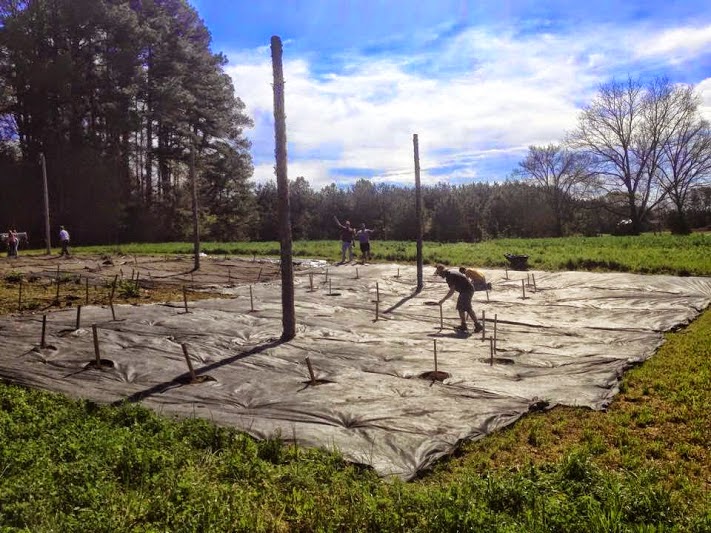
In one of the communities I follow over on Google+, I came across this photo of a hop yard in New Jersey.  My connection Brad (this is his photo) was highlighting the addition of two new poles, for a total of six poles, which are surrounded by a circle of 15 plants each.

The land is on a hillside, part of a county-owned farm there.  Brad says they are growing Cascade, Chinook, Nugget, and Mt. Hood, although there may be one more variety in the mix.  Most of the production will go to brewing club members.

When we were first conceptualizing Hawksbill Hop Yards, we considered this traditional arrangement of the plants.  You can get pretty good density with this approach, which would allow you to get to commercial production levels.  However, once we started having a look at the scale we were going for - a full acre with expansion to a second acre, this arrangement didn't work anymore, since it would make laying the irrigation system difficult, and operating machines in there would be a challenge.

The other system we looked at, but didn't adopt, is the in-line system shown in the photo of a model one of the vendors brought to the hops conference in North Carolina last month.  Neighbor Dan also uses this type of system in his hop yard, supporting his Beaver Run Brewery operation.  This approach simplifies the irrigation and equipment problems, but it is costly if you don't have a ready and cheap supply of poles - because you are using poles on every row to support the trellis cables.  

Our system, which I'll be showing off soon - we're digging holes for the poles right now- is a matrix, with poles every four rows.  The system is stabilized through the combination of lengthwise and crosswise cables that are all anchored on the exterior.

In any of these arrangements, despite the challenges each presents, a hops farmer can get densities of up to 1,000 plants per acre.  We're planting Hawksbill Hop Yards on a less dense approach, since we're in a learning stage and don't want to add stress to the plants.

I could be convinced to put in a couple of central pole set-ups, but they would be for non-production plants.  We could use them for rhizome cultivation, educational outreach, or ceremonially.  I like the looks of it, so I'll keep it in mind.

Wednesday, April 8, 2015

My Hops Mentor


For frequent readers, there's no secret about my main inspiration for starting Hawksbill Hop Yards:  my neighbor Dan's small hop yard that supplies his "Beaver Run Brewery" endeavor.  Dan keeps between 20 and 30 plants up there - and he has seven or eight varieties.

Part of his property includes a two-acre forest of cedars that grow straight and tall, which are the source of some of his poles.  The lines are strung at 10 feet so he can reach them with a ladder, and since many of these plants are more than five years old, they yield quite well.  By the end of May, they'll have reached the top of the trellis

While Mary and I were at the vineyard on Saturday, Dan texted that he was working out in the hop yard cleaning up and stringing for this year's growing season.  I stopped by on Sunday to have a look - everything is neat and clean, and many of the hills are already sprouting growth.  This one here has some sprouts that look ready to take off, even though it is only April.

Looks like it will be a solid year for him and Beaver Run Brewery!

Thursday, November 27, 2014

Another Great Brew Day at Beaver Run Brewery

It's been a two-year project for the Blue Ridge Brewers Association to develop a local source of malted barley for our home brewed ales - a project with legs, which if successful, could develop the source into a commercial product.

This year, working with a local farmer and a facility that could malt the grain down in Nelson County, a total of nearly 700 pounds was harvested and prepared for brewing.  Last week Dan drove down to Nelson County to pick it up, and he told me he was going to brew with it this weekend.  So I made plans to join him out in the brew-barn for part of the day.

As usual, I checked out the "on tap" board to know what I would be sampling during the work at hand.  Both offerings were great, but the Honey Brown Ale was unique in that it used some 25-year old honey Dan had in the basement.  The honey originated in Washington state, where his dad had a hive that foraged in a blackberry bramble.

They're calling the new malt 6-row Thoroughbred and I'll see if I can learn more about it in the future.  On brew day, Dan had planned a 10 gallon batch of IPA, and he had milled 20 pounds of malt for that effort, matched up with a selection of hops from the backyard hop yard.

I had an important errand to run during the middle of the brew, so I had my obligatory samples and helped stir the mash before checking out for a couple of hours.  Dan was using a step-mash approach to fully bring out the fermentables.  The effort involves a couple of pauses where the mash rests at temperature to ensure that its productivity is maximized.

When I got back to the brewery, the boil was just getting underway.  We walked through the hop additions - five of them, shown in order in the photo below.  All of the hops used in this brew were grown on the property - so between the well-supplied water, hops, and Luray-grown barley, this was a mostly local product.


I suppose the brew club will need to get to work on developing a local yeast strain now.  When they do, we'll have all of the major ingredients underway locally in Page County.

Our friends at Wisteria ferment one of their varieties with the yeast that comes in with the grapes from the field - so we know it's possible.  And I've heard rumors that at least one member is working on it.  In any case, there is a strain that has been isolated down in Richmond - we could brew with that one and have a Virginia-centric product, progressing gradually to our goal of a beer produced entirely from Page County ingredients!


Moving on to the true brew nerd portion of the post - Dan pulled samples of the wort as it progressed through the mash, all the way up until he started the boil.  We tasted each of them, from the sticky sweet, oatmeal flavored first pull through to the light amber of the final bit.

He measured gravity after the boil, before pitching the yeast, and it read 1.060.  Assuming the fermentation progresses normally, the target is 6.3% ABV.  Calculated IBU measurement is 64.

Ready in five weeks, I guess!

Tuesday, October 14, 2014

Brewing with Fresh Cascades - Chapter 2

When brewing with "leaf" hops I use poly muslin bags to minimize the
need to filter stray flowers in later stages of brewing.
They say home brewers are creative, and I guess that’s why I consider each batch of beer that I brew with the Cascade hops Bill grew in his backyard an experiment.  The theory is only confirmed by a conversation I had with Dan recently after he told me he planned to use some honey that his dad collected in Alaska and stored years ago in a brown ale.  That batch will be all grain – pretty advanced stuff – in addition to crafty…I’m looking forward to a sample.


Meanwhile, my investigations are moving in parallel, focused on perfecting a couple of different brews so that I can experiment with different hops to see what I get.  So far, I’m on my third batch of Black IPA – which I’ve named the Black Widow series:  

  1. Black Widow IPA #1 – this was brewed according to the Northern Brewer recipe, including Magnum, Chinook, and Centennial hops, then dry hopped with some of Bills Cascade from last year’s crop;
  2.  Black Widow IPA #2 – this was the first batch I brewed with the fresh hops we picked at Bill’s place in August (check out the links at the end of this post), which is dry hopped in secondary with packaged Cascades; and
  3. Here's the first pour of Black Widow IPA #2.
  4. Black Widow IPA #3 – this batch was a weekend project just brewed on Sunday, and currently in primary – the recipe is the same but the difference between batch 2 and batch 3 will be the storage time I had the fresh hops frozen, as I used the hops in batch 2 within three weeks of picking them and in batch 3 about two months afterwards.


Batch 2 has been in conditioned the bottle long enough that I tasted it over the weekend. These batches are fresh hop brews, which reminds me of the efforts by the Old Dominion Hops Co-op to establish a hops industry in Virginia.  Those guys recommend starting small, and since the harvest doesn’t yet have the scale to merit some post-harvest processing, the focus is on selling the fresh hops to local brewers who will use them right away in a seasonal brew.

These are the spent hops from Black Widow IPA #3.
Here’s a quote from an article earlier this year in the Richmond Times-Dispatch:

"While brewers want to be supportive of the local product, quality and price are business considerations. Hops straight from the bines, or “wet hops,” must be used quickly — a good thing in capturing flavor and aroma for special brews. But for year-round beers, pellet hops purchased in bulk with analysis of acids and oils go a long way toward ensuring consistency and control costs."


I guess the Black Widow series is my own small-scale experiment with the concept. 


Here are links to those earlier posts about Bill’s hops.

Friday, August 1, 2014

Dan's Hops - August Harvest


It's harvest time for backyard hops, and neighbor Dan sent me along a couple of photos of the haul this year, including this one of dry hopping a batch of his Flat Tail IPA. From the looks of it, these are Cascades, although he should have quite a few other varieties available as well.

In past posts I've mentioned his hopyard.  There are about 20 plants of several varieties in there, and it is maybe a tenth of an acre.  He climbs a ladder and hand selects the cones that are ready for harvest, going back in the yard several times during the harvest.

At this point I'm going on record that my growing season was a failure - I set the Goldings bines back by transplanting them, and none of us has had any luck with Willamettes, except as a decorative plant.  And that is where my hopyard stands for 2014.


Meanwhile, here's a second photo Dan sent along, of the harvest in progress.  I'm sorry I couldn't join him - but I did contribute those buckets!

From here, he'll take them in for drying - although he did save some for dryhopping as shown above.  Then he packages them and freezes them for use all year long, picking out the ones he needs for each recipe.

At this stage of the game, the hopyard produces enough for his brewing every year, although he does buy some from time to time for specialty recipes.  And he even has enough to share!

Wednesday, July 16, 2014

Dan's Hops - July Update

Dan sent along some photos of the hopyard up around the corner from Hawksbill Cabin.  Over the weekend, he started picking them, and by all accounts this is going to be a banner year.

I'm guessing that these are the Cascade bines, but he has had good luck with some of the other varieties as well, including Fuggles and Columbus.

I tried to grow Willamette hops in Alexandria because Dan's bines looked like they were doing so well.  Mine look good, but no cones - Dan said he has had problems in the past too.

I'll post an update on the plants I have tomorrow.  I'll go ahead and preview that post now - I don't have any cones! lol


Friday, June 13, 2014

Alexandria Hops - June Update


Last Monday I gave an update on how Dan's hopyard is doing over at Beaver Run Brewery in Stanley, so today I'll make a short post on how the ones I have in the backyard in Alexandria are doing.  Readers may recall that I have one Willamette bine and two Goldings bines - the Willamette and one of the Goldings are both in their second year, while the other Golding is a new plant started this spring.
The Willamette bine.

Cones starting to form on the Willamette.
 Last year, the Willamette didn't produce any cones.  I've been told that they take three years to reach full maturity, so you can't expect full production until then. However, I changed it's location to a spot in the full sun, and it is growing very well, with buds forming already - I'll have a small crop of Willamette this fall.

I can't put an optimally sized trellis up in the spot I have this one planted in because the power line to the house crosses over there.  It only goes up to seven feet, and it has reached the top and started to bunch up there.  This is where most of the cones will likely be when it is time to harvest. 

The two Goldings bines.
The Goldings are faring poorly this year.  Moving the second year plant probably set it back, and the first year plant is focusing its energy on establishment, so I don't expect much of a harvest over there.  

As far as conditions go, for the Goldings bines I have a 10-foot trellis set up, so they have room to grow.  As of last Tuesday morning the older plant had made it up to five feet or so - I think the location here is part of the problem.  There may not be enough sun on them during the day to get full growth, which compounds the problem I created when I moved the older plant.

I'm still optimistic.  Last year I had a half dozen or more little cones on the one Goldings bines, so I hope that it will produce something.  I'll reward it by finding a better place for it next year.

Tuesday, March 25, 2014

Brew Day at Beaver Run Brewery

We had plenty of errands to run at Hawksbill Cabin over the weekend, but ended up with a few postponements on our Saturday appointments - so I walked on up to visit Dan at Beaver Run Brewery to see if I could help out on brew day.

I'd seen a post on Facebook earlier that day that he had planned a 10-gallon batch of the Flat Tail IPA (Brian:  beavers have flat tails, and the brewery is near Beaver Run, hence the name). He had some new equipment and techniques to try out, and I was interested in seeing how those worked as well.

Dan's evolution in brewing technique graduated to all grain two or three years ago, when he added large kettles that suit this style. He added propane "outdoor" style burners, along with a pump and wort chiller to complete the set up.  He doesn't have to lift any hot kettles, and temperature sensors are built in.

It's a pretty high quality operation that produces consistent results, so he has also been experimenting with beer styles, producing a pilsener and stout recently. His standby has always been the IPA though - so this was a good batch to be around for.

The major upgrade of the day was the new yeast starter outfit.  It's shown here in the photo - I've lost track of how long this yeast had been "awake."  The plan was to split it into two five gallon carboys, after starting from one commercial vial.  Later he'll harvest a little and start keeping his own starters in the brewery fridge.

While I did help out during the boil, my role for the day was to act as brewer's assistant.  I took care of some of the intermediary cleaning and sanitation after the mash and sparge were completed.

As always, one of the main features of Beaver Run brews are the home grown hops - there's a photo here of Dan adding the bittering hops early during the boil.  Later on I took a walk over for a look at the idle hopyard.  It won't be long until we start seeing little shoots come up on the bines.

For myself, I really am impatient for winter to end this year.  So I'm looking forward to seeing some green in those little hills in the backyard.


Tuesday, January 21, 2014

Dan's Double IPA


Here's the mash tun during the early stages.
We decided to take a three-day weekend out at Hawksbill Cabin.  There was an agenda, as we'd be meeting friends in Culpeper for dinner one of the days - and I needed to check on the pigs.  Then Dan told me he was planning to brew on Saturday, and that he'd be using a new recipe that involved 20 pounds of malt - a double IPA - so I decided I would make a stop over at Beaver Run Brewery and help out where I could.

Dan's been using the Beer Smith app to compile recipes - he has been brewing for years and the Flat Tale Ale recipe is pretty set.  Largely as a result of the brewers association, he has been adding a few ingredients to the mash, including rye, and using a step-mash technique to get as much out of the malt as possible.  This time, he was going for a double, and he queued up the app to list all the ingredients (I have a snap of that part of the recipe below).
Here's a portion of the recipe - hash marks are mine.

The step mash process is very effective, but there is a lot of extra time and detailed record-keeping involved.  It seems like, especially when you are brewing with this kind of quantity, you really do need a second set of hands in the brewery to help out with every thing.

We were checking mash temps and stirring the mash at intervals as everything progressed - it really was a demanding pace.  I know it will pay off with a high-quality brew though!

Since we are getting close to butcherin' season, I decided to save the spent grains for a trip to visit the hogs.  I'll post on that visit over to Public House Produce tomorrow.


Tuesday, October 15, 2013

Blue Ridge Brewers - October Meeting

I can't always make it to the Blue Ridge Brewers Association meetings.  They're held every other month on Sunday afternoons - since I drive back to Alexandria that evening and since sampling is involved, I figure it's best to avoid temptation...but  this time, with a three day holiday weekend upon us, I was able to join the group to learn about what's going on and enjoy some samples of what everybody else has in the kettle.

By the way, here's a link to our brewers' club:
http://blueridgebrewers.blogspot.com/
I also have a link to it in the blogroll in the far right column.

This meeting was held at Beaver Run Brewery - at my neighbors Dan and Sally's barn.  We had a good turn out of around 15 people, which means plenty of samples, including a summery Saison, Pilsener, Oktoberfest Lager, a Lambic, and several Porters and Stouts.

The meetings usually include a mention of equipment or methods.  In this one, Dan showed how his all-grain system worked, using gravity feed and 10 gallon capacity kettles.  Kevin showed us a new bottle cleaning and drying system that was recently featured by Northern Brewer.

There continues to be a lot of interest among the community for identifying local sources of ingredients to brew with.  We had a lucky break in the rain and strolled out to look at the hop yard, which produced over 4 pounds of dried cascade this season - there were a lot of flowers left behind on the bines due to a challenging harvest schedule.  That demonstrated that we know we can get large quantities of hops - several of the brewers have small hopyards producing other varieties.

We also had the attempt last year to grow some local barley - that ended up being more a learning experience for us all, but I understand the farmer is going to make another go of it this year.  I'll keep an eye out for news on this one.

Over the next few days, the notes from the meeting will go up on the website above - one of our members uses the tasting session as an opportunity to polish her skills at food pairings.  I'll be looking forward to seeing the suggestions she comes up with in that next post.

Meanwhile, I need to get back to brewing myself - I have a pumpkin porter planned, and really want to get that one underway one evening this week.

Wednesday, October 9, 2013

Dan's Whiskey Barrel Stout

Post-bottling, here's Dan with the Whiskey Barrel.
For a couple of months now, neighbor Dan has been talking about the whiskey barrel stout he's had in primary and then secondary fermentation. I posted on this brew in early August, but last weekend it was finally ready to bottle, so I took a walk up to visit with him and Sally and to help out where I could.

Technically, this is an Imperial Stout, brewed all-grain, and then aged in an actual whiskey barrel that Dan obtained in the Pacific Northwest.  I've been fortunate enough to have a sample of it as it progressed through stages - it's going to be a very good beer when it's ready...even uncarbonated it's very tasty.

Dan shared the grain bill with me, and the O.G. - which was in the 1.080 range!  No wonder he let this ferment for more than two months.  The bottled ABV is above 10% - this is a beverage you'd better plan ahead for when it's finished bottle conditioning!

There was an earlier post with photos over on our Homebrew Association blog page:  http://blueridgebrewers.blogspot.com/2013/08/brewer-at-work-imperial-stout-aged-in.html

We have a meeting coming up next Sunday!


Monday, September 9, 2013

Pick Your Own Hops


Earlier in the week I had an email from Dan inviting me to come over and do a "pick your own" thing at his little hopyard.  They were heading out for their late summer vacation to the Pacific Northwest, and he'd already picked quite a bit - two or three harvests, I think - but there were still Cascades on the bines.  I thought it would be interesting to get out there and check this out, plus I could use whatever I got for brewing later.

Dan uses a folding ladder to get to the highest parts of the bines, but I wasn't altogether interested in doing that, so I decided to stay on the ground and pick off whatever I could reach.  This meant I wasn't going to get to the most productive areas in the high branches, but when I got there I found plenty of cones ready to pick.

We were between events at the vineyard so I only had a half hour or so to pick - I took down about a half pound, as shown here.  If I were going to dry them, I would probably get about an ounce of flowers from this, enough for a lightly hopped batch of beer.  I have them in a zip-loc bag in the fridge, hopefully they'll keep a day or two this way.

At another event I met a couple of the local brewers and chatted them up about what to do with the hops - their suggestion was to use them "wet" and add them to the boil at the end for aroma.  I have a two ounce bag of last year's Cascade crop that I can pair these up with, so I think I have a plan.  I'll use all of these field grown hops in an extract-based pale ale, since I can get a brew like that done on a school night.

Times a wastin'!


Tuesday, August 27, 2013

More August Hops


After I checked on my own little hopyard in Alexandria, I hit the road for Hawksbill Cabin.  I'd planned a stop by Beaver Run Brewery that afternoon for a little sampling of Dan's latest, plus a Saison I had brewed and the Starr Hill Pumpkin Porter that I had picked up at Bethesda Market.  Of course, stopping by to see Dan and Sally often means a visit to the hopyard and then a cruise through the brewery to check out what's new - and so we did.

I opened this post with a photo of some of this years Fuggles hops.  These are new bines, started from rhizomes one of the other valley brewers gave Dan.  They have a distinct round cone, as opposed to the Cascades, which are shown in the second photo and are more conical.  There are a couple of other varieties in the hopyard - Centennial, which didn't even come out of the ground for me and has rarely produced anything for Dan, Willamette, and Goldings...he may also have Hallertauer in the yard but I can't remember and would have to check past posts.

Dan has been keeping busy with the harvest.  He told me he is getting about one pound of dried hop flowers from each plant, which seems like a good yield for his operation.  He said he has four pounds already put away in the freezer, so he's stocked for his brewing requirements for a while.

We talked about all the pumpkin beers that have been showing up in stores this month.  I wanted to try the porter I'd brought, but also wanted to see what he knew about pumpkin ale.  I am going to get some local Page County pumpkins as soon as they are available, and brew a pale ale with them.

Before I close the post, I guess I should list out all the beers we tasted together sitting out on his flagstone porch, where Mary and Sally also joined us in the sun:


  • Starr Hill Boxcar (Pumpkin Porter)
  • Jim's Cynical Saison
  • Beaver Run Pilsner
  • Beaver Run IPA
  • Beaver Run Imperial Whiskey Barrell Stout


Not bad considering most of that was homebrewed, eh?


Friday, August 2, 2013

Beaver Run Brewery's Whisky Stout

I checked in with Dan after my post on his hopyard last week.  He sent me the update that follows:

This is actually my 4th picking and after tallying the total production to date: 4 pounds dried hops packed away in the freezer.  I'd say 96% of those were picked from the eight Cascade plants...Off to Wolf Trap to a SOJA concert.  Also, the Imperial Stout went into the Woodenville Whiskey oak whiskey barrel last night.  Check out the pictures.

I can't wait til this one is tapped!


Monday, July 29, 2013

Beaver Run Hops

Last week I began seeing a lot of posts from the homebrewing community about it being hops season.  So, while I haven't even seen any flowers on my two backyard bines, I knew that Dan was probably in the thick of things at Beaver Run Brewey and I started looking forward to a visit over the weekend.

Cascade hops ready for picking.
When I arrived, sure enough, he was out in the hopyard, where the Cascades are laden with a crop.  Dan told me this is the second picking - when I arrived, he'd already gathered about a pound in finished weight (shown in the 3 gallon bucket).  And there were plenty more still on the bines.

We took a look around and how the rest of the varieties were doing - none as prolific as the Cascades, and since some are first year plants, they won't produce nearly as much if anything at all this year.
On approach to the hopyard - these are the Cascade bines.

After having a look around, we went back into the brewery to check things out.  In particular, I wanted to catch up with him about the barley project the local homebrewers association had started.  This was a plan where a local farmer put about an acre into production for brewable barley.

The crop has come in, and it is about 3,000 pounds.  Arrangements were made for malting it at a local facility - there were commitments for nearly 1,200 pounds (I wanted to go in for 50 pounds), but in the end, our processing wasn't successful.  There are some lessons learned that I am looking forward to hearing, but to me this was one of the most exciting brewing adventures going on - to think we could brew with local barley, hops and water...that would have been great, and I hope that the association will give this one another go!

This is the 3-gallon bucket already picked.
By the way, you can check in on our association in my blogroll to the right.

To conclude my visit, we went to the beer cooler, where Dan happened to have a whiskey barrel porter on tap.  This was a delicious hoppy beer with oak and bourbon notes - courtesy of supplies from our distillery friends at Copper Fox in Sperryville, the home of Wasmunds whiskey.  We shared a pint and then I needed to move on to my Sunday errands.

I hope to have a post up in the next few days about the status of my two hop bines.  Catch you then.
The first picking is already dried and stored.

Monday, June 10, 2013

Another Brew Day at Beaver Run Brewery


The hops for this batch of Flat Tale IPA.
There’s plenty going on at Hawksbill Cabin this summer.  But it seems I have fallen a little behind on putting up some highlight posts from the vacation week that Mary and I spent there in late May, so I am going to work on getting caught up this week with a few posts – today is the first of three.

We’d had a great visit from Kathy that included rib night with Sally and Dan out on their patio, and then Dan announced he was going to brew a new batch of his Flat Tale IPA. It turned out that spending Sunday morning at Beaver Run Brewery would be a great way to get the vacation underway – so I headed over there after breakfast to join him, arriving just as the mash began.
Wrapping up the mash.

Already I’ve written a few posts about the upgrades at Beaver Run Brewery – they’ve been designed both to help scale up the operation a bit for the most part, but they also make everything just a bit easier to manage.  That’s especially the case with the pump – which eliminates the need to lift boiling hot wort – and the plate chiller, which expedites cooling the wort down to yeast pitching temperature. 


The wort chiller is the last step in the brewing process.
So the activity is just a lot of fun, and then you have a great product to enjoy at the end of it all.  As usual here are a few photos of the process – it will be a few weeks before we can enjoy the beer, though!

Thursday, May 9, 2013

Visiting Beaver Run Brewery


Tess had a good time running around the yard,
so when we went into the brewery she sacked out.
During the winter, I made a check-in spot on Foursquare for Beaver Run Brewery – that’s my neighbor’s garage near Hawksbill Cabin, when Dan has outfitted a pretty sophisticated operation that includes about a quarter-acre hopyard.  On Sunday, Mary and I made a visit over there to check in (I'm the mayor, after all, with four check-ins in the last 60 days), and to offer a sample of my latest batch of honey porter, which was reciprocated with Dan’s new pilsner.

We had a good visit out in the garden, comparing notes about how busy we’ve been.  Dan and Sally have been following the crew circuit around the mid-Atlantic – their daughter is a junior at WVU.  And we’ve had a lot to do that kept us away from the house more than usual.  We decided to make up for that with a brief stopover this weekend.

The hops are climbing past 6 feet already.
We took a walk through the hopyard, where Dan showed me that he now has five varietals going:  Willamette, Cascade, Centennial, Kent Goldings, and US Fuggle.  I have some packs of the Cascade and US Fuggle I’ll be using soon, by the way.  After that it was over to the brewery.

Quite the set-up they have over there at
Beaver Run Brewery!
Dan added a couple of new pieces of equipment in there, including a new floor that was recycled from a river raft, and a new kettle that he hand-fitted with a new spout.  He can do an all-grain batch now, and it’s an automated set-up with a pump and plate wort chiller.  We chatted about my plans to do an all-grain batch using the Brooklyn Brew Shop recipe for Honey Grapefruit Ale, so I have that to look forward to!

Dan’s moved on up like this because he’s had a couple of requests to brew for parties and celebrations – he even has one of those kegging set-ups that he can use for this purpose.  He tells me he’s been a very busy brewer!

Not to mention a very busy hop farmer!  

Monday, April 22, 2013

Hops Rhizomes are in


After enjoying my friend Dan’s homebrews these last few years and realizing that one thing that makes them special is the fact that he grows most of the hops he uses, I’ve decided to try growing some myself in the backyard in Alexandria.  If I’m successful, I might put in some rhizomes out at Hawksbill Cabin over the next few years.

You have to buy the rhizomes early – I placed my orders at the end of February for two each of the Willamette, Golding, and Centennial cultivars.  I planted them in pots out in the backyard, because I haven’t decided their final location, or even the proper trellising for them.  In any case, hopefully I will see something come up in about two weeks.

Dan has offered me Cascade rhizomes in the past. They are the ones that do well in his hopyard at Beaver Run Brewery, but I did something wrong and lost the plants.  So this project is a do-over and hopefully I will get enough to share some with him, maybe not this year but next (although the Willamettes have been known to produce in quantity their first year).

In addition to the periodic gift of home grown Cascade hops, Dan gave me some Fuggle hops another friend in the Valley grew.  I used these in my recent honey porter to great success, so much so, that I want to make this into a signature beer.  The only problem is that those where sold out, so I substituted the Golding.

Now I remember that Golding is the variety in some of the dubbel kits I’ve been brewing, so I guess I am lucky.  I just like saying “Fuggle.”

I plan to post on my progress with these from time to time – say twice a month.  So until then…

Tuesday, February 19, 2013

Brew, Share, Enjoy ... Repeat


Neighbor Dan has undertaken some upgrades at the little brewing operation he’s had going on over there around the bend.  It all started last spring when he decided he was ready to graduate to all-grain brewing – the pots required to do this are just too big to fit in a standard kitchen, so it’s typical that a home brewer would move outside or to the garage once he or she reaches this threshold. 

In his case, Dan had room in the little barn on the property – I’ve posted in the past about his efforts to get the place in shape for scaling up the operation.  Last week I stopped by for a little while to visit him and Sally, and they told me he’d be brewing on Saturday, so I stopped by with Tessie to help out.

There’s a plan to feature a Beaver Run Brewery product at an upcoming nuptial, and he was setting out to brew a batch of the Flat Tale IPA.  I learned that he will be putting part of the batch into the new kegs, shown here.  That’s an upgrade even from the all-grain move!

While we were waiting on the boil, another one of the valley home brewers, Josh, stopped by to use the grain mill so that he could grind some malt for an upcoming brew he’d planned – an oatmeal stout.  I didn’t get the whole grain bill, but I know it includes Briess Victory, English Barley, and English Dark Crystal malts – he gave me 4 oz. leftovers of each, which I ground to save and mix in with a future brew.
 
During all of this, we sampled a few home brews.  I’d brought along a quart of the honey porter and the saison, while Dan had his smoked ale – “Rauch” – and Josh had a double IPA to share.  This was a robust range of styles, very suitable for a winter’s day.  I’d look forward to a tasting like that anytime!

Soon enough, it was dark and the boil was finished.  We called it a day.  But I can say this, that’s a lucky couple who will soon be enjoying that Flat Tail IPA “vom fass!”