Ramble On

Showing posts with label Lavender Tincture. Show all posts

Thursday, July 23, 2015

Getting Close @hawksbillhops


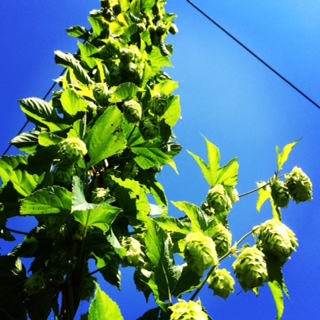
Here's a great big Cascade cone!
Since I knew that harvest is nearly upon us, I decided that I would stay back in Alexandria last weekend.  I took care of a few errands I have been trying to get to - and I brewed two batches of beer using some honey a work colleague gave me.  In the meantime, I missed my check-in at the hop yard, but fortunately David indulged me with a few snaps.

By the way, the two brews were a honey lavender kolsch - this will use the lavender tincture process I've discribed before (click on the label with this post to see how that was done), and a honey peppercorn saison.  The backyard honey I had was a very light amber, so I figured I'd use it in summery brews.  Later I'll get some buckwheat honey from our cover crop that I will use in a porter.

We've been tracking the Cascade, Chinook, and Columbus for the last few weeks, since those plants all did well enough in their first year to give us a harvest.  The Fuggles and Goldings all have cones as well, but the quantities aren't enough to consider them with the same intensity.  I will likely go out this weekend and hand pick the cones from those.

That situation isn't unexpected, and it's also nothing to worry about.  Especially with the Goldings, I figured the plants might need as much as three full years to mature to full yields - so we're going to patiently wait on them.

I suppose I have been obsessing about the harvest almost since we planted the rhizomes back in May - and my worries only increased once we started getting burrs on many of the plants.  At around July 4, I'd even picked a lupulin laden Columbus cone off of one of those bines.  I'm still not happy with myself about the harvest plan - we've never been through the cycle before and we definitely don't have a solid process, so I'm a little worried.
Here's a monster Chinook bine.

The other side of the argument is that it is the first year, so the yields are unpredictable anyhow.  The range of maturity times throughout the hop yard is varying widely within the varieties and between the varieties, which is typical of a first year crop, from what I hear.  So the decision we've made is to go ahead and harvest all at once, setting a date that is about a week later than what we're hearing from the guys down in Richmond and Charlottesville - we're one growing zone away from them, as confirmed by the arrival of Japanese beetles a week or two after they all got them.  

So that's our story for now.  We'll be working on the logistics for the harvest, and for oasting, as a next step.  The real fun is about to start!


Tuesday, March 18, 2014

Brewer's Chores

For this snow day, I decided to kick back and take paid time off - used the time to take care of some brewing chores that had been waiting.

First thing, I bottled my Cascade IPA on Friday, taking notes on the gravity readings.  Since I lost a lot of data when my old computer crashed recently, I needed to find a new alcohol by volume (ABV) calculator, and I did, using it to calculate the results of the Cascade IPA.  By the way, since that is conditioning in the bottle right now and I'm estimating that it will be ready on April 15, I am calling it "Tax Day IPA."

The temperature corrected original gravity on this one was 1.051.  It finished up at a final gravity of 1.013 - so I'm giving it a 4.99% ABV.  That is paired up with an international bitterness unit (IBU) measurement of 55.3, all from Cascade hops, including 3 ounces of Luray local hops from fellow grower Bill.

My second errand was to strain off the bitter orange/coriander tincture I've been making for "La Petite Orange" - the Belgian Dubbel I posted about last week.  That orange peel is difficult to work with - it absorbed a lot of the vodker and I could not extract it.  I'll go with what I was able to strain off - maybe two ounces - and I'll just add that at bottling time.

My third and last chore was to move La Petite Orange to secondary.  It's been percolating downstairs since last weekend, but primary fermentation has finally ended.  Two weeks or so in secondary, and I'll bottle it with the tincture mixed in.

Wednesday, March 12, 2014

Brewing La Petite Orange

After steeping the specialty grains.
This is a recipe kit I bought last year: it's a Belgian Dubbel style, and I decided to postpone brewing it because it wouldn't be ready until the summer.  With March already here, it seemed that I'd best go ahead and brew it now for a May release, before the full heat of summer is upon us.  Here's the beer's description from the recipe kit:

Back by popular demand! A Belgian Dubbel without the deep dark chocolate maltiness, the Orange is rich with caramel sweetness and a full body that hides the 6.1% ABV very well.  Lueven ale yeast contributes rich esters - cherry, strawberry, lychee fruit, even hints of tropical breezes.  A simple sipper that evokes warm summery memories with every sip, yet fits perfectly into the colder months; standard brewing repertoire.

By now I know my way around the brew kitchen well enough to take some liberties, so I went off recipe for some elements of this one.  First of all, I used a dry ale yeast instead of the Lueven ale yeast suggested - I don't even remember receiving that one in the kit, to be honest.  Goodbye, lychee fruit esters!
Making the coriander/bitter orange tincture.

I also decided to use some bitter orange peel and coriander in the recipe, which suggests this addition at the end of the boil.  That was part one of the approach...also from the recipe:

Brewer's note:  You may wish to add up to 1/2 ounce crushed coriander and the zest of two oranges at flameout for a "La Petite Orange Blanche."

I took this suggestion a step further - I added the "blanche" ingredients, as suggested.  I decided I wanted these flavors to be a little stronger, though, so I also started a tincture with half the ingredients.  I had success with this method before - a Honey Lavender Kolsch from last spring, just check the "Lavender Tincture" label at the end of the post.

Coriander and orange peels floating around.
I'll let those ingredients steep a week or so, then strain them off in the hopes of not being too strong when I add them back at bottling time.

After I finished the boil and gave the beer its ice bath, I moved it into the carboy.  I've upgraded my approach, so I took a hydrometer reading after that.  O.G. is 1.052 at 70 degrees - right on target for the recipe, so fingers crossed this comes out at 6.1%.

I'm planning one week in primary, then two weeks in secondary.  I'll also strain the tincture after the first week, and keep it refrigerated until I am ready to bottle.

Speaking of bottling, I'll be putting up the Cascade IPA soon.  And next on the brew calendar is a repeat of the honey lavender kolsch!

Friday, May 17, 2013

The Honey-Lavender Kolsch: Part 2


It’s my least favorite chore in brewing, but when the time comes, it has to be done.  And after all, it’s a kind of payday.

I brewed the honey kolsch kit five or six weeks ago.  We’ve had a cold spring and the temps in the basement led to a very slow start for the years – so I let the beer sit in primary for two weeks, and then let it ride for three in secondary. 

Hey, I may not have posted this, so here is the catalog copy from Northern Brewer for this one:
A variation on our extremely popular Kölsch recipe with the addition of honey and a new yeast strain for a lighter body and flavor. This pale, light-bodied golden ale is traditionally given a long, cold aging period which makes it very smooth and clean. "Spritzy" is a word often used to describe Kolsch - very refreshing, and a popular lawnmower beer for beer snobs!

As an extra, which may turn into a gimmick, I added a lavender tincture to the brew at bottling time – see yesterday’s post for some highlights. 

After all that, the beer looks to have a golden color like you would expect from a kolsch – although when it comes time to drink it in a few week, it will probably be more of an amber color.  Here’s a shot of it passing through the siphon.

When all was said and done, I had a nice output of the beer.  I made a few extra 22 oz. bottles since my beer has been a popular giveaway at the office and with the neighbors, and I like this bottle size for that purpose.

I’ll let it bottle condition for three weeks now.  Planned release date is June 7.

Thursday, May 16, 2013

The Honey-Lavender Kolsch: Part 1


For a spring brew I decided to pick up the Honey Kolsch kit from Northern Brewer.  I thought it might be even more interesting to add some lavender – that is an ingredient that they feature on their site, after all – and I had a small sachet that our friend Lilly gave us last year.  The question was how to use it as an ingredient in the kit beer.

I did some research on the topic, and one suggested way was to create a tincture – infuse the little herbal flowers with a 40% alcohol solution.  I combined two shot glasses full of the flowers with three shot glasses full of Absolut Vodka (80 proof!), and voila – I had my tincture!

(If you're interested in the process, Wikipedia is a good place to start.)

Here are a couple of photos of the final steps in the process, filtering out the flowers, and the final product. 

I bottled the kolsch on Sunday, adding the tincture and the priming sugar to the big bottling tub.  I’ll have a post on that tomorrow.

Tuesday, April 16, 2013

Honey Kolsch Progress Report

Earlier this month I wrote about the honey kolsch that I brewed one Saturday.  I had been very worried about it - the yeast took a few days to activate and I thought I might have had some bad microbes.  But lo, eventually they woke up.

Here's an update from Saturday, where they'd been going strong for two days.  Look at that flocculation.

I just checked on things and there is still a steady burp, so I will let it stay in primary for a few more days.

Meanwhile, I'm planning to do something extra with this batch - I want to add a little bit of lavender to the beer when it is finished.  I could add the flowers to the secondary, but I'd like to have a better way, since that would clog my siphon.

This process of extracting the essence of an herb is
called making a tincture.  I was concerned about putting
the dried flowers into my brew, so decided to use vodka
to extract the flavor, and I'll add it at bottling time.
I've read about tinctures...Wikipedia says, "Herbs are put in a container and and a spirit of 40% or more ethanol is added, or 80 proof vodka..."  So I took a couple of shot glasses worth of lavender flowers and three shots of Absolut to make this one.  I'll add it at the bottling stage when I mix in the priming sugar.

So what we'll have is a special spring kolsch with honey and lavender...hoping for good results here.