Ramble On

Thursday, July 23, 2015

Getting Close @hawksbillhops


Here's a great big Cascade cone!
Since I knew that harvest is nearly upon us, I decided that I would stay back in Alexandria last weekend.  I took care of a few errands I have been trying to get to - and I brewed two batches of beer using some honey a work colleague gave me.  In the meantime, I missed my check-in at the hop yard, but fortunately David indulged me with a few snaps.

By the way, the two brews were a honey lavender kolsch - this will use the lavender tincture process I've discribed before (click on the label with this post to see how that was done), and a honey peppercorn saison.  The backyard honey I had was a very light amber, so I figured I'd use it in summery brews.  Later I'll get some buckwheat honey from our cover crop that I will use in a porter.

We've been tracking the Cascade, Chinook, and Columbus for the last few weeks, since those plants all did well enough in their first year to give us a harvest.  The Fuggles and Goldings all have cones as well, but the quantities aren't enough to consider them with the same intensity.  I will likely go out this weekend and hand pick the cones from those.

That situation isn't unexpected, and it's also nothing to worry about.  Especially with the Goldings, I figured the plants might need as much as three full years to mature to full yields - so we're going to patiently wait on them.

I suppose I have been obsessing about the harvest almost since we planted the rhizomes back in May - and my worries only increased once we started getting burrs on many of the plants.  At around July 4, I'd even picked a lupulin laden Columbus cone off of one of those bines.  I'm still not happy with myself about the harvest plan - we've never been through the cycle before and we definitely don't have a solid process, so I'm a little worried.
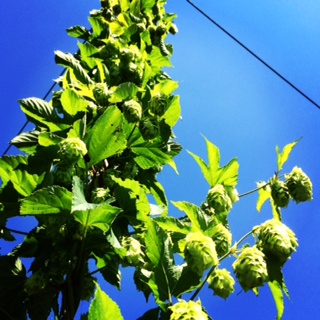
Here's a monster Chinook bine.

The other side of the argument is that it is the first year, so the yields are unpredictable anyhow.  The range of maturity times throughout the hop yard is varying widely within the varieties and between the varieties, which is typical of a first year crop, from what I hear.  So the decision we've made is to go ahead and harvest all at once, setting a date that is about a week later than what we're hearing from the guys down in Richmond and Charlottesville - we're one growing zone away from them, as confirmed by the arrival of Japanese beetles a week or two after they all got them.  

So that's our story for now.  We'll be working on the logistics for the harvest, and for oasting, as a next step.  The real fun is about to start!


Monday, July 20, 2015

Important Visitors @hawksbillhops

The team under our new trade show tent, with the new
banner and stuff.  (left to right: Kenner, me, David)
Funny how progress goes.  I'm stretched for making a post here because a lot of our activities at Hawksbill Hop Yards right now are watching the bines grow - which they are, enthusiastically! - but I do have an update to report at last:

We had our first brewery visits a couple of weekends ago!

The growth of craft brewing in Virginia has been astounding.  After a few years of languishing behind other states (I'm not talking about California, Colorado, or Vermont here - I'm talking about Georgia, Maryland, and North Carolina, for goodness sake (no disrespect intended)), at last Virginia is seeing a surge in breweries.

Visiting with brewers from Tin Cannon and Pen Druid.
In 2013, the Brewers Association listed a mere 60 breweries, including the Coors establishment in Elkton and the Anheuser Busch operation in Williamsburg.  A directory check at Virginia Beer Trail now will offer over 120 breweries throughout the state, with even more scheduled to open through the rest of 2015!

At the hop yard, we hope to supply some of the new breweries, especially in the Shenandoah Valley and Northern Virginia areas - geographically close to us - with our high quality hops.  So we invited a few of the new brewers out, and we were very pleased to welcome Pen Druid Brewing from Sperryville and Tin Cannon Brewing Company from Gainesville to the yards on a recent Sunday morning.  In addition to the breweries, a couple of local VIPs joined us - our ag extension rep, Kenner, and Ligon from the Page County Economic Development Authority.

We had a good time with a brief tour of the rows and discussion of how we got this whole thing started, as well as our plans for the harvest.  As we get closer to that, and solve some of our logistics challenges - nothing too difficult, in fact very typical for any start-up - we'll be reaching out to these folks and other brewers with news of what we have to offer.

That'll be great progress and we're looking forward to it!  The next post will be an update on how the hops are doing, along with a preliminary harvest schedule.

Thursday, July 16, 2015

Bethesda Flyover

Off and on during my career, I've had offices in the Clarendon or Ballston areas of Arlington, Virginia.  Among the other advantages these neighborhoods enjoy, one is their proximity to Arlington Cemetery - and because of that, there are regular flyovers of memorial formations for the military funerals that take place there.

After a six year Air Force enlistment - one that had amazingly few encounters with military aircraft, given my career field and the locations I was assigned, I am still thrilled whenever I see one or more of our military aircraft flying by.  So I was attuned to the sound of a military flyover when I worked in those Arlington offices, and I would rise and rush over to a window to check them out.

Flyovers happened a few times now in my Bethesda digs.  I imagine that whenever the aircraft are based somewhere north along the east coast, the sortie exits the area by flying along the Potomac, which takes them into our field of view.

And so it happened a few weeks back that I caught site of this squadron on its way home after a ceremonial Arlington flyover, the missing man just catching up with the rest of the group and preparing to form up.

Whenever I have the opportunity, I'll stop and look up for this - pausing my thoughts just long enough to consider the significance of the flyover, and then picking back up with the thrill of seeing the planes.

Friday, July 10, 2015

Profiles in Hops @hawksbillhops - Cascade

Here's a look a one of the Cascades, showing plenty
of burrs in development.
This is the final post in this week long series about some of the hop varieties we are growing at Hawksbill Hop Yards.  I posted about the Columbus and Chinook earlier, so today is about the Cascades.  We planted 300 bines, and of all the varieties, it looks like the Cascade will be the champion.

As with the other two varieties, I'm citing the Wikipedia article about hops varieties, which you can find here.

Here's what Wikipedia has to say about Cascade:
 
Very successful and well-established American aroma hop developed by Oregon State University's breeding program in 1956 from Fuggle and Serebrianker (a Russion variety), but not released for cultivation until 1972. It has a flowery and spicy, citrus-like quality with a slight grapefruit characteristic. One of the "Three Cs" along with Centennial and Columbus. Substitutes: Centennial and Columbus (but they have a higher Alpha Acid content).
Backlit shot showing a lot of burrs on another Cascade.

The Cascade have been the high-achievers in the yard:  they were the first to reach the cable at the top of the trellis, and the percentage of plants with burrs far exceeds the other varieties.  If I didn't know this already from how well they do in Dan's yard, or Bill's, or Kevin's, then all of the other growers telling me about them at the Winston-Salem conference or other Old Dominion Hops Cooperative functions would have - and the proof is certainly in the pudding, based on my walk last weekend.

To me, it seems like the yield here is better than I expected at the beginning of the year, but we'll take it.  There is a lot of work to be done to get these picked and processed, but fortunately we have a few weeks to go before it's time for that.  

I posted last year about Bill's harvest, here, and then I brewed two batches of a "Harvest Black IPA" with those hops - posts here and here.  If things work out, I may do a homebrew batch or two of harvest ale, using either Chinook or Columbus for bittering and Cascade for aroma.  I'll need to get my ducks in a row for that one - I'm already committed to doing a couple of honey porter brews in the fall, which will hopefully use whatever Fuggles and Goldings we are able to harvest from the first-year bines.  

I won't post a profile piece on those two varieties - they need time to grow, and we're not planning to take them down during the main phase of harvesting.  Although, as I mentioned, I would like to brew with them if there are enough cones for a batch or two.  I'll keep an eye out for that.

In the meantime, our Cascades are busting out.

Wednesday, July 8, 2015

Profiles in Hops @hawksbillhops - Chinook

A Chinook bine with  formed cones (it's planted
near the buckwheat cover).
As I mentioned in my post the other day, things are starting to shape up for the coming harvest at Hawksbill Hop Yards.  In my walks I took a few photos and planned this "profile in hops" series of posts - today I'll write about the Chinook bines.

As before, I'm citing the Wikipedia about hops varieties, which you can find here.

Here's what Wikipedia has to say about Chinook:

This green bine cultivar (W-421-38) was released in May 1985 in Washington State and Idaho from a cross between a Petham Golding and a USDA-selected male (63012M). Slightly spicy and very piney. Its alpha acid content ranges from 12 to 14%. Substitutes for bittering: Eroica, Galena, Nugget. Substitutes for aroma and flavor: Southern Cross, Sticklebract.

Another Chinook, with cones.


As with the Columbus, we planted 120 bines.  They're on the east side of the yard, near the Columbus, but separated by the open row we left there to allow for ventilation of the Columbuses.  The empty row is in buckwheat cover for now, audibly buzzing with honey bees, but it will be either a row of Chinook or Columbus next year, depending on which does best in the market.

Chinook is the strongly flavored hop that Sierra Nevada uses in Torpedo, and that is one of the reasons we chose this variety.  The other is the recommendations we received from other Virginia growers, that they had done well with it.  At the NOVA Brewfest a few weekends ago, it was even the topic of conversation for one of the breweries and one of the growers that was at the show.

The Chinook is doing well, but on the whole, I'd say that our Columbus crop is a bit more robust then they are.  Still, it's another that we should have in commercial quantities when all is said and done.  

And I'm happy about that.

Monday, July 6, 2015

Profiles in Hops @hawksbillhops - Columbus

Checking out the lupulin on one of the fully
formed Columbus cones.
Out at the hop yard this weekend, we could see that we were bearing down on the harvest.  I took a few photos, and thought I might do a series on the three "c" varieties that we appear to be doing well in - well enough to anticipate we will have commercial quantities available in for this, our first year.  Starting with Columbus today, Later in the week, I'll post about Cascade and Chinook as well.

Each of the posts will cite the Wikipedia article about hops varieties, which you can find here.

Here's what Wikipedia has to say about Columbus:

A high yielding, high alpha acid American bittering hop. Also known by the trade name Tomahawk. One of the "Three Cs" along with Cascade and Centennial. Like the others it is citrusy and slightly woody. Columbus has a very high amount of total oils, and can impart a 'resiny' quality to a beer. Substitutes for bittering: Nugget, Chinook. Substitutes for aroma and flavor: Cascade, Centennial.

We planted the Columbus on the east side of
the yard for ventilation.  Here we have also
planted buckwheat as a cover, for the bees.

We put in two rows of these, so we have about 120 plants.  They arrived marked "CTZ" - as Wikipedia notes, the trade name is Tomahawk, and the industry considers the variety known as Zeus to be the same, thus the reference.  I ordered Columbus, so I'm going back to calling them that.

Because I had been advised they might not do as well in Virginia, advice that more likely is because there aren't many planted here rather than a specific susceptibility to some feature of Virginia's climate, I planted them on the east side of the hop yard with an empty row next to them, where they would have plenty of ventilation.  We did this out of a worry that the risk was mildew, but we're not seeing a lot of that on these plants.  

I saw plenty of formed cones, and I tested one of them to see how laden they might be with lupulin.  There are plenty of plants that are still midway between burrs and cones, as well.  I think we got production from about 50% of the first year plants, which is better than I thought we would do.

There are still a few weeks left before we harvest, but these may be the first to come down.  There are some calculations we need to do to be sure, but for now, things are looking good.

Thursday, July 2, 2015

In the Thick of It

Summer has finally arrived, and although the hop yard is keeping me busy full-time, I can't forget how lucky we are to have our getaway at Hawksbill Cabin, and how beautifully it reminds us every year of the changing seasons.

Today, to welcome July, I've got a couple of random photos I managed to take while I was tooling around doing errands at the house last weekend.  In the first one, one of our barncats - the one we call "Momcat" because she is the mother of one of the kittens we adopted - is hanging around the brick terrace supervising me.  At the moment I was down by the pool setting up the robot and cleaning out filters.  

I guess our relationship with her has evolved so that she is one of those "outdoor pets" that you hear about.  We feed her when we're there, and there is another neighbor that feeds her and the other barncats when we're not there.  She shows up right on queue when we drive up, popping up on the brick terrace by the time we're packing in the second armload of stuff from the car.

The second photo shows some of the bee balm blossoms we got this year, which seems to be a good year for them.  There's a patch of them that comes back every year out in the back by the little shed - sometimes it's more robust, and sometimes less.  But with all the rain, at last we have more than 20 flowers on this.

It was in bloom the first time we came by to look at the house, back in 2007.  It was an exceptional show that year, too - and I had never seen the plant before then, so I spent a few minutes checking it out.

By the time we closed on the place, the blooming season was over, but I did a little research to learn more and found out that it would likely come back year after year.

And sure enough it does, so it is one of the things I look forward to now every summer.  Things go 'round, you know.

Tuesday, June 30, 2015

@HawksbillHops - General Goin's On


Here's an overall view of the hop yard.
This is the final post from my weekly check-in at the hop yards.  I've got a nice perspective here of the yard from the southwest corner, over by the Cascades.  Sure, the weeds got away from us - we had them under pretty good control until we got all that rain during the last two weeks - but looking through the yard shows that we've got good progress across all varieties, especially considering we're in our first year.

I'm amazed to think that we had our planting event on May 2, and here we are, just two months later, with good prospects for harvest across all of our varieties - Cascade, Chinook, Columbus/CTZ, Fuggles, and Goldings.


We did plant a cover crop of fescue to help control the weeds, and while it's holding its own out there, it's hard to pick out between the pig weed and everything else, lol.  It's also just too late to get out there and try to manually weed.
Here's a look at the buckwheat cover on our empty row.

In another kind of success story, David planted our empty row with buckwheat as a cover crop.  PawPaws honey has about a dozen bee hives out on the farm, and this will make great forage for them.  When I checked it out on Saturday, I saw hundreds of the happy little buzzers working over this crop.

As I mentioned in a post yesterday, my plan is to get two pounds of this honey - which will be a delicious dark variety -  to use in a couple of homebrewed honey porter batches this fall.

That buckwheat honey will combine nicely with the Fuggles crop from Hawksbill Hop Yards to make a unique and tasty farmhouse product!

Monday, June 29, 2015

Virginia-grown Fuggles and Chinook Hops @hawksbillhops

The Fuggles have already formed cones.
During my weekly status walk of Hawksbill Hop Yards I went deep into the yard to check out all of the varieties - we're growing Cascade, Chinook, Columbus/CTZ, Fuggles, and Goldings.  We're looking pretty good all around, with the Cascades ready to deliver a solid yield, and the Golding lagging behind the others.

But I was pleasantly surprised over on the Fuggles row (we have 60 plants), and the Chinook rows (120 plants).  Just like with the Cascades, there were burrs growing on the Chinook, but the Fuggles have already set cones.

I do not expect a commercial yield from the Fuggles this year, and I'm planning to use them in my own home brews this fall - a series of honey porters that will use these hops and local honeys from a friend in Bethesda and two others in Luray.

Plenty of burrs on the Chinook!
More about one of the honeys in the next post, but the Bethesda variety will come from a work friend's backyard hive - I'm getting 2 pounds from there - and a friend in Luray who has supplied a nice woodland style to me in the past for use in this beer.  I'm looking forward to brewing again, and honey porter is my signature style.

I took a photo of the most vigorous Chinook plant.  About a quarter of them have reached the top cable, but most of them are at least over 10 feet.  In this case, we have two or three bines that are intertwined on the rope, and it is well-leafed and pushing out a lot of cones.

This variety is well-suited to IPA styles, and is readily identified in Sierra Nevada and Lagunitas (check this link!) - it's described as spicy-piney.  It's a high-alpha variety with decent aroma properties.

From the looks of things, we'll have 20 pounds of wet Chinook for brewers looking to do a harvest ale with this variety.  That's something to look forward to!

More Virginia Hops - Cascades @hawksbillhops

We finally had a break from the rain on Saturday afternoon - David says we got two inches, and I wouldn't be surprised.  In any case, with sunshine finally breaking through, I took a drive over to the hop yards to have a look around and see how things were going.  This post is about the Cascade bines, but I've got two more posts going up from the visit following this one.

We put in 300 Cascade (out of 680 plants total).  It is the variety we'll have the most of, and we chose it specifically for it's popularity in American ales.  We had a great success rate of over 90% on the bines, and they are truly the high-achievers in the yard, with half of them approaching or surpassing the 16 foot cable at the top of the trellis!


The lore is that hops grow vertically until the Equinox, which was June 21, and then they start branching out laterally.  That's exactly what we're seeing in the yard, although some of the bines are still looking for someplace to go up.  Instead, they'll probably follow the cables and keep the main bines moving that way.

When they are mature, these plants will yield anywhere from 2 to 4 pounds of wet hops.  We'll be able to support any interested nearby breweries that are planning harvest ales with these (leave a comment if you're interested!).

We'll dry what isn't taken wet, which will reduce the weight to between a half to full pound per plant.  Conservatively, the first year plants will yield from 10% to 20% of what a mature plant produces, so I estimated a yield of from 60 to 100 pounds wet (it takes about 6 pounds per barrel for a harvest ale), and between 15 and 25 pounds dried.

A closer look at the photos will show that the plants are not only branching, but producing "burrs" - the early stage of the flowers, or cones, which is what we'll harvest.  We've already gotten to work figuring out our harvest and processing plans for the hops - we welcome inquiries from anyone who is interested in "amazing" Virginia-grown hops!

Thursday, June 25, 2015

Weekly Check-in @hawksbillhops

At Public House Produce, David and the team are right in the middle of busy times - they picked 160 pounds of cauliflower yesterday and the pick-up for CSA shares was on tap.  He still found time to make some rounds in Hawksbill Hop Yards and send along some status photos, which I'm sharing here in this post.

After we built the one acre trellis earlier in the spring, we had a volunteer event to plant 680 rhizomes in five main varieties - Cascade, Chinook, CTZ, Fuggles, and Goldings.  In an earlier post, we had verified a 95% success rate with these plantings, which had left 120 or so fills for next year, when we plan to expand to a second acre and add another 800 plants.


We got about 7 weeks of vertical growth from the first-year rhizomes based on the time between our 2 May planting and the equinox on June 21.  I was anxious to see how much vertical growth we'd get - so that's the main reason for David's photos yesterday.

I wasn't disappointed: the first photo shows that the Cascades have proven as robust as their reputation - quite a few of them have reached the top cable of the trellis, approaching 16 feet tall.  Some of them are even looking for places to go from there - they still want to climb, and in general we are starting to see good branching.  On Saturday I will walk the yard to see how many of the plants are starting cones.

The second photo shows some highlights of the CTZ, Fuggles, and Goldings.  The CTZ are getting bushy - it's as if they worked on pushing out leaves and branches rather than reaching for the top of the trellis.  From the looks of the bine in the photo, with all of those burrs turning into cones soon, this may be the first variety we harvest!

The Fuggles is also a high achiever, being the first variety to break ground and also the first to four feet tall.  It looks like we have a few of them up to 10 feet, so we've had a solid establishment growing season.  I'll keep an eye on them to see what kind of harvest to expect, although at this point I don't foresee a commercial yield from them.

Finally, there is the Goldings - I'm happy to see a thriving bine here, after hearing from so many hobby growers and other Virginia farmers that they just don't do well here.  We have 60 of them, and we'll double that next year.  It is such a versatile hop and there isn't a lot of the variety in Virginia, so there is an opportunity with this one to offer something unique at quantity for some of the brewers who are focused on English styles.

That's it for the week - on Saturday I'm walking the yards to have a look at where we have cones and get a better sense of potential yields.  We'll follow that with one last outreach post to brewers - and then start planning the harvest!

Wednesday, June 24, 2015

Talking Virginia Hops - @hawksbillhops @novabrewfest

Our booth featured the co-op's new logo.
Last weekend I joined two other growers – Nat from Highline Hops and Gordon from Massanutten Hops, at the NOVA Brewfest.  We represented the Old Dominion Hops Co-op and spent two days talking to brewers, home brewers and the general public about hops, wet hops, and in general, why locally sourced beer is better for Virginians.  We figure our outreach had an impact on up to 1,000 people at the booth, and in the sponsor tent where “Cooking with Beer” was a featured demonstration program. 
Some good crowds at the fest.
These were good results for the co-op, and for the three growers involved.  The feedback we’ve received confirms that there will be continued outreach about our growing industry – both from the co-op and other growers.  I’m looking forward to that – first, though, we’re getting close to harvest, and that’s a growing priority. 

Hawksbill Hop Yards had a
new banner on display.
Here are a few highlight photos from the fest – tomorrow’s post will be the weekly check-in at the hop yards!

Tuesday, June 23, 2015

Dottie's - a Souvenir

We open the mailbox yesterday and found this great surprise - two cups from Dottie's True Blue Cafe in San Francisco, a gift from our friend Brian who lives there.  They're a pretty classic shape and will hold a generous portion, just like they would if you were visiting in person.

They'll make me wish I was headed out for another visit every time I use one of them.

Brian's a big fan of Dottie's, as you'd easily see from his 67 posts and counting that mention the place on his "Breakfast at Epiphany" blog, linked in the right hand column.  In fact, he visited there just last month - the post from that visit is linked here.

I've visited a couple of time the last few years, and have been to Dottie's twice - click the label at the end of this post for links to those visits.  I stood in line both time, first at the charming original location, and again at the more upscale location they've relocated to.

The lines don't matter though - you can't go wrong with Dottie's, whether you're ordering off the menu or off of the specials board.  By the way, here is the link to the restaurant:  Oh wait, there isn't one.  You can find it easily enough on your favorite restaurant review site.

Tuesday, June 16, 2015

Weekly Check-in @hawksbillhops

 Last week, David sent me a photo of one of the Cascade bines that had climbed to 14 feet - nearly the top of our trellis at Hawksbill Hops (due to some slack in the cables, the top height ranges from 15 to 16 feet).  He told me that he thought we might be at the top by Friday or Saturday, so I made a point of stopping by to have a look on Saturday afternoon, inviting Dan along to check things out.  

This may or may not be the same Cascade, but it was within an inch of the cable.  Since we were planning to be there about an hour, I told him we needed to be sure and take a look when we were leaving, in case this one had made it all the way up over the course of that hour.  Also, where last week there was only one plant that was taller than me, somewhere between an quarter and a third of the yards - almost all varieties, have gotten over 7 feet, and there are many that have reached 8 or 9 feet.

In the earlier photo from David, I noticed that the plant had begun branching already - this happens as the vertical growth begins to slow, and the plant starts filling out with side branches.  He'd sent a photo of a Chinook that was showing this phenomenon, and looking closely at it, I noticed it also had "burrs" - this is the start of cones.  

My thinking on this was that it seems early for the first year plants to be setting cones, and it had me very worried:  I am counting on a harvest that begins in mid-July and later, and here the plants are maybe two or three weeks early!  We're totally not set up for it!

I did the hop yards tour and I found a lot more branching, which is great.  In our survey, we didn't find a whole lot of burring just yet, although there is some - this is a Chinook bine that has five or six burrs on a branch.  The burrs still have to flesh out to become cones, and then there is a short period of time when the cones ripen - filling with lupulin, which is the magical ingredient they provide to beer.  

From the looks of things, I think we are still a month of and maybe longer before Hawksbill Hops is ready for harvest.  So that was a relief!

As we were leaving, we walked back over to the 15-foot Cascade.  Honestly, I couldn't tell if it had grown at all during that hour - but I bet it did! 

Monday, June 15, 2015

Catching Up - Dan's Hops


A view from the east side, the oldest
plants are here.
There are a couple of hop yards that I credit for inspiring us to start Hawksbill Hop Yards - Bill's, which I posted about last week, and Dan's, which I visited on Saturday and will post about today.  Sometimes, I even refer to them as "pilots" because I learned a lot about the plants from these guys.

I first came across Dan's hop yards back in 2009 or so, maybe sooner, but it was when he was just getting started.  There were a dozen or so hills of three or so varieties, and he hadn't quite figured out the trellis.

The makeshift trellis, an additional
10 feet, extends from the lower right.
Flash forward to 2015, and there are more than two dozen hills of five varieties, and the trellis is continually improving.  It's ten feet tall and built of found objects, such as recycled plumbing pipes, and cedar poles that come from the 2-acre wood lot he's got back there.  This year he added some drip irrigation as well.

Production has been consistent all these years, so he always has ingredients for his home brewing operation.  This year, all of his plant except for the first year ones have cones.  It's a sign of progress that some which hadn't borne before are doing so this year.

There were a couple of case studies from the visit - by the way, afterwards we enjoyed a fantastic ribs dinner from the grill.

First, Dan has had a couple of Goldings plants in his garden for a few years now, but this is the first year that they have set cones.  I made a point of selecting this variety at Hawksbill Hop Yards, and I've received a lot of comments about them not working out well.   After seeing how his are doing, my takeaway is that we'll have to be patient with them - that row of 60 Goldings may need a full three years to mature, so that's just how it will have to be.

The second takeaway is something we've learned about the Willamettes - Dan's had these in the garden forever, using them as decorative plants.  They never set cones until this year, when he transplanted them to a new spot, and added more support to them so they could climb higher than the trellis.  He put a rope up they could climb to a neighboring tree branch so they can climb to 20 feet...and guess what, these plants are laden with huge cones.

They'll be a challenge to harvest, but they'll be a great variety to experiment with as he brews his batches over the winter!

Friday, June 12, 2015

As Seen On ... A Visit to Tempelhof - Berlin's Famous Airport

This week's enjoyable find on the web is Kyle Dunst's "commercial and travel blog" called ThirtyThousand.us.  In the post I read, Kyle wrote about a recent visit to Tempelhof Airport in Berlin - you can find his post here, and the photo below is copied from his blog (the link in the caption will take you directly to it).

http://www.thirtythousand.us/wp-content/uploads/2015/05/DSCN2472.jpg

I've written about Tempelhof quite a few times here on Hawksbill Cabin - the base was my home during most of my USAF enlistment, and I lived there from October 1981 to April 1986.  As a resident, the history of the place had its own presence, as if it were a person always there with you, where ever you went on base.  I even have dreams from time to time where I am exploring unknown places on the base, fictional mysteries created by the subconscious mind while I sleep.

Kyle's post includes a snapshot of the history, past and present, and it is generously sprinkled with photos from the tour he took.  One I found especially interesting is the one he took from the basketball court that was located on the sixth floor of the central building.  I've copied the photo below - the link in the caption will take you to the original on Kyle's blog.

http://www.thirtythousand.us/wp-content/uploads/2015/05/DSCN2540.jpg
I played basketball on that court for the entire time I was at Tempelhof.  There was a weight room and sauna as well, which were facilities I used during my training for the Berlin Marathon in 1983.  Also right next door, through a doorway to the right in this photo, was a bowling alley, which was another site of many good memories - we spent a lot of time in there having group bowling outings during our time off.

On a side note, there's other news about Tempelhof - or TCA as we often called it, standing for Tempelhof Central Airport - they're filming one of the Mockingjay movies there this summer.  Lot's of interesting sets have been built featuring areas of the building as background, which you can see at this link.

Wednesday, June 10, 2015

Catching Up - Bill's Hops

There were three "pilot" hops projects that I encountered or worked with before I started Hawksbill Hop Yards in Luray - first, Dan's yard in Stanley; second, my own plants in the backyard in Alexandria; and third, Bill's hops in Luray.  Yesterday Bill sent me the amazing photo here as an update on how his six Cascade bines are doing.

I posted last year about the harvest, here, and then I brewed two batches of a "Harvest Black IPA" with the hops - posts here and here.

They are second-year plants, mounted on a trellis in his backyard, and get good day-long sun from the south.  They have about 8-feet of run to the top of the set-up there, and they bridge across on support lines when they reach the top of the structure.  He's had great success with them, and as the photo shows, they've already set cones - they look ready for harvest!

I hope to be able to stop by to check them out this coming weekend.  In the meantime, I better brush off that IPA recipe!

Monday, June 8, 2015

Growing Season @hawksbillhops

Here's our 9-footer Cascade!
Now that the growing season is in full swing - and continuing for the next four to six weeks - we are going to slow down the posts about hop yards progress to once per week.  We'll make exceptions for exciting developments, and undoubtedly there are still going to be some discoveries about how the whole thing works, or about Virginia's craft brewing scene in particular.

On Saturday, with my mother and brother up from Raleigh for a visit, we took a drive over to the hop yards for a check in.  Last week, we had one Cascade plant that had gotten up to 7 feet tall, but this week, there were many, and at least one from every variety, that had made it to that height.  This week's tallest plant was a Cascade and it had reached 9 feet - it doesn't seem unreasonable to guess that they could make it all the way to the top of the trellis, which ranges from 14.5 to 16 feet!

Looking down one of the Chinook rows.
Most of the "pilot" plants - the ones I learned from, or Dan's, Bill's, Kevin's, and my backyard plants - have already set cones, while these in the hop yard are still growing vertically.  That's what I understood the growing behavior would be:  they grow vertically until the solstice, and then begin pushing out horizontally, followed by the cones.  I'm tracking that carefully, you can believe it.

The second photo I'm putting up today features a look down one of the Chinook rows, where many of the plants are over 6 feet tall.  You can see that the fescue cover crop has sprouted between the rows as well, and that we have purslane and milkweed to beat the band in the rows.  We've got a team coming out for a couple of days this week to take these two pesky weeds on.


Thursday, June 4, 2015

Chores and Progress @hawksbillhops

This Cascade is 7 feet tall!
Overall, last weekend was one that marked a lot of progress at the hop yards: our rhizomes are now a month old, and we've got a lot of the start-up work done.  Out thoughts turned to maintenance in the yards...and marketing the crop, which we'll harvest come August.

So I had two goals at the farm on Sunday morning, first, to weed out the feral patch of butternut squash that was taking off in the Cascades and Fuggles rows, and second, to walk through and train any bines that were ready.  I also had an idea that I might take a walk over behind the hedgerow to see the bees that David has just added to the farm, getting ready for vegetable season.

This field hasn't been used for much over the last 30 years or so, and it was just cleared in the last couple.  It made for a great winter hunting ground, though, and somewhere along the way some surplussed butternut squash got dumped there.  During the clearing, when we did the big burn pile, the seeds from the squash were spread around, and then they were spread even more during soil prep.

By last Sunday, they were covering an area as big as the backyard in Alexandria, and spread across four rows.  We'd weeded some of it out when we checked on the Centennials, and then again when David planted the fescue cover, but there was still a bunch and it was right in our rows, so I got the chore to clear it.

It took a couple of hours to get it all - literally blood, sweat, and tears, since apparently I was a prized morsel for a bunch of chiggers out there.  But at last I had persevered and staved off all manner of threats, and I outlasted the butternut.  So we celebrate this small triumph and move on.

At the end of the chores, I decided I might like to head over to the hedgerow, where the new hives have been set up.  There are seven so far, but there's room inside the electric fence for 10, and the rest of them will go in soon.  I could see the bees flying around over there so I kept my distance while taking my photo.

So why the electric fence?  These hives are far enough away from the other day to day operations, and they are out of sight from the barn, so the fence is designed to keep out the varmints - not just ground hogs and the miscellaneous low-slung critters you have everywhere, but also the bears that we see from time to time.  We'll see how that works out, but in the meantime, these worker bees will have plenty to do at Public House Produce...there's a tomato in their future!

Monday, June 1, 2015

A Precision Operation @hawksbillhops

We had been talking about what to use in the rows at Hawksbill Hop Yards - we'd looked mainly at clovers, to take advantage of their natural ability to fix nitrogen into the soil.  Around the hops community, there were plenty of other examples to choose from as well.

With all of the rain we've been having - wet spring days - we started to worry about the storm water's impact on the soil between the rows.  Eventually David determined that fescue would do the trick.  He took care of the soil prep and planting last week, being careful to maneuver the equipment between our 12-foot rows - they're generously space for most of the operation, but a little bit of a squeeze for this one.

It won't be long before we see fescue sprouts, and they'll get to work keeping our soil in place and suppressing weeds.  There will still be some work to keep the rows a little tidy, but this is going to take care of a lot of that.