Ramble On

Thursday, August 27, 2015

The 2015 Hops Harvest @hawksbillhops - Part 6 (finale)

Finally, the last day of our week-long harvest had arrived.  All the activities we had left to complete were the final lot of oasting and packaging two rows of the Cascades.  Before getting to work on that, I took a walk over to the hop yard for a look at it now that all the hops had been taken down.   
We decided to leave the Fuggles and Goldings rows up for the rest of the growing season.  We know there is demand for these varieties, but the plants definitely need another year to strengthen and adapt to our region.  Hopefully they'll benefit from additional sun and time so that we'll see enough cones on them next year to have a first harvest.

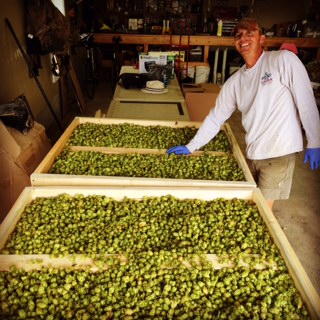
Here's a photo of the hops we harvest and packaged -
totaling around 50 pounds - now they're off to brewers!
From the Chinook, CTZ/Columbus, and the first two lots of Cascade hops, I pulled an eight ounce sample for testing at the Virginia Tech lab.  We were pleased with the results - they were in line with expectations and the commercial ranges - and since the lab included a moisture assessment, we have the info we need to refine our oasting process for next year.  It's great to have this asset in the community!

Incidentally, here are our alpha/beta results for the three varieties we harvested this year:

  • Cascade (average of two lots):  alpha 6.65%, beta 3.74%
  • Chinook:  alpha 8.84%, beta 2.39%
  • CTZ/Columbus:  alpha 13.23%, beta 3.52%
Our final  yield of hops across these three varieties was about 50 pounds.  We packed them as one-pounders for the craft brewers we are marketing, and 4-oz packs for home brewers.  More on the marketing in a moment, because I want to mention a funny story that happened during the packaging.

We'd been working in David and Heather's garage on this process for the duration of the week.  On Tuesday afternoon, Heather had put some spare concert tickets up for sale on Craigslist, and the eventual buyer came around to pick them up while David and I were in the middle of packaging the hops.

As you can see in the photo of our final product, this activity appears suspicious, since we're handling green plant material and packaging it in bulk - not to mention there is a lot of it.  

So the buyer comes into the garage and asks for Heather.  After a moment, he notices the bags of green product all around us - his eyes grew big as saucers before he turned to knock on the door and ask for her!

Over the course of the growing season we'd had some visits from brewers, and I had done a few other outreach activities to let everyone know about our first harvest.  Once I had the lab results and quantities, I did some follow-up activities.  

Soon we had orders from five craft breweries in Virginia, and we've also sold to home brewers in Florida, California, Pennsylvania, and Virginia!  Needless to say, our success at selling the hops far exceed anything I expected.  I can't wait to hear that they've got their beers ready and on tap - I hope to be able to make a visit to each one to celebrate!

So this post concludes the series on our first harvest at Hawksbill Hop Yards.  What a great and unique insight being a hops farmer gives to the craft brewing industry!  We have some expansion and improvement plans for the hop yard this fall and next spring, and then we'll get started again on the whole thing.

It's been a lot of fun, even though it was hard work the whole way.  But to be honest, I can't wait until next year!

Tuesday, August 25, 2015

The 2015 Hops Harvest @hawksbillhops - Part 5

Here's a tray of Cascades, ready for sampling and
packaging - bowl and scale in the foreground.
Thanks to David Sours for this photo -
working late into the evening to package
our first batch of dried hops!


By the second day of drying and packaging, the activities had settled into a routine.  Once we loaded the HOP-N-ATOR 4000 with fresh wet hop cones, and ensured they were distributed evenly, we closed up the machine and turned on the heater and fans to get things going.  (Our first batch had taken 30+ hours to dry, so we improved the machine with a little space heater - we'll probably upgrade this part of the operation next year!)

Here's a few Cascade cones that I tore apart for
inspection after they'd been dried.
The goal of drying the cones - or Oasting, as it is traditionally called - is to reduce the moisture in the raw plants so that they become more stable and easier to store and handle.  The industry standard for this is around 8% moisture, so if the assumption is the plant materials are 10% of the originally weight, you're after getting the wet cones down to 18% or so of their original weight.

This seemed to me to be an excellent application of those operations management classes I loved in business school...in fact I was a tutor for this subject!  So I devised a "statistical process control" method for taking periodic samples of the hops to determine our drying progress.  I developed a formula for setting a target weight (there was an error in the one I used, so we didn't get all the way down to 18% - plus the lab informed me that no one in Virginia was quite getting there, likely due to our humid climate).

I used the bowl shown in one of the photos as the standard volume to weigh - setting the original weight with a sample from each of the HOP-N-ATOR 4000 trays.  After averaging this, I calculated a target rate by using an interval formula (note that this is where the error in my calculations crept in).  Then I pulled a sample or two from each of the trays every few hours to measure progress, and to estimate the remaining drying time.

This wheat beer from @boulevard_beer became my
refreshment of choice during hops drying.  Our operation is
too small to supply them, though (I asked).
This worked well and added some much needed predictability to the process.  Even though we didn't quite get to the 18% weight target, we did manage to get the Cascades into the range of 26-28% which is pretty close.  It's enough to stabilize the hops, and now that the harvest is a few weeks behind us we've gone ahead and moved them into the freezer as well.

The next post will be the final in this series.  I'll post the alphas and betas we achieved on our inaugural crop, talk about yields, and also will discuss some of the improvements we have in mind for next year.

Sunday, August 23, 2015

The 2015 Hops Harvest @hawksbillhops - Part 4

Thanks to our 15 or so volunteers who came out to pick for us -
and many of them in their t-short "uniform"!
Along with all the preparation we had been doing for the upcoming harvest, we were starting to see a few queries about the possibility of having a harvest event for the hops.  We'd had a wonderful time at spring planting (here) so it definitely sounded like a good idea - so we began to plan for fitting it in on the Saturday of our harvest week.

We did a few fun things to organize this, including a Facebook event page - we named it "Harvest Daze", for example - and I started looking for a nice swag opportunity for the volunteers that might show up.  Eventually, we settled on the ubiquitous pint - or shaker - glass that is often used to serve draft beers.  There's a photo below.


No good volunteer deed at Hawksbill Hop Yards
goes unswagged!
We had great weather that day, and we had 15 or so volunteers join us for the fun.  Picking is one of the harder tasks on the farm, since the hops cones are so small and there are so many of them. This is one of the reasons we see a lot of folks going after the big European harvesters...I'm not sure we're in the market for that yet, although eventually we'll probably add some kind of machine to the mix.

By now, as you can see in the photo of the volunteers, we'd figured out how to house the activities under the pole barn, so everyone worked in the shade.  David, Grayson, and I had gone out to the field earlier to cut down a full row of Cascades for everyone to work on - the one featured in this post.

Back when I was reading up on what it would take to build a hops farm, there were notes that on average it takes 45 minutes to pick a bine clean...someday I'll do the math to see what our average was, but I don't think we saw that in our first year, for sure.  Even so, the cheerful volunteers working with us made it through the 60 bines in less than three hours.  It was a good time.

We really have enjoyed the community support we received this year - including all the volunteer hands we benefited from in our two events.

In my next post, the second-to-last in this harvest series, we'll take a look at the packaging operation we put together for the crop.

Friday, August 21, 2015

The 2015 Hops Harvest @hawksbillhops - Part 3

Here's a look at some fresh hops - right from the field!
As the harvest progressed on Day 2, we were finding that we had plenty of CTZ/Columbus and Chinook cones.  I took a few highlight photos to show them off, comparing them to my car keys, for example - as with the Cascade cones in the first photo here.

This photo was taken from the trailer bed early in the morning.  Our approach was to go out and take down the bines for each day's work early, before the heat of the day got up.  The quality of hops can suffer pretty quickly if that heat isn't managed - fortunately we had some cooler days, and a light rain on one or two of them, which actually worked in our favor, even if it was somewhat uncomfortable.


A couple of team members loading the HOP-N-ATOR 4000.

Once all of the hops were picked off of the bines, we'd take the produce crates and store them in the farm's walk-in cooler until we had all of the variety for that day.  I mentioned the haul from day 2 - which was about 32 "wet" pounds from the CTZ/Columbus and the Chinook, but on each of the remaining 3 picking days we had a similar amount from the Cascade rows.

We took two of those rows on Friday, one on Saturday - the day of our harvest event, which I'll write about in the next post - and the final two on Monday.  It's not just that we had so many rows of Cascade - these bines are well suited to the US climate and have proven to do well in Virginia, so they were simply bountiful.


Dried hops, fresh from the HOP-N-ATOR 4000.
After the day's picking was done, we'd take the crates from the walk-in and load the hops into the HOP-N-ATOR 4000.  In the second photo, David and one of the SPI crew has loaded the bottom tray of the HOP-N-ATOR 4000 with about eight pounds of wet hops.  We loaded each of the trays this way, and then turned on the fans to start the drying process.

The final photo of the day has David showing off the dried hops after their stint in the HOP-N-ATOR 4000.  While our machine did not dry the hops to an optimal 8% moisture, we did manage to get them down to 28% or so.  That's enough to stabilize them so they'll retain their potency a few months, and we will handle them by freezing what we don't quickly sell, in order to ensure their quality.

The moisture percentage is a factor we'll work on next year, along with ensuring we can handle the harvest quantities we expect from the maturing bines.  As we make progress on those ideas, I'll add some posts - but it will probably be in the winter.  Meanwhile, the next post will be about our volunteer harvest event, which we called "Hawksbill Hops Harvest Daze!"


Wednesday, August 19, 2015

The 2015 Hops Harvest @hawksbillhops - Part 2

Grayson was up in the bucket, with David
driving, as we took the bines down from
the trellis.
The second day of the harvest dawned bright and early enough.  Well, that is, it dawned bright and early enough for David and Grayson, who were out working the field for an hour or so before I showed up!  But at last I did - by the way, at the scheduled time, so I wasn't late.

Our plan was to work on the CTZ/Columbus rows first, since they were the first to have cones.  In fact, there were ripe cones on this row as early as July 4, so I wanted to get them down soonest.

Here are the first few CTZ/Columbus bines
as we began taking them down.
Although we modified the set up when we moved to the Cascade rows, on this day of picking, we had the bucket set up with the tractor so that Grayson could cut the bines down from the top of the trellis, and the trailer was behind the old truck where I could take the bines after they were down.

We'd gone ahead down the row to cut the plants at two to four feet high so that we could keep Grayson moving up there while I hauled the cut bines off to the trailer.  When we changed the set up, it was simply to put the trailer behind the tractor so that we didn't have to keep moving the truck to keep up with everything.

Here's the SPI crew at work picking CTZ.  Still early in
the process - we had the bines stockpiled on the trailer.


With only two rows each of CTZ/Columbus and Chinook, and with each these bines producing less than the Cascades, we quickly made our way through the two varieties.  Our thought was to get our SPI crew, shown in the photo to the left, started on the CTZ so they could get the hang of what we wanted them to do before they got to the more productive Cascade, which would be on Friday.

We set them up on one of the long produce tables and the team got to work picking, putting the cones into produce baskets.  Once they finished a bine, they put it on the floor and either I or somebody else came around to put them in a discard pile - we'll compost the waste for this year.

Here's our first bin of hops - about four pounds "wet."


To the right in the photo of the SPI crew is a crate of sweet corn and some flats of tomatoes - on Thursday, one of David's Public House Produce customers comes by for a pick up.  When those items were gone on Friday, we were able to put the trailer in that spot and do all the work in the shade of the pole barn.

The team made their way through the first variety by late morning, so we went back into the field to bring in the Chinook crop, which they set out on after lunch, and finished by the end of the day.

Our haul on these two varieties was a total of about eight bins, which weighed about four pounds each - 32 pounds "wet" total.  We'd take these over to the HOP-N-ATOR 4000 next, so that we could dry them, and that's where the next post will pick up.

Monday, August 17, 2015

The 2015 Hops Harvest @hawksbillhops - Part 1


Here's a row of Cascades, ready for harvest.
All season long, as we watched those hops bines we planted last May grow, I was planning to take a week off for the harvest.  And even though I knew that as first year plants, the yields wouldn't be as much as they will be in a couple of years, it's fair to say that we were pleasantly surprised by how well the crop did - and I needed just about every hour of the six days I took off to get the crop in.

Our plan for oasting.
So on Wednesday morning I got up early enough to drive out from Alexandria to Luray - a drive that was surprisingly pleasant, heading out in the opposite direction of most DC area commuters.  I enjoyed the early morning views of my short cut from I-66 to Shenandoah National Park, then up and over the mountain into Luray, arriving in just about two hours flat.  When I got to the farm, I quickly found David and we began discussing what needed to be done about these hops - we could get started as soon as the CSA shares were put together.

The first thing on my mind was building an oast - the heated air dryer that is used to dry the hops.  We'd talked about this process a number of times over the growing season, but now the rubber was hitting the road and we needed to get out there and actually do it.  David sketched out a straightforward design on the CSA board, and we headed over to the co-op for the lumber and materials we needed.

The finished oast - the HOP-N-ATOR 4000!
We built a simple frame and then fit some shelves with bins into it.  It is modeled somewhat on the design the University of Vermont extension has on their website, although we did make some changes - for example, theirs is an eight-shelf design, while ours is a four-shelf design, and theirs conducts the air downward through the hops, while ours draws it upwards through them.

We were able to accomplish all this with only one trip to the co-op - no return trips because of some failure of design or bill of materials slip up.  David entrusted me with the use of some of the power tools as well - I didn't hurt myself or him in the process - and we got most of the unit done without any major mistakes.  And plenty of laughs.  

The unit is covered on all four sides with a small opening at the bottom to ensure that the air is drawn in consistently through all of the hop cones resting in the bins.  We recycled four barn fans for the air power, and eventually added a space heater as a heat source.

Additional details - powered by four barn fans.


When all was said and done, we had our oast.  We turned those fans on and watch how the powerful breeze drew through the machine.

It's a good machine, good enough to deserve a name, so we christened it the HOP-N-ATOR 4000, which is named after another utilitarian item that was in use at the farm a few years ago when I was on my internship.

Next year, we may need an upgrade to an eight-shelf unit - the HOP-N-ATOR 8000, and ultimately we could have both of them in operation for the duration of the harvest.  But for now, our first day's work was done - we had our machine, and picking could begin on Thursday morning...as soon as I got to the farm.

Wednesday, August 12, 2015

Page County Grown - the 2015 Farm-to-Table Dinner

Last Saturday, the Mimslyn Inn hosted the fourth annual Page County Grown farm-to-table dinner.  It's an event we still look forward to every year, so Mary and I made early plans to attend, despite some reservation snafus I hope they can fix before next year.
We were joined by many of our friends, most of whom have also attended the events in the past.  And as always, the dinner chef Chris prepared from fresh local ingredients was a delight.

When I started the hop yards, one of my first objectives was to become a part of Page County Grown.  Since the meetings are held on week nights, I generally am not able to make it out for them, and I get updates from the other members.  This year I was surprised to find out that I was designated the "Director of Marketing and Social Media" - an assignment I have yet to deliver on - and that meant I would have to give some welcoming remarks at the dinner.

I hope what I said was innocuous enough - except for two things:  first, my conclusion was to thank the kitchen and serving staff at the Mimslyn for their flawless performance these four years; and second, I read off the vision statement for Page County Grown, quoted below. 

Page County Grown is thriving family farms driving local food economies and promoting healthy communities where quality farming is a valued heritage and a staple for growth.
From some of the conversations I have had with the other members, there have been some successes over the last few years - there are new farmers and there are new markets.  But there are still opportunities, and I guess my challenge will be to identify those and help the organization take advantage of them. 

I was enjoying myself so much at the dinner, I forgot to take photos of every course as I have done in the past.  So these two are some highlights, the appetizer first course and the dessert last course.  All paired with some favorite wines from Wisteria...it's a treat to look forward to again next year!

Thursday, August 6, 2015

Nature Break at Hawksbill Cabin

I was taking care of some chores on Saturday afternoon and happened to catch a little movement out of the corner of my eye.  It turned out to be this little praying mantis, no more than an inch and a half long.

We get them every year in the gardens at the cabin, sometimes I see them when they're young, but more frequently I see the mature ones, since they're bigger and much easier to spot.  I think this is the smallest one I've seen to date.

I hope it gets its fill of some of our bugs.

Tuesday, August 4, 2015

Next Week We Harvest @hawksbillhops


We've begun making preparations for the harvest at Hawksbill Hop Yards.  When I look at the plants now, it's hard to believe that it has only been three months since we had our planting event (blog posts here).  Our Cascades are doing especially well, considering they're only in their first year, and we're "hoppy" with the action overo n the Chinook and Columbus/CTZ rows as well.

On Saturday we'll have a harvest event at the farm - we've invited the volunteers who helped with planting to come back out to see how things are doing, and to help with picking the cones.  In the meantime, we're working on our oasting and storage solutions - there is a lot of interest in the hops, and it looks like we'll have a good amount to contribute to the Virginia craft brewers market!

The hop yards shares the farm with Public House Produce, where the tomato season is just getting underway - it reminded me of this old post from 2011.  When I was out at the yard yesterday, I came back around to the pole barn to have a look around, and David had set these out to cure and ripen.  There are several heritage varieties here, including the famous "pineapple."

Our final preparations for the harvest continue - we hope to see all our friends at the farm next weekend!

Monday, August 3, 2015

Returning the Favor @pendruidbrewing

Pen Druid's soft opening on July 31.
 A few weeks back, we had visitors from a couple of breweries out at the hop yards - Pen Druid Brewing, who were on the verge of opening over the mountain in Sperryville, and Tin Cannon, who operate in Gainesville, not too much farther away.  I put up this post - we really had a great day at the farm visiting with these folks and learning that much more about the Virginia Craft Brewing Industry.

Flash forward a few weeks, and here we are with the Pen Druid Brewing soft opening on August 1 - neighbor Dan and I trekked over to have a look around and try some truly crafty beers!  David couldn't join us for the visit, since he and Heather were up in Frederick for a race, but we'll make a plan for a follow-on visit soon.

Enjoying the vibe with the Pen Druid team!

I first learned about this team back in May, during a visit up to Black Hops Farm in Lucketts - somehow I missed posting about that road trip.  I met with Jonathan up there and he showed me around the operation - again, lots of collaboration and creativity going on, and that's an aspect of this whole thing that is really growing on me.

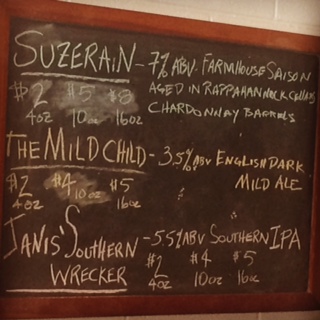
That's really the theme of this brewery, as you can see on the tap board from our visit.  Dan and I sampled all three of the offerings, and got a little tour of the place as well.  We tried the 10 oz. pours of all three beers - doing an "ABV ladder," starting with The Mild Child before progressing through Janis' Southern Wrecker and Suzerain.


Creativity in chalk.  I think Pen Druid is a
good example of what craft brewing is all about.
I'd like to highlight that last one - over the last few years, in my home brewing experience, I'd seen kits that offer combinations of beer and wine, and I had thought I might give one a try over the summer.  That didn't work out for me because of the hop yards schedule, so I was pleased to have a chance to try the one these guys had worked out.

They obtained a chardonnay barrel from one of the nearby wineries and aged this Saison in it.  From the process, this beer picked up some wonderful flavors that are complex and delicious - but still respect the summer's heat - so they are very refreshing.

These barrels are part of the creative process at Pen Druid.
The brothers walked us through their plans to experiment with several beers this way.  There's even a sherry cask in the inventory, and Dan and I agreed we'd look froward to that one!


It's terrific to have this new brewery so close.  I'm looking forward to future visits - and perhaps some collaborations with hops from Hawksbill Hop Yards!

Congrats guys!


Tuesday, July 28, 2015

The Watchful Eye @hawksbillhops

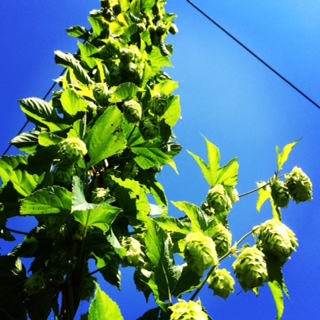
Here's a branch of Chinook cones.  Piney goodness.
This weekend we walked through the hop yard scouting the plants for signs that they are ready - our conclusion is yes they are!  We have finally agreed upon the dates we're going to do this:  August 6-12.  We're planning an event associated with it, so those details are forthcoming.

I've been writing about the varieties we're going to have at harvest, and after our walk yesterday it is clear that we are going to have a decent quantity of each of the Cascade, Chinook, and Columbus varieties.   I suspected the Goldings and Fuggles might need a couple of years, and that is the case.

Those same Chinooks.


After the walk, we sat on the front porch across the street for a little while and enjoyed the view of the new hop yard.  If you'd asked me last October, when we really buckled down to write the business plan for this venture, or even last March, when I went to the hop growers conference in Winston-Salem - there's just no way I could have foreseen that we would be here doing this right now.

But that is how it goes sometimes.  It's been a lot of fun so far, and I'm looking forward to each step of the way.

Thursday, July 23, 2015

Getting Close @hawksbillhops


Here's a great big Cascade cone!
Since I knew that harvest is nearly upon us, I decided that I would stay back in Alexandria last weekend.  I took care of a few errands I have been trying to get to - and I brewed two batches of beer using some honey a work colleague gave me.  In the meantime, I missed my check-in at the hop yard, but fortunately David indulged me with a few snaps.

By the way, the two brews were a honey lavender kolsch - this will use the lavender tincture process I've discribed before (click on the label with this post to see how that was done), and a honey peppercorn saison.  The backyard honey I had was a very light amber, so I figured I'd use it in summery brews.  Later I'll get some buckwheat honey from our cover crop that I will use in a porter.

We've been tracking the Cascade, Chinook, and Columbus for the last few weeks, since those plants all did well enough in their first year to give us a harvest.  The Fuggles and Goldings all have cones as well, but the quantities aren't enough to consider them with the same intensity.  I will likely go out this weekend and hand pick the cones from those.

That situation isn't unexpected, and it's also nothing to worry about.  Especially with the Goldings, I figured the plants might need as much as three full years to mature to full yields - so we're going to patiently wait on them.

I suppose I have been obsessing about the harvest almost since we planted the rhizomes back in May - and my worries only increased once we started getting burrs on many of the plants.  At around July 4, I'd even picked a lupulin laden Columbus cone off of one of those bines.  I'm still not happy with myself about the harvest plan - we've never been through the cycle before and we definitely don't have a solid process, so I'm a little worried.
Here's a monster Chinook bine.

The other side of the argument is that it is the first year, so the yields are unpredictable anyhow.  The range of maturity times throughout the hop yard is varying widely within the varieties and between the varieties, which is typical of a first year crop, from what I hear.  So the decision we've made is to go ahead and harvest all at once, setting a date that is about a week later than what we're hearing from the guys down in Richmond and Charlottesville - we're one growing zone away from them, as confirmed by the arrival of Japanese beetles a week or two after they all got them.  

So that's our story for now.  We'll be working on the logistics for the harvest, and for oasting, as a next step.  The real fun is about to start!


Monday, July 20, 2015

Important Visitors @hawksbillhops

The team under our new trade show tent, with the new
banner and stuff.  (left to right: Kenner, me, David)
Funny how progress goes.  I'm stretched for making a post here because a lot of our activities at Hawksbill Hop Yards right now are watching the bines grow - which they are, enthusiastically! - but I do have an update to report at last:

We had our first brewery visits a couple of weekends ago!

The growth of craft brewing in Virginia has been astounding.  After a few years of languishing behind other states (I'm not talking about California, Colorado, or Vermont here - I'm talking about Georgia, Maryland, and North Carolina, for goodness sake (no disrespect intended)), at last Virginia is seeing a surge in breweries.

Visiting with brewers from Tin Cannon and Pen Druid.
In 2013, the Brewers Association listed a mere 60 breweries, including the Coors establishment in Elkton and the Anheuser Busch operation in Williamsburg.  A directory check at Virginia Beer Trail now will offer over 120 breweries throughout the state, with even more scheduled to open through the rest of 2015!

At the hop yard, we hope to supply some of the new breweries, especially in the Shenandoah Valley and Northern Virginia areas - geographically close to us - with our high quality hops.  So we invited a few of the new brewers out, and we were very pleased to welcome Pen Druid Brewing from Sperryville and Tin Cannon Brewing Company from Gainesville to the yards on a recent Sunday morning.  In addition to the breweries, a couple of local VIPs joined us - our ag extension rep, Kenner, and Ligon from the Page County Economic Development Authority.

We had a good time with a brief tour of the rows and discussion of how we got this whole thing started, as well as our plans for the harvest.  As we get closer to that, and solve some of our logistics challenges - nothing too difficult, in fact very typical for any start-up - we'll be reaching out to these folks and other brewers with news of what we have to offer.

That'll be great progress and we're looking forward to it!  The next post will be an update on how the hops are doing, along with a preliminary harvest schedule.

Thursday, July 16, 2015

Bethesda Flyover

Off and on during my career, I've had offices in the Clarendon or Ballston areas of Arlington, Virginia.  Among the other advantages these neighborhoods enjoy, one is their proximity to Arlington Cemetery - and because of that, there are regular flyovers of memorial formations for the military funerals that take place there.

After a six year Air Force enlistment - one that had amazingly few encounters with military aircraft, given my career field and the locations I was assigned, I am still thrilled whenever I see one or more of our military aircraft flying by.  So I was attuned to the sound of a military flyover when I worked in those Arlington offices, and I would rise and rush over to a window to check them out.

Flyovers happened a few times now in my Bethesda digs.  I imagine that whenever the aircraft are based somewhere north along the east coast, the sortie exits the area by flying along the Potomac, which takes them into our field of view.

And so it happened a few weeks back that I caught site of this squadron on its way home after a ceremonial Arlington flyover, the missing man just catching up with the rest of the group and preparing to form up.

Whenever I have the opportunity, I'll stop and look up for this - pausing my thoughts just long enough to consider the significance of the flyover, and then picking back up with the thrill of seeing the planes.

Friday, July 10, 2015

Profiles in Hops @hawksbillhops - Cascade

Here's a look a one of the Cascades, showing plenty
of burrs in development.
This is the final post in this week long series about some of the hop varieties we are growing at Hawksbill Hop Yards.  I posted about the Columbus and Chinook earlier, so today is about the Cascades.  We planted 300 bines, and of all the varieties, it looks like the Cascade will be the champion.

As with the other two varieties, I'm citing the Wikipedia article about hops varieties, which you can find here.

Here's what Wikipedia has to say about Cascade:
 
Very successful and well-established American aroma hop developed by Oregon State University's breeding program in 1956 from Fuggle and Serebrianker (a Russion variety), but not released for cultivation until 1972. It has a flowery and spicy, citrus-like quality with a slight grapefruit characteristic. One of the "Three Cs" along with Centennial and Columbus. Substitutes: Centennial and Columbus (but they have a higher Alpha Acid content).
Backlit shot showing a lot of burrs on another Cascade.

The Cascade have been the high-achievers in the yard:  they were the first to reach the cable at the top of the trellis, and the percentage of plants with burrs far exceeds the other varieties.  If I didn't know this already from how well they do in Dan's yard, or Bill's, or Kevin's, then all of the other growers telling me about them at the Winston-Salem conference or other Old Dominion Hops Cooperative functions would have - and the proof is certainly in the pudding, based on my walk last weekend.

To me, it seems like the yield here is better than I expected at the beginning of the year, but we'll take it.  There is a lot of work to be done to get these picked and processed, but fortunately we have a few weeks to go before it's time for that.  

I posted last year about Bill's harvest, here, and then I brewed two batches of a "Harvest Black IPA" with those hops - posts here and here.  If things work out, I may do a homebrew batch or two of harvest ale, using either Chinook or Columbus for bittering and Cascade for aroma.  I'll need to get my ducks in a row for that one - I'm already committed to doing a couple of honey porter brews in the fall, which will hopefully use whatever Fuggles and Goldings we are able to harvest from the first-year bines.  

I won't post a profile piece on those two varieties - they need time to grow, and we're not planning to take them down during the main phase of harvesting.  Although, as I mentioned, I would like to brew with them if there are enough cones for a batch or two.  I'll keep an eye out for that.

In the meantime, our Cascades are busting out.

Wednesday, July 8, 2015

Profiles in Hops @hawksbillhops - Chinook

A Chinook bine with  formed cones (it's planted
near the buckwheat cover).
As I mentioned in my post the other day, things are starting to shape up for the coming harvest at Hawksbill Hop Yards.  In my walks I took a few photos and planned this "profile in hops" series of posts - today I'll write about the Chinook bines.

As before, I'm citing the Wikipedia about hops varieties, which you can find here.

Here's what Wikipedia has to say about Chinook:

This green bine cultivar (W-421-38) was released in May 1985 in Washington State and Idaho from a cross between a Petham Golding and a USDA-selected male (63012M). Slightly spicy and very piney. Its alpha acid content ranges from 12 to 14%. Substitutes for bittering: Eroica, Galena, Nugget. Substitutes for aroma and flavor: Southern Cross, Sticklebract.

Another Chinook, with cones.


As with the Columbus, we planted 120 bines.  They're on the east side of the yard, near the Columbus, but separated by the open row we left there to allow for ventilation of the Columbuses.  The empty row is in buckwheat cover for now, audibly buzzing with honey bees, but it will be either a row of Chinook or Columbus next year, depending on which does best in the market.

Chinook is the strongly flavored hop that Sierra Nevada uses in Torpedo, and that is one of the reasons we chose this variety.  The other is the recommendations we received from other Virginia growers, that they had done well with it.  At the NOVA Brewfest a few weekends ago, it was even the topic of conversation for one of the breweries and one of the growers that was at the show.

The Chinook is doing well, but on the whole, I'd say that our Columbus crop is a bit more robust then they are.  Still, it's another that we should have in commercial quantities when all is said and done.  

And I'm happy about that.

Monday, July 6, 2015

Profiles in Hops @hawksbillhops - Columbus

Checking out the lupulin on one of the fully
formed Columbus cones.
Out at the hop yard this weekend, we could see that we were bearing down on the harvest.  I took a few photos, and thought I might do a series on the three "c" varieties that we appear to be doing well in - well enough to anticipate we will have commercial quantities available in for this, our first year.  Starting with Columbus today, Later in the week, I'll post about Cascade and Chinook as well.

Each of the posts will cite the Wikipedia article about hops varieties, which you can find here.

Here's what Wikipedia has to say about Columbus:

A high yielding, high alpha acid American bittering hop. Also known by the trade name Tomahawk. One of the "Three Cs" along with Cascade and Centennial. Like the others it is citrusy and slightly woody. Columbus has a very high amount of total oils, and can impart a 'resiny' quality to a beer. Substitutes for bittering: Nugget, Chinook. Substitutes for aroma and flavor: Cascade, Centennial.

We planted the Columbus on the east side of
the yard for ventilation.  Here we have also
planted buckwheat as a cover, for the bees.

We put in two rows of these, so we have about 120 plants.  They arrived marked "CTZ" - as Wikipedia notes, the trade name is Tomahawk, and the industry considers the variety known as Zeus to be the same, thus the reference.  I ordered Columbus, so I'm going back to calling them that.

Because I had been advised they might not do as well in Virginia, advice that more likely is because there aren't many planted here rather than a specific susceptibility to some feature of Virginia's climate, I planted them on the east side of the hop yard with an empty row next to them, where they would have plenty of ventilation.  We did this out of a worry that the risk was mildew, but we're not seeing a lot of that on these plants.  

I saw plenty of formed cones, and I tested one of them to see how laden they might be with lupulin.  There are plenty of plants that are still midway between burrs and cones, as well.  I think we got production from about 50% of the first year plants, which is better than I thought we would do.

There are still a few weeks left before we harvest, but these may be the first to come down.  There are some calculations we need to do to be sure, but for now, things are looking good.

Thursday, July 2, 2015

In the Thick of It

Summer has finally arrived, and although the hop yard is keeping me busy full-time, I can't forget how lucky we are to have our getaway at Hawksbill Cabin, and how beautifully it reminds us every year of the changing seasons.

Today, to welcome July, I've got a couple of random photos I managed to take while I was tooling around doing errands at the house last weekend.  In the first one, one of our barncats - the one we call "Momcat" because she is the mother of one of the kittens we adopted - is hanging around the brick terrace supervising me.  At the moment I was down by the pool setting up the robot and cleaning out filters.  

I guess our relationship with her has evolved so that she is one of those "outdoor pets" that you hear about.  We feed her when we're there, and there is another neighbor that feeds her and the other barncats when we're not there.  She shows up right on queue when we drive up, popping up on the brick terrace by the time we're packing in the second armload of stuff from the car.

The second photo shows some of the bee balm blossoms we got this year, which seems to be a good year for them.  There's a patch of them that comes back every year out in the back by the little shed - sometimes it's more robust, and sometimes less.  But with all the rain, at last we have more than 20 flowers on this.

It was in bloom the first time we came by to look at the house, back in 2007.  It was an exceptional show that year, too - and I had never seen the plant before then, so I spent a few minutes checking it out.

By the time we closed on the place, the blooming season was over, but I did a little research to learn more and found out that it would likely come back year after year.

And sure enough it does, so it is one of the things I look forward to now every summer.  Things go 'round, you know.

Tuesday, June 30, 2015

@HawksbillHops - General Goin's On


Here's an overall view of the hop yard.
This is the final post from my weekly check-in at the hop yards.  I've got a nice perspective here of the yard from the southwest corner, over by the Cascades.  Sure, the weeds got away from us - we had them under pretty good control until we got all that rain during the last two weeks - but looking through the yard shows that we've got good progress across all varieties, especially considering we're in our first year.

I'm amazed to think that we had our planting event on May 2, and here we are, just two months later, with good prospects for harvest across all of our varieties - Cascade, Chinook, Columbus/CTZ, Fuggles, and Goldings.


We did plant a cover crop of fescue to help control the weeds, and while it's holding its own out there, it's hard to pick out between the pig weed and everything else, lol.  It's also just too late to get out there and try to manually weed.
Here's a look at the buckwheat cover on our empty row.

In another kind of success story, David planted our empty row with buckwheat as a cover crop.  PawPaws honey has about a dozen bee hives out on the farm, and this will make great forage for them.  When I checked it out on Saturday, I saw hundreds of the happy little buzzers working over this crop.

As I mentioned in a post yesterday, my plan is to get two pounds of this honey - which will be a delicious dark variety -  to use in a couple of homebrewed honey porter batches this fall.

That buckwheat honey will combine nicely with the Fuggles crop from Hawksbill Hop Yards to make a unique and tasty farmhouse product!

Monday, June 29, 2015

Virginia-grown Fuggles and Chinook Hops @hawksbillhops

The Fuggles have already formed cones.
During my weekly status walk of Hawksbill Hop Yards I went deep into the yard to check out all of the varieties - we're growing Cascade, Chinook, Columbus/CTZ, Fuggles, and Goldings.  We're looking pretty good all around, with the Cascades ready to deliver a solid yield, and the Golding lagging behind the others.

But I was pleasantly surprised over on the Fuggles row (we have 60 plants), and the Chinook rows (120 plants).  Just like with the Cascades, there were burrs growing on the Chinook, but the Fuggles have already set cones.

I do not expect a commercial yield from the Fuggles this year, and I'm planning to use them in my own home brews this fall - a series of honey porters that will use these hops and local honeys from a friend in Bethesda and two others in Luray.

Plenty of burrs on the Chinook!
More about one of the honeys in the next post, but the Bethesda variety will come from a work friend's backyard hive - I'm getting 2 pounds from there - and a friend in Luray who has supplied a nice woodland style to me in the past for use in this beer.  I'm looking forward to brewing again, and honey porter is my signature style.

I took a photo of the most vigorous Chinook plant.  About a quarter of them have reached the top cable, but most of them are at least over 10 feet.  In this case, we have two or three bines that are intertwined on the rope, and it is well-leafed and pushing out a lot of cones.

This variety is well-suited to IPA styles, and is readily identified in Sierra Nevada and Lagunitas (check this link!) - it's described as spicy-piney.  It's a high-alpha variety with decent aroma properties.

From the looks of things, we'll have 20 pounds of wet Chinook for brewers looking to do a harvest ale with this variety.  That's something to look forward to!