Ramble On

Monday, June 13, 2016

New Hampshire and Maine Breweries Tour - Part 1

Fermentation vessels - there are four stories
of these!
Mash tuns and boil kettles.
Mary and I are just getting back from a week of vacation in Massachusetts, New Hampshire, and  Maine.

While I am still getting the photos downloaded, I wanted to get started with a few blog posts from the trip - as we did during the 2014 vacation to Mendocino, Mary indulged me with a few brewery stops, so I'll start with those.  I already posted about seeing the Anheuser Busch Clydesdales, so why not begin with the brewery tour there in Merrimack, NH.

These are new ale fermemters to be installed
at the brewery.  The jacketed tanks are
stored upside down, pending construction.
Anyone who visits this brewery can get on a tour to see the high points, and I had done that before - actually this is one of two A-B breweries I've toured, the other one is in Tampa - but Mary and I decided to take an upgraded tour behind the scenes into the production areas.  But first let me detour into a personal history with Anheuser Busch.

As the team and I have been making progress on Hawksbill Brewing Company, I only recently remembered that one of my first job offers after I completed my undergrad was with Anheuser Busch.  The Tampa brewery is near USF, where I got my bachelor's degree, and I got a referral for a quality assurance spot there back in 1988.  I actually got an offer from them, and really considered taking the job, which included two cases of beer per month as part of the compensation - we learned that it's still a standard part of the package these days, too!

The A-B hops demonstration garden.
The job I took during that job search was with a government contracting firm based in Billerica, Massachusetts, not too far south from the Merrimack brewery.  During a two-week orientation trip I went up for a brewery tour on my free Sunday.  During our trip this time, I remembered how much things had changed - everything but the tasting room, that is, it was pretty much what I remembered!

One of the automation screens.
After a short overview of the history of the company (light on details of the current A-B Inbev situation, focused a bit more on the branding we Americans know so well), we went off on our tour of the plant.  They even suited Mary and me up in safety gear!

We visited the grain room, mash tuns, boil kettles, and fermentation spaces during the trip.  The vessels are typically in excess of 700 barrels, and this is a 24/7 operation, so they really go through the ingredients.  The grain bed in one of the mash tuns shown above is four-feet deep!

We also had a look at the control room and quality assurance areas.  As you can imagine, with a plant this size, there is a lot of automation.  I have a highlight photo here - there is also software that keeps an inventory of the hops on hand, and automatically compiles the hops bill for whichever recipe is being brewed on a given day.
One of the canning lines.
Part of the bottling line.

After we stopped in the fermentation room, we had a taste of Bud Light pulled right from one of the tanks.

We learned that the tanks we could see in the room were less than one quarter of all the ones in this brewery - the fermentation building is four stories tall, and each floor is essentially laid out the same way as the one we saw.

Our tour guide Katherine, along with the flight I sampled.
After all of that we checked out the bottling and canning lines.  I remembered that the team at Boulevard were particularly proud of their line, which was being upgraded when Eric and I visited.  I've also seen the line at Port City in Alexandria...but the scale of these two breweries doesn't hold a candle to what they had at A-B.  The operation stretched in both directions as far as the eye could see, bottles on one side, and cans on the other.

To close out the tour, we went down to the tasting room for some samples.  In addition to the A-B brews that everyone is very familiar with, there were some from the new acquisitions to be tried.  I selected their Red Bridge Gluten Free, Oculto (aged in Tequila casks), the Blue Point Summer Ale, and the Blue Point Blueberry Ale.

It was a good sample, and I was very impressed with the Gluten Free offering as well as the Blueberry Ale - given the scale of the brewery, it seemed that making a product like this wouldn't be economically feasible.  That's a discussion for another day, though: the impact of the craft beer industry and how this company is responding - remember that the Devil's Backbone acquisition is still fresh, and A-B was an early investor in Red Hook.

It would be easy for me, an aspiring craft brewery operator, to be negative about this company that is so dominant in the industry.  But that isn't the impression I was left with after the tour, and besides, I couldn't feel that way about them given the history and fond memories I have of them.  They have a key role to play in the beer industry, they're a true leader, even if you can't call them "craft" - and they do everything so well, there is a lot that we can learn from them.

I recommend the tour for anybody who happens to be in the area.  It's well worth the stop, and the upgrade is only $25 if you want to check out behind the scenes.

Thursday, June 9, 2016

We Like the Horsies


As I'm writing this, Mary and I are on a vacation in New England; and when this post goes up, we'll be enjoying a couple of days in Maine.  I'll have plenty of material for the blog when we get back, but I wanted to highlight one of the activities we enjoyed on our first day up here: visiting the Clydesdale Hamlet at the Anheuser-Busch Brewery in Merrimack, NH.

The hamlet is a short walk from the brewery itself, and all guests are invited to go over for a visit.  We were lucky that the main team was in the barn along with all of the "trainees," and as it turned out we saw a youngster (they can't join a hitch team until they are 4) paired up with another horse learning how to be a team.


There were a couple of noteworthy facts we learned while we were walking around the barn, and I've supplemented what we learned by reading the Wikipedia article about them here.

The breed is descended from Flemish draught horses, eventually winding up hauling coal and other draught uses in Scotland.  The horses have been modified further so that they are large and impressive - their appearance as a Budweiser brand ambassador is a good example of this.

"King" here, the gelding in the first photo, meets the Budweiser standards for their teams:  he is 6 -feet tall at the shoulder and weighs about 2,000 pounds.  He has distinctive while markings on his face and legs, a black main and tail, and is a bay color overall.  (They have a good page of info on the horses here.)

The Budweiser teams were originally a birthday gift to one of the senior Busch family members.  Coincidentally, the timing was the end of Prohibition in the US, and they hitched the horses up to a wagon to deliver the first post-Prohibition barrel of beer to the White House!  That makes for a great story!

As I mentioned, there'll be a few more posts about the vacation coming up.  For now, we're having a lovely time in Maine.  Catch you on the flip!

Monday, June 6, 2016

Visiting @MotherBunchBrew in Phoenix

Mary and I are on vacation this week, and while I hope to be able to make some posts to the blog from the road, I thought I might do a quick write-up about the brewery I visited a couple of weeks ago in Phoenix:  Mother Bunch Brewing Company.

The brewery is in an old grocery
(photos from their web page).
I was in town to participate in a trade show, giving a short talk and then networking in our trade show booth.  Back in 2003, I’d had a great project with Maricopa County that meant I traveled there three or four times for a week each trip, and I ended up at the same hotel as I used to go to back then – one of my favorite business hotels, in fact, although that is probably more due to familiarity than anything else, but it’s nice and the service was very good.

After we had packed up the booth, I had time on my hands, and as fate would have it, I was traveling with my trusty sidekick Eric (I posted about our trip to Boulevard Brewing in Kansas City here).  He had family in town and planned to meet them, but when they showed up we talked them into driving over to Mother Bunch.  It turns out they knew the place and were happy to accommodate.

Nice daylighting and an ample bar.
(Photo from their web page.)
Mother Bunch is one of the more interesting brewery names I’ve come across, and as it turns out, the name honors a local woman there.  They have a portrait hanging in the tasting room, but there’s not much about her to be found on the internet.  In addition to a 7-barrel nanobrewery, they have a full bar and a restaurant.

Since I had been sampling local IPAs for most of the week (Four Peaks and Sleepy Dog), I ordered their Saison de Peche, made with local seasonal peaches.  The other guys went with the IPAs.  I checked in on Facebook and also Untappd – there was an immediate “like” from the Facebook post, and we were soon invited back to the brew kitchen.

They were wrapping up a collaboration brew with BlastedBarley, another brewery in the area.   They used the visitor’s recipe on their system – I’m sorry I won’t have the chance to taste it.  After a quick visit in the back, Eric and I returned to the bar to finish our pours.  I had a second taster of the Grapefruit Wit.

A couple had joined the bar scene, by coincidence they were in town from Falls Church, VA.  We had a good visit, and I invited them to check out Hawksbill Brewing on Facebook, which they did (we’re still planning a fall 2016 opening, by the way).

All in all, we had a good time checking out Mother Bunch.  I really liked the Saison, we share an inspiration to use locally grown ingredients.  I had been wanting to try something with peaches in it, and Saison de Peche checked the box very well.


Now it’s off to Massachusetts, New Hamshire, and Maine.  Hopefully we will get a few brewery stops in on the trip.  We’ll see!

Friday, June 3, 2016

Hops Stringing - 2016 @hawksbillhops

 The growing season is underway at Hawksbill Hop Yards.  It's hard to believe that May is already done with, and here we are in June.  The bines are racing to the top of the trellis already - they'll grow vertically through the Solstice, and then they will begin branching sideways, eventually growing burs and then flowers, which we call cones.

This year David and I decided we might hire the crew from ShenPaco Industries to come out and help with stringing.  They were helpful during last year's harvest, and I'm told they really like to work at the hopyard.  I'm pretty grateful for all they do.

Here are a couple of links to posts showing the guys at work last year - they were out helping with some weeding during the growing season, and again at the harvest.

http://hawksbillcabin.blogspot.com/2016/03/spring-weeding-hawksbillhops.html
http://hawksbillcabin.blogspot.com/2015/08/the-2015-hops-harvest-hawksbillhops_19.html

We'll have them back out in six weeks to 2 months from now, when it's harvest time.  They're great workers and it's always great to see them get into it at the farm.

Wednesday, June 1, 2016

Shenandoah National Park Views from Above and Below

 A few weeks back I found some time on Sunday morning to take my first trip of the spring up to Skyline Drive.  We were destined for our first sunny day in the 80's, so I thought I might find a view to look down at our lovely Valley.

I settled on Blackrock Summit, which is the southern peak of the little saddleback that hosts Big Meadows Lodge up in Shenandoah National Park.  They say you used to be able to see the lodge from the brick terrace at Hawksbill Cabin, but the trees have grown in now and it is obscured.

That's no problem - a view of the peak hangs over the road into the neighborhood, so I'm reminded of it's proximity nearly every time we visit the house.

As it turns out, the next weekend was the annual spring planting event at our neighbors' Wisteria Vineyard.  While I had some chores to take care of at Hawksbill Hop Yard, Mary wanted to go and work in the vineyard to plant some of the new vines, so I dropped her off and headed over to the farm.

Later, when I came by to pick her up, the group was socializing out in the vineyard, near a spot where there is a great view of Blackrock Summit and the lodge.  So I took a short walk over there and snapped a photo of it, enjoying the symmetry of the experience I'd had, visiting there last week to have a look down at the Valley, and now having a look up at the peak.


One final one - on the way to the summit that day, I stopped at the Pinnacles Overlook on Skyline Drive to take in another favorite view.  This one is of Old Rag, which stands off to the east of the drive.

These days we're keeping too busy to visit the Park as much as I'd like.  Instead, I'll treasure the short time I do get to spend there - and these photos will help me to do that.

Sunday, May 29, 2016

Memorial Day 2016

Yukla 27 Memorial at Elmendorf, Alaska.  link
On Sunday there was a poignant article in the Washington Post on the topic of Memorial Day.  It fits well with how I have been thinking of the holiday this year.

I am a veteran, but as I have said many times on this blog and elsewhere, the service I was called upon to give was relatively risk free.  In that era in Berlin, although our mission was important and we received regular feedback on the value of of our work, we were more likely to injure - or kill - ourselves based on our immature hi-jinks than under any kind of hostile fire.  

Still, there are those who served with me who did lose their lives, and I wanted to be sure and pause a moment to remember them, and their loved ones and families, this year.

It seems the best way for me to do this is to repeat the original proclamation from 1868, made by General John Logan in May 1868:

“The 30th of May, 1868, is designated for the purpose of strewing with flowers, or otherwise decorating the graves of comrades who died in defense of their country during the late rebellion, and whose bodies now lie in almost every city, village and hamlet churchyard in the land.”

While Mary and I won't have a chance to visit any of those graves today, we will take a moment to pause and reflect on these, and to be thankful for all of the opportunity given us because of their sacrifice.

Monday, May 16, 2016

Backyard Full of Nature

Late Sunday afternoon I took a walk into the right of way behind the house.  I wanted to check out where the power company had recently cleared (post here) because I have been thinking about sowing some wild flowers there, and perhaps putting in a bee hive.

As I walked down the hill, I started hearing the sounds of something moving through the wood lot.  It was just rustling leaves on the ground, and not very loud, so I thought it could just be a squirrel, or maybe a browsing deer - although that wasn't very likely.

But suddenly right in front of me a young bear popped out into the clearing - not 20 feet away.  He didn't see me, so I had time to get my phone and snap off a couple of photos.

As it happens, I'd seen him last weekend down at the stream, but I was too far away to get a photo.  This time it all worked out.  Afterwards, I made a lot of noise so he would look back at me, and maybe to scare him off.

It's not the first time I've seen a youngster around the yard, but it has been a few years - 2009, in fact, as documented in this post!  They stop in the neighborhood, and as long as they aren't encouraged to stick around, generally move on after a few days.  I hope that's what happened with this fellow.

The distraction meant I didn't make any progress on my plan for bee hives.  But Mother Nature wasn't quite finished with me yet - as I came back near the house I discovered a shed snakeskin.  It was a pretty decent size, about four feet long, left by a black rat snake.

This is a critter we see around here much more often - I'll bet I see one every year, and sometimes I'll see more than one.  Here's a post about one I saw at work in 2014, and here's another about the last time we had one in the yard.  

Of course, no post about black rat snakes would be complete without a link to this post, which is about the time I found one in the laundry room of the cabin.

To be honest, these encounters are part of what I look forward to on my weekends out here.  I like to think they help me find some balance, juxtaposed against a 45-minute commute and all those Excel spreadsheet exercises I have to do during the week.  And yeah, these two sightings definitely rounded out last weekend for me.

Friday, May 13, 2016

Visiting Pale Fire Brewing ( @palefirebrewing )

My flight at Pale Fire!
Knowing that our strings and w-clips were on the way for the hop yard, I went on a shopping trip down to Harrisonburg to pick up some additional supplies at Home Depot.  Since Harrisonburg downtown is home to four breweries, I decided to make a side trip to one of them - Pale Fire, which quite a few of my Luray friends have visited and recommended since it opened last year.  I was not disappointed!

The brewery is set in a adaptive re-use development in downtown proper, just across the street from the farmers market.  It's an old industrial facility of some sort, and they've set up some of the old pumps and machines around as art and interpretive elements of the old site.  There's a nice circular drive up into the property that I assume can accommodate a food truck or two when needed.

I grabbed a seat at the bar and began to check out the offerings, eventually deciding on a flight of five 4 ounce pours.  I was soon to learn that the name Pale Fire comes from the Nabokov novel of the same name (I'll have to reacquaint myself with the author, which I read often during my enlistment as a Russian linguist).  On tap were some interesting choices, and I settled on two Belgian styles, two pale ales, and a stout.

The Belgians - Saving Grace and To Hell w/ Good Intentions - were good, both made with the same yeast strain.  Saving Grace is Pale Fire's take on a traditional farm house Saison, and I'd like to have a taste of it again someday when I'm taking a break from weeding the hop yard.  The other one, To Hell w/ Good Intentions, was a collaboration with Adroit Theory Brewing in Purcellville, highlighting another Belgian tradition, using fresh adjuncts - blueberries and Thai Basil, in this case.

The stout, Lucille, was a good beer, but what I really enjoyed was the two Pale Ales, a style that has been growing on me for the last couple of years since I found a stray six-pack of 21st Amendment's Down to Earth at Bethesda Market.  Both of the Pale Fire versions were good, but Razor's Edge, a Rye Pale Ale, carried the day, in my opinion.

While I was enjoying the beers, which were accompanied by excellent write-ups, I took the time to smell the beers deeply.  I wanted to get some insight on the hops they used, since I grow a few of the varieties in evidence here.

One of the owners was sitting nearby and noticed my activities, so we struck up a conversation.  I told him I was growing hops and he was encouraging - only they have a 40 barrel brew kitchen.  I asked for advice about how a nascent grower like Hawksbill Hop Yards could potentially supply a brewery their size.

First of all, they require pelletized hops for consistency.  It's a fact that none of the current Virginia growers can supply a brewer at this scale consistently - even at full production our one- and two-acre farms could only deliver enough hops for a few batches!

However, it may be possible to support a Virginia hops harvest ale, using freshly picked, whole cone hops.  At 40 barrels, we estimated that Pale Fire would require about 120 pounds.  I expect to have that much in Cascade this year, but that would be almost the entire crop!  I offered to track how our plants do this year and check in again in July, when I make a final estimate of what the harvest will look like.

I was really glad to find the time on my hands to make this stop.  As an aspiring grower, I got some great insights to the process for supplying a brewery operating at this scale.  We'll have to work on coming up to speed in a few years, and come back around to see if we can make something happen.

Wednesday, May 11, 2016

Ready for Stringing @hawksbillhops

The Cascades will climb themselves
if there's no string around.
With Spring Planting out of the way, the rains came back to the Valley.  There were a couple of days of sunshine mixed in, and that was all it took for the Cascade bines to take off.


Of all the varieties we have at Hawksbill Hop Yards, this one, developed as an American variety in the Pacific Northwest, is most suited to the Virginia climate.  It does very well here, as the photos show.  The bines are practically climbing themselves while they are waiting for us to tie them in.


Here's about 1,000 coir strings.
We took a little different approach this year, and ordered supplies as a co-op.  I went in with three other growers for my strings, and in the process saved a good 50% of the cost over last year.  While it meant a little more coordination and getting them a week or two later, the savings are worth it and we'll probably do it again next year.

The product we use is coir strings - made from Sri Lankan coconut husk fibers.  You can get them in several formats, but the ones we get are pre-cut to a length of 20 feet, 6 inches.  Our lines are 16 feet, so there is a little extra room for tying them and then a couple of feet of extra twine on the ground afterwards.

We'll start to work on this during the next week or so, first soaking the strings to soften them up so they untangle easily, and then taking them over to the yard so they can be tied and anchored.

More updates on that to follow, of course!

Monday, May 9, 2016

Spring Planting 2016 @hawksbillhops

Here's a section of the new Fuggles half row.
We had our spring planting event at the hop yard on the last Saturday in April.  It had been a wet, rainy week, but the weather broke just in time for planting.


Unlike last year, when we were just starting up the farm and had to plant all 700 rhizomes, this year we had planned to do some fill-ins.  We added a row of 60 Chinook, so that we have three now - about about 180 plants.


Also, because they were slow starters last year, we had considered taking out the half row Centennials and putting in a row of Fuggles in their place.  The Centennials were up and at 'em this year, 27 plants, so we decided to plant the balance of that row with Fuggles, so now we have about 85 of those along with the Centennial.  There is a 12 foot space between the two varieties in that row so that we can ensure we don't mix them up during the season, when they can intertwine at the top cable across that distance, or during harvest.

One of the Goldings hills after weeding.


We also added some fills in our Cascade rows, patching about 25 empty spaces where plants didn't come up this spring.


The second major undertaking was to weed the Goldings.  These are an English variety that I'd really like to see have a go, but they seem ill-suited for the Virginia climate.  When I scouted the row - we had planted 50 of them last year, I only spotted 25 or so of them.

There are a couple of our volunteers who are especially dedicated to these plants - they planted the rhizomes last year and checked on their progress several times throughout the season - and they happily jumped right into the task of weeding them.  In the process, they found the rest of the Goldings - so we're up to 50.  Time will tell if they can make it with all the competition from Virginia weeds, and the challenges of Virginia daylight hours being shorter than their native England!

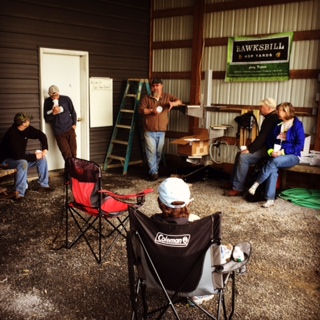
Once the field chores were done everyone took a break
under the pole barn.
All in all we had about 15 folks come out to help, and like last year they made pretty quick work out of planting the rhizomes and the weeding.  At the end, everyone spread out into the yard and freelanced on more weeding.  We pretty much cleaned up the Cascades, leaving the Chinooks and Columbuses for later this spring.

Of course we had Luray's famous donuts from the Fairview Grocery for refreshments.  We also had some homebrews to share - one made with hops from our yard, and two others that included hops that Kevin grew in Luray.

The help from the volunteers is so valuable and important to our little start-up hop yard.  This work will go a long way towards helping us get to a viable harvest this year - especially with the new rows and the Goldings!  I'm really looking forward to the growing season now!

Wednesday, May 4, 2016

Cabin Lore - the Hawksbill Cannery

I see these colorful can labels around the county from time to time.  There are a couple of them, on cans and in frames, at the Hawksbill Diner in Stanley, and this weekend I found these two examples in Gathering Grounds in Luray.

The Gathering Grounds piece has a few of the tokens and chits that were issued by the cannery, I guess to workers and others.  There was an auction last year for a token printed with 4 cents on it - these items date from the late 1800's into the early 1900's.

So that inspired me to do a little research to see what I could learn about it, and off to Google I went.

As with the building on Zerkel Street where we hope to operate the brewery soon, the first things that came up in my search were trade publications.  The cannery was listed as a hotels supply vendor in the one I found, dated 1922.

There are a couple of photos in the "Luray and Page County Revisited" book by Dan Vaughn.  The author has included a photograph of the cannery under construction in 1906, located on North Hawksbill Street in Luray.  It was called Luray Canning Company at that time.  The business was renamed Hawksbill Cannery after I.N.Dovel bought it in 1914.

A subsequent photo shows well drilling for a proposed but failed expansion in Stanley.  Apparently there was a fire in 1950, but it was rebuilt by Dovel's son and by 1954 was one of the leading canners of watercress - that's one of the labels that they have at the Hawksbill Diner.

In any case, I have always like the color and graphical style of these labels.  I'm on the lookout for some.  And we're going to use them for inspiration in the brewery logo - we'll have to see what the designer comes up with on that one!

Monday, May 2, 2016

The Building Permit @hawksbillbrew

Since my day trip to the Valley on brewery business, we have keep the ball rolling on things.  The meeting with the bank two weeks ago went well, but unfortunately the types of support we needed from them did not match their charter or business model.

The good news out of that experience was feedback on our business plan, which led to some polish and refinements.  Then we were able to network to two other local banks, both of whom are very interested in the project.  Now we are tracking them and working to have the meetings and complete the paperwork they require - hopefully we'll get all of this done in the first couple of weeks of May.

Meanwhile, after all the work on rezoning, and chasing down some documentation, David was able to get our building permit.  Although we've had it a couple of weeks, we didn't want to put it up until we had signed the lease...and now that's happened too.

So while things may be moving a little more slowly than we would like, they are headed in the right direction.  Progress is good.

Thursday, April 21, 2016

Another IPA Brewed with @hawksbillhops

Still working with the new half-barrel brewing system that will eventually become the pilot system for Hawksbill Brewing, the team experimented with an IPA a few weekends back.  This one was on the heels of an English Brown Ale and a Coffee Porter, so with two brews down we were hoping that we would finally have the groove down with the work flow.

Kevin had researched a recipe that would use the kinds of hops we are likely to have available locally - which from the farm at Hawksbill Hop Yards will be Cascade, Chinook, Columbus, Fuggles, and Goldings, and with any luck, maybe some Centennial this year.  As it turned out, there were still two pounds left from last year's Cascades, so we used most of one of them in this brew - they were combined with a share of Fuggles that Kevin had left from his crop.

Equal measures of the two hop varieties in two additions, followed by an aroma addition at flame out that was all Citra pellets - we don't grow that variety so it was the exception to our strategy of using local hops for this.  In the future, if we start pelletizing the Hawksbill Hop Yard crop, we can use some of the Cascade for this purpose.

David tells us that fermentation is nearly complete on this one, and he's already sampled it.  There's a burst of aroma from the pour, and he was pleased at the intensity of the IPA taste afterwards.  Sounds like we are on to something - we'll need a couple of IPAs in the repertoire when the brewery gets up and running.

And it won't be long before I have a chance to sample it as well - I have some work to do in the hop yard this weekend, and I may come around for some refreshments.

Monday, April 18, 2016

Visiting Swover Creek Farm Brewery


On Thursday I found myself out in the Valley on brewery and hops business – I’d scheduled a meeting in Winchester but it was moved to Woodstock.  From Winchester I had planned to visit my friend Jonathan up in Lucketts Mill, but I canceled that due to the longer drive after Woodstock.  Instead, I took a drive over to Swover Creek Farm Brewery.

The last time I went to Woodstock, I didn’t make it.  Mary was with me and we were on the way to the new Woodstock Brew House, but we hit a buck that totaled the car.  We hadn’t ventured back since then, although I’d still like to go check out the brewery.

Over the last few years as I have gotten involved with the hop yard and now that we are beginning to plan the brewery, I met the proprietors of Swover Creek.  They have a hop yard on the property and were early members of the Old Dominion Hops Co-op, and they eventually moved forward opening a farm brewery on the property.  It’s a pretty inspiring story that matches my aspirations.

With time on my hands, I checked both Woodstock and Swover Creek and found that Woodstock wasn’t open until 4pm, but Swover Creek opened at noon, so I decided to take the drive out to Swover Creek.  This neck of the woods also has a favorite vineyard of ours, North Mountain, which I written about before – and they are growing hops as well, but whenever I am there, I remind myself that the big mountain to the west is North Mountain, and that’s West Virginia.  It’s close enough that you could almost reach out and touch it.

Once I got there, I ordered a flight, highlighted by the Red Clay IPA and the Coffee Stout (on Nitro!).  There were a couple of locals in the tap room, so I struck up a conversation with a few of them (I was in my farm shirt with the logo, which I have found opens doors in the industry).  They were useful contacts that I hope to have a chance to talk with further.

Proprietor Lynn was in the tap room and offered a brewery tour, which I gleefully took advantage of – they also shared some farm-made andouille sausage and zucchini relish that I couldn’t resist.  I learned their story of starting with a half-barrel system and growing to the current 3.5-barrel system that fills the brew kitchen – the story is on their web site, which is linked above.  Obviously, there was a lot of perspective to be gained to an aspiring brewery operator!

I took away some good lessons from the visit and shared them with my partners at Hawksbill Brewing, David and Kevin.  Very helpful insights that are going to help us stay on track as we continue to make our own progress on this journey!

Now back to the tasting - so far I've found that every one of the Virginia breweries I visited have at least one memorable offering, and Swover Creek was no exception.  The Red Clay IPA came highly recommended by the brewtender, and I was not disappointed.  But an even more pleasant surprise awaited with the Coffee Stout (on Nitro!) - it's a style that is trending right now, and I am quite fond of it, but also there is this technique of using nitrogen gas during tapping.

I'll do some research for a future post, but it is said that using Nitro was pioneered by Guinness (who doesn't love a Guinness?) but we are finding it used more and more by craft brewers in Virginia and nationally.  Heck, we're even using it during our pilot brews - by coincidence we just did a Coffee Porter pilot and put a 5-gallon keg on nitro! 

All in all, I had a lucky day.  My business meetings went well, and time will tell if they were successful.  But the real luck came because the meeting moved and I had some found time - and I had an opportunity to meet some great people at an up-and-coming farm brewery!

Friday, April 15, 2016

The Bees Have a Good View

On Sunday I decided that Tessie and I should drive over to Hawksbill Hop Yards and scout for progress on the bines.  While it's early in the season - May 14 is the frost free date in the Valley - I wanted to see how things were going.  And since the dog was along, we took a walk out into the other fields at Public House Produce once the scouting trip was over.


Just across the little drainage from the hop yards is an "idle" field - at least it appears that way.  But at the produce farm this field has two key purposes - one, it's a key forage area for the bees that will be busy pollinating the crops later in the season, and two, it's a food patch that serves to keep some of the deer at bay from the other crops.


With the proliferation of the varmints, you could argue whether or not it's a success in that second role, but as far as the first goes, I think the bees are happy.


David has a cover crop in right now that will serve to nourish the bees in the early going.  As Tessie and I walked along I noticed the incredible view of Stonyman Mountain in Shenandoah National Park just over there in the distance, so I had to stop for a moment to admire it.


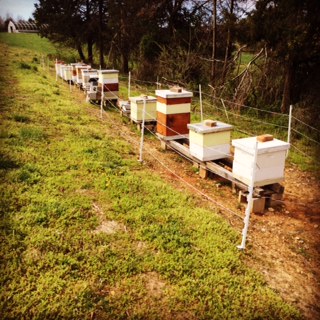
Then as we turned to walk back to the hops, I went to have a look at the apiary.  It was too cold for much activity in the hives, so I was able to get close.  I had to cajole Tess a bit to keep her away from the electric fence, fortunately this was a listening day for her and she didn't get a "life lesson."

But that could happen some day - I wouldn't bet against it.

Wednesday, April 13, 2016

Shakedown Batch 2 - The Coffee Porter

Since I wasn’t able to participate in the first pilot brew, I made plans to be there for the second.  The planned recipe was a coffee porter – the idea of combining cold-brewed coffee with porters and stouts is very popular these days, and I’ve found some good ones in the offering commercially from Sierra Nevada and Schlafly.  So it’s a natural conclusion to want to have one of these on the rotation eventually.

When I arrived, the team was working on the mash.
When I arrived, the team had already brought the hot liquor tank up to temperature and the grain was milled.  As before, in true shakedown style, there were some hitches in the process – true learning experiences that I see as an investment of time and effort to build skills.


The situations reminded me of my first terrified homebrewing experience when I graduated from one gallon batches to five gallon batches.  I’d made all of this investment in the equipment and the recipe kit – and when I went to do a check on fermentation about a teaspoon of my sanitation solution spilled in the beer.

Sanitation is the key to good beer, so it’s not unusual to have a solution around all the time while doing chores in the brewery.  I use a food grade product that offers the convenience of no rinse application, so after I checked the label to see if this small dilution would be okay in a five-gallon batch, I relaxed a little.

Eventually I called a friend about it though, and he reminded me that people have been brewing for 5,000 years, and sanitation hasn’t even been a science that long.  You can imagine brewers in the dark ages using malt that had been ransacked by rodents, animals crawling around in it, maybe feces dropping in there…so here I was worried that I might have a little sani-solution mixed in to my brew.
 
A side chore for the day was to move the Brown Barn Ale -
the "extra special bitter" - into a keg.
That conversation ended with the comment, “Relax, don't worry, and have a homebrew!” So flash forward a few years and here we are going through the steps of a shakedown on the pilot system – my sense of it was we should experience the whole thing and learn how to operate as a team.
Since the cooler needed to be set for some hop yard supplies
(lower than fermentation temps) the coffee porter is going
to ferment in the garage.

So when I arrived, the guys were in the middle of figuring out some wort flow issues with the mash and the hoses and pumps – eventually diagnosed that the grain had been milled too finely.  The fix was to do a few of the steps manually, and during implementation that meant we got a longer protein rest at a lower temperature than the recipe called for…at the end of all of this we still had an O.G. that will yield a session alcohol by volume level.


Plus, it will be a coffee porter.  You know, the flavor of a beer like that is the key, not so much the ABV – so we’re looking forward to what’s likely to be a good thing!

Monday, April 11, 2016

The Shakedown Brew

The pilot system gleaming in the sun
of an early spring morning.
While the brewery is still in developmental stages and the licensing process is underway, we cannot brew beer and we certainly cannot sell it.  Meanwhile we still have some work to do on getting recipes together and perfecting all the steps needed to make beer, so we bought a pilot half-barrel brewing system and shopped it out to a local home brewer for all these shake down activities.
The malt for the first pilot brew.

After unboxing and assembling the system a few weeks ago, there was a lot of preparation for the first brew.  A brown ale was selected, and since it was brewed in a barn, the name for it was Brown Barn Ale. 


Local Fuggles and Cascade hops were used,
provided by one of the neighbors.
In true shakedown style, the grain was milled and then went into the mash tun.  The brewing process flowed from there – pumps and hoses and plate chillers and all.  At the end of it, the beer went into the fermenter at a good pitching temperature – just about 70 degrees. 


The fermentation process was carefully monitored over the course of about two weeks.  A northern English ale yeast was chosen for fermentation on this, but some recipe substitutions had to be made on the hops bill. 

Pitching the northern English ale yeast.
The product ends up just a little more bitter than what you might expect for a brown ale, so our brewing team promoted it – it’s now an extra special bitter. 


True to form in brewing, where you might find your taste tends more towards aroma hops than bitter hops, this will appeal to some but not all.  But it is still very drinkable and I’m sure that every drop will be consumed as the recipe development and equipment shakedown processes continue.


And the best part is it was our first one, made on the pilot system that eventually will become part of the brewery.

Tuesday, April 5, 2016

Revisiting the La Belle Discotheque Bombing

April 5 is an important day in American history - mainly because it is the anniversary of MLK's assassination.  That happened when I was a youngster, and although I was too young to understand the man's significance when it happened, his impact was clear as I grew up.  After all, the neighborhood I moved to in Washington, DC in 1992 still bore the scars of the unrest that happened after his death 26 years earlier in 1968.

On a more personal note, April 5 is the day before the anniversary of my USAF enlistment in 1980, and my discharge six years later, in 1986.  On that Sunday morning in 1986, I boarded a flight from Berlin's Tegel airport and out-processed the next day, April 6, at McGuire Air Force Base in New Jersey.

In 2012, I wrote about the La Belle Discotheque bombing in a post linked here - the whole chronology of my evening on April 5 is there, along with a brief description of the events afterwards.

Going forward to 2016, I chanced to read a post about the bombing on Facebook (my 2012 post was also inspired by a friend's post on Facebook).  This time, I was amazed to see the author of the post - Abdul - who was one of the guys I encountered at the base NCO club that evening.  He and his friends had said they were on their way to La Belle and invited us along.

So here we are, 30 years later, and I was finally hearing the rest of his story - they were en route to the club when the blast happened, and arrived there shortly after.  I had heard over the years that he or some of the friends he went with were injured, but that wasn't true either. Abdul's post about the disco concludes with the following quote:

"Thanking God we didn't make it there during the explosion but we were enroute to this club the night they blew it up. Prayers and blessing to those who were in there especially the Army soldier whose life was tragically taken too soon. We had some great times inside Club LaBelle."

I'm so glad and relieved to hear this news all these years later.

(note:  After I posted this, I learned that there were a few USAF guys who were injured in the bombing - but none that I knew personally.  Several other friends were either there or on their way, so I guess the event could have had an even bigger impact on my circles.  Still, it's worthwhile to take a moment to think about those injured from this criminal act.  I hope they are having good lives despite the tragedy,)

Wednesday, March 30, 2016

Backyard Hops - 2016 edition @hawksbillhops


After watching neighbor Dan in his hopyard down the road from Hawksbill Cabin, I got interested in trying to grow them for myself - I also started brewing at around the same time, and eventually used the hops I was growing in the backyard in some of my beers.


It all started with this Willamette, which is in a five gallon pot along the fence in the back.  The plant is three years old now, and I am sure there are roots that spread out deep and wide from the pot.  It would take a lot of work to move it, in other words - but I may do that next year.


There are quite a few other "home growers" out in the Luray area, and this year I got to know Kevin a little better.  He's always been fond of Fuggles, which he uses for some very tasty porters and stouts.  His plants are thriving, and they are mature - seven years old, in fact.

Because he championed Fuggles so strongly, it was one of the varieties that I chose to plant in the commercial hopyard we started last year.  In fact, this year, we're going to add a second row of Fuggles, for a total of 120 crowns.  We'll need to pull out the 20 or so hills of Centennials - I hope to salvage those in some temporary pots and use them in the future when we expand.

My plan on Sunday was to get out in the yard and trim back all those shoots from the Willamette.  Some of them are already four feet long, and they are nearly ready to grab on to the fence and climb! I'll have to prevent that!

Meanwhile, Kevin told me he got out to clean up the the Fuggles row.  He sent me this photo after he thinned the rhizomes - he estimated a half bushel of them.  We're going to get together for a look at them soon.  I may be able to use a few of them for fills in my original row.

It reminds me that I need to get out for a look at Dan's hopyard soon, too.  I bet that there's some action in his backyard as well!


Monday, March 28, 2016

Shipping Off to Baltimore - #nfmt16

Looking over my past posts I thought I had written about the NFMT conference in Baltimore more frequently.  I have been presenting there every year consistently since 2007, although I was sick in 2008 and didn't go.

My scan of posts shows that although I've written about the sister shows in Las Vegas and Orlando more recently, I haven't posted about the Baltimore show since 2010!  So I'm overdue for an update.


I ended up in the facilities management field after I completed my MBA at USC in 1997.  When I got back to DC from LA, they had a management consulting practice focusing on this specialty just starting up at what was then known as Sverdrup (subsequently bought by Jacobs), and I was the third employee to join it.


Here we are, nearly 20 years later, and it turns out that my work with 80+ clients has revealed some inscrutable truths about how organizations run their real estate and facilities - and this discovery convinced me that maybe I should talk about some of the things I've learned in the field.

So, in 2007, I put together a talk about prioritizing facilities investments, and presented it at NFMT in Baltimore.  Then, in 2009, I gave a new talk about high-performing facilities organizations in Baltimore and Las Vegas - I also gave the prioritization talk in Vegas that year.

Every year since then, except for 2014, I have presented at Baltimore, and in alternating odd-numbered years, I've given my talks in Vegas or Orlando.  In 2014, while I didn't present, the company put a booth up at the Baltimore show, so I did attend - I hate the idea of missing it, truth be told!

The topics continue to evolve.  After the high-performance talk had run its course, I made up a new one called "Building a Better Business Case" - once again, featuring how to make good investment decisions about facilities, but adding the key concept of how to justify funding requests to management.  This year was another new topic, although the title is no where near as catchy:  "An Overview of Facilities Management."

A few of my team members joined me in Baltimore this time, and I was very happy to run into some current and former students from the graduate program I teach in at Catholic University.  Since this was a new topic, I didn't know how the audience would receive it, but it ended up that there were more than 180 attendees in the room!

So we'll call that a success!  I already have some updates for this talk to keep it fresh a year or two, and I'll see if I can take it to Vegas this year.

Some might say that facilities management isn't a glamorous field.  I beg to differ.

Friday, March 25, 2016

Brewery Lore and Loose Ends @hawksbillbrew

Along with everything else going on right now as we continue to develop the brewery, a few weeks ago we discovered a hitch in the zoning for the building.  I’m not altogether clear on how or why the problem was discovered – but it sheds some interesting background on the building, so I thought I might revisit the topic
.
What we know so far about the building is that it was built in the 19-teens to be an ice storage facility for the railroad, which passes alongside to the west to this day.  When refrigeration came along, that business faded away, and the next one to occupy the building was the “Blue Ridge Creamery” – sometimes you can find bottles and such from them on eBay – and I’ve found a few folks around town who remember the creamery.


Following that was a string of retail establishments, including an auto parts store that was there for a long time, and many people remember.  Since Mary and I have been coming to Luray, we’ve known the building as an appliance store and as the scooter store, which was the most recent iteration.

Flash forward to 2016, and as we were going through permitting and licensing activities, we discovered that the building was in the industrial zone of town – probably as a legacy to those earlier uses.  During almost 50 years of use for retail, the zoning was never changed to commercial.  It became necessary to clarify the zoning, and working with the Luray Fire Department, our landlord, we decided to seek the zoning change.

This is a regulated process, requiring meetings with the Planning Board and the Town Council, along with advanced notice in the paper and even a site visit – I have a copy of that post here as a photo.  When all was said and done, the rezoning was approved – but we had a lot of in person support at the meetings, and quite a few letters were sent in.  

That inspired the following Facebook post, which I wanted to share on the blog:
We had so much support for our meetings with the planning commission and town council today - it was both humbling and exciting. Thanks so much to everyone who came out and spoke or wrote a letter today on our behalf. There is a little bit of a road ahead - but we are looking forward to it. It's going to be a fun ride.

One of the fun comments on Facebook was an article about characteristics that identify successful towns – and the presence of craft breweries was one of the features.  Here’s the link, and the quote is below:
Having craft breweries. This might seem like the strangest attribute, but the researchers say a town that has a craft brewery has a certain kind of entrepreneur spirit and is a reliable marker of a city on the move.


We certainly hope to have that kind of a positive impact!  

Wednesday, March 23, 2016

The Pilot System Part 2 - @hawksbillbrew

Since receiving the pilot system two weeks ago, David and Kevin have kept busy inspecting and assembling the components.  They completed this task over the weekend and moved the system out to the barn, where the power was correct for operating the system.  

In the first photo here, the tower, the kettles, and the hot liquor tank are shown as they will be set up during brewing. Also, the controller is installed with the system plugged in.

Everything's pretty much ready to go - they need some additional hoses and connections to complete the job before the guest home brewer will brew the first batch, but that time is coming. The selected recipe is a red ale.

As I understand the schedule, there'll be a practice run with hot water, a cleaning, and after that the first brew - sometime over the next two weeks or so.  I hope to be there for it.

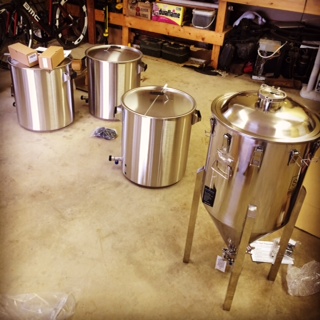
The storage solution for everything when it is not in use is to lock it away nearby.  It makes for a shiny display, as seen in the second photo!

Our plan for the fermentation phase is to use the walk in fridge - there's a cool bot control there so that we can monitor and manage fermentation temps - should work well.

I'll have a post for the pilot batch whenever it's completed - hopefully I'll be there to see that in person!

Monday, March 21, 2016

The Pilot System Part 1 @hawksbillbrew

There are a lot of irons in the fire these days.  In addition to finishing up the lease and some of our LLC formation documents, Hawksbill Brewing has engaged our licensing consultant, we've got a design for the brew house, and we're working on getting our construction effort underway.

Over the last month or so we decided to begin working on testing recipes, so Kevin designed a pilot brewing system that could be used informally for this purpose - it arrived last week and the team got together to assemble it over a couple of weekends.

It is a half-barrel system, so it is designed to brew 15.5 gallons per batch.  We chose an electric system, and since the power we need for it is available in David's barn, that's where it will spend most of its time.


One of our key assumptions on this system was that it should be modular, and work well within the ultimate brewery when we are in operation.

That's the reason we picked electric, but it is also the reason we selected a conical fermenter.  It even has a coil inside of it so that we can use it with the glycol system we'll be installing in the fermentation area of the brewery.

There's a tower with electric controls to go with all of this hardware - so we'll be able to precisely manage mash termperatures and boil times.  There's a pump and plate chiller to go with it all.

While I wasn't out there to help with final assembly, it didn't slow the team down.  Honestly, I know I'm not much help on this part.  But I look good in team photographs.

Next weekend we'll be putting the system to the test.  First with a water cycle to make sure everything is hooked up correctly.

If that goes well, the first batch will follow on Saturday.  I don't know what the fellows have in mind for that - but I'm looking forward to it!

Wednesday, March 16, 2016

Tree Trimming in the Hollow - with @svec_coop


A few weeks ago, our local power company came through to clear some trees along the right of way in the back, behind the cabin.  They've been working for a while on this project and our neighborhood's turn finally came - only the crews were interrupted by the big snow that happened last month.

They came back today to clean up all the downed branches and trees that had been removed.  So right now I'm getting serenaded with safety beepers and chippers. (Just like at work!)

Beaver Run cuts through here, so there is a steep little valley that makes it interesting with these vehicles, but as the one photo shows, that is not stopping them.

Earlier I took a walk out there to check everything out - it struck me that my little yard is only part of the whole county, and their effort has been going on for some time.  It's quite the industry.

Then one of the guys said that they actually used helicopters up in here to take down the branches that were too close to the lines.  I was sorry I missed that - had no idea.


I decided to look it up online though - and I found a good explanation video on YouTube that I have embedded below.  Pretty good show - I still wish I could have seen it in person!

Monday, March 14, 2016

Early Spring @hawksbillhops

Look closely for little pink buds on this Columbus.
On Sunday, as a spring rain was starting to move in, I took an hour to walk around the hop yard to scout.  I had a brief moment in the sun on Saturday while I was walking Tessie in the field, and I found a Columbus bine that had begun to bud, accompanied by some little leaves.

Since it is so early - two or three weeks, at least - I thought no problem, we've just got a high-achiever out here.  Then I started seeing Facebook posts by growers in Ohio and Kentucky saying their yards are starting about two weeks early, so I clearly needed to take a walk around.

What I found in the field was prolific leafing and budding - not every hill mind you, but at least 1/4 to 1/3 of the hills.  On every variety but the Goldings, so I have Cascades, Fuggles, Chinook, and Columbus already greening out.  I'm happy for the vigor, but we still have a lot of work to do in the field before we're ready for growing season!  Our supplies haven't even arrived!

I've lost track of the photos - this is probably Cascade.
It's not just the early sprouting that I found so amazing - I found that our Cascades are going gangbusters and are reaching out into the drive aisles.  I found clusters of leaves four feet out into the rows!

Our part of the Shenandoah Valley isn't past the frost stage until May 14, David tells me, so these little plants have a bit of a struggle ahead.   We still have a few weed control steps to take, although we're going to have to change our plans to reduce the stress in the yard.

Plus we have work to do on preventing mildew.  It's simply too early for this.

We are proceeding with plans for our spring planting event despite this.  We're set for April 30, and this year we'll be adding rows of Chinook and Fuggles.  The Fuggles row is going to be fun, because we have to take out 25 Centennials first.

And also because it is fun to say Fuggles.