Ramble On

Wednesday, November 26, 2014

On to the High Line


Mary and I had a list of destinations we wanted to take in during our stay in Manhattan.  These things can be hit or miss - things take longer than you plan, they're not open, what have you.  But on our list was the High Line Park along the West Side, and we did manage to get there after our walk from China Town with Rosie.


The story of this park is that it is a "rails to trails" sort of development, with the converted elevated rail line actually an old freight line that ran directly into the heart of the city.  Starting in 2006, the community and the city began to build a park out of it.

In all, it's about 1.5 miles long.  We probably walked about 6 city blocks worth, enjoying views across the Hudson to New Jersey, or cross town views along some of the streets - and also, the peak out here and there to colorful murals and all the other stuff that makes New York great.

Although we were warned that by late afternoon the place is crowded, that is exactly when we ended up there - and the predictions were correct, it was crowded!  Still, there were ample spots to stop and take a break to enjoy the location.

I think Mary and I are already planning a next visit to take in more of it!

We exited around 23rd Street, which was only a few blocks (east-west blocks mind you - the big ones) from our hotel.  We made a stop to refresh ourselves there, and then headed out for a movie and a late dinner.

All in all, a great day with a big plus for us, in that we had a good visit with my hipster niece!


Tuesday, November 25, 2014

The Meeting in Chinatown

While I wanted to try and catch the Staten Island ferry round trip on our walk through lower Manhattan, there was a very good reason we weren't going to have time - we were meeting our niece Rosie and her friend Paul for lunch in Chinatown.

So we got back on the subway to head for our meeting place in the Bowery - where we thought we might check out the Tenement Museum. 

A reminder to fellow tourists:  there is a lot to do here...don't bite off more than you can chew!

Yeah, so that didn't work out, but that was the location of our rendezvous.

From there, it was over to Chinatown, for hand-pulled noodles at the eponymously named restaurant.  Great stuff and everybody left full!  If you go, try not to pay too much attention to the restaurant itself, just saying, and anyhow they focus on the food here.

Paul had to get back to work so we parted ways after lunch.  Then Rosie, Mary and I spent some more time walking the streets of New York afterwards, eventually making our way over to the West Village, and then to the High Line, which will be the subject of the next post.


Monday, November 24, 2014

Lower Manhattan Walk

Mary and I had a full day set aside for touring Manhattan on Sunday during our recent trip.  We set off for lower Manhattan to start, with the goal of viewing the 9-11 Memorial.

While we were down there, we had a look at the new World Trade Center, which was set to open two weeks after our visit.  In an earlier post, I included some of my photographs of that area.

We took the subway, although it would have been just as easy to catch a bus - and we have done that before on previous visits.  We emerged and navigated the streets that are still an obstacle course of construction, although that will likely reduce over the next few months.

We hadn't made any plans to go into the museum, and I doubt that I ever will.  I have my own memories of the day - as I have posted before, and the exhibit I saw at the Newseum a few years back was moving.  However, we did want to check out the memorial itself, so we took a walk through the area, stopping to have a look at the water features, the plaza, and the new forest getting started there.

It is difficult to capture the scale of this construction with a camera from ground level.  I was careful to try and capture a few full names of the people mentioned in the plaques with a view of the water feature in the background.  It was a pleasant fall day, and of course there were hundreds of tourists visiting the memorial.

We continued along, with a plan to visit the battery, and - time permitting - perhaps catching the Staten Island ferry for a round trip across the Hudson.  As it turned out, we didn't have time for that.

The area down at that end of the island was extensively damaged by Hurricane Sandy.  Between the WTC construction and the revitalization efforts after the storm, it has really made a comeback.  There is a new boardwalk and all sorts of pocket parks allowing the new residents to make their way to the waterfront.

I caught a glimpse of the Statue of Liberty out there in the narrows and was moved by it, and the memory of visiting Ellis Island a few years back with Mary, where we checked out the records of so many families that passed through there.  I'll close out with a reminder of what she represents, from the poem, The New Colossus:

"Keep, ancient lands, your storied pomp!" cries she
With silent lips. "Give me your tired, your poor,
Your huddled masses yearning to breathe free,
The wretched refuse of your teeming shore.
Send these, the homeless, tempest-tost to me,
I lift my lamp beside the golden door!"

Thursday, November 20, 2014

The Beaver Dam in Fall

In a September post I wrote about the ephemeral beaver pond that shows up in the hollow across the road from Hawksbill Cabin. At the time the area was covered over with wild greenery, but through the verge you could just make out that something had happened to the dam and the pond behind was empty.

Fast forward to last weekend, and now that the leaves are down and some of the plants have died back, you can see that the critters repaired their dam, and the pond has filled back up.  The pond is not as big as it has been at other times, but it's nice to see in any case.

For comparison purposes, the second photo with today's post was taken last spring, before the leaves came up.  The pond was much bigger at the time, probably full from the spring rains.

Mary and I took a look over there on Saturday afternoon, finding the pond partly frozen over.  Then we saw the wake of one of the beavers swimming around, and eventually the animal came into view.  Good to see them still around.

This stream is called Beaver Run - the hollow across the road isn't on our property, but it's part of the view from the brick terrace, so we enjoy having a look at it for most of the year.  When the dam is there, we have the benefit of the constant sound of running water tumbling through.

I'll keep an eye out for the opportunity to take some photos later in the winter, when it is frozen over.


Tuesday, November 18, 2014

Visiting the Glass House, Part 3

Because he was a famous architect, the completion of Philip Johnson's attracted a lot of attention in the press at the time.  A number of publications since then have called the gatherings that occurred there a '20th Century Salon' - since they featured other prominent arts and culture figures from the mid-century era.  

The story goes that there is a cigarette burn on one of the Mies pieces in the living room - courtesy of Andy Warhol (this will not be the only Warhol reference in today's post, by the way).  Our group toured the main house and had a walk around the grounds.

While we were in the house, Mary and I couldn't help notice a few similarities between the place and our beloved Hawksbill Cabin.  One example is the brick flooring that ends at the line of windows, as it does at our house - although here, there's a bit of lawn outside, and at the Hawksbill Cabin, the view continues to the brick terrace, progressing off into the wilderness of the hollow below.


Our tour included many of the other buildings on the property.  I won't highlight them in this post, but would refer readers back to the Wikipedia article for more information.  However, here is a view from the living room, looking out to the pond and a couple of the follies there.

The original 11-acre estate was developed over the course of 50 years or so, with small structures such as these scattered throughout.  I can imagine strolling about these grounds and enjoying the little projects as I came upon them - a very relaxing juxtaposition to life in the city.

Johnson lived here with his partner David Whitney.  They collected a lot of art, including this Warhol portrait of Johnson, and built galleries for the paintings as well as the sculptures.  These buildings are on one side of the grounds, so we enjoyed a walk through the fall colors, mostly hickory trees, over to them,

There was an installation by a Japanese artist in place at the time that periodically framed the main house in fog.  Our visit took place on a sunny day so the feature was a bit incongruous - I would have liked to see it under an overcast sky to appreciate it differently, evoking a naturalist frame of mind.

As we progressed towards the end of our tour, we visited Johnson's library and studio, a small building set away and across the field from the main house.  There on a drawing table I saw some of the tools he used laid out precisely, at the ready, should someone come along and need to roll out some construction drawings and work on a detail.  Nothing doing, though, and eventually my thoughts turned to the thought that most of that work is done on computers now anyway!

Finally, our tour ended, and the group made our way by shuttle back to New Canaan.  The group all parted ways, and Mary and I hopped on the train, bound for our next stop, New York, where we planned to spend a couple of nights sightseeing from a home base in Chelsea.  I'll get to those posts next.


Monday, November 17, 2014

Visiting the Glass House, Part 2

The main objective of our fall weekend trip was to visit the Glass House in New Canaan, Connecticut. Some of Mary's college friends had arranged a tour and the plan was for the group to convene there as a group from all over the northeast.  Over dinner at one of her classmate's house on the night of our arrival, we got caught up on some of their alumni business and talked about the plan for the next day.

We had traveled up by train from Alexandria - we walked to the station, caught a regional, and rode all the way to Connecticut, where we had to make a switch to a commuter line for four stops.  It would have made for a long day, but since the visitor center for the Glass House was walking distance from the station in New Canaan, if the scheduling worked out we probably could have done this whole trip in one day.  It's a shame, but I doubt you could do something like that in other regions of the US.


The Glass House was designed to be a weekend residence by architect Philip Johnson, who built in on an 11 acre property in 1948.  His architecture practice was in the city, but the story goes that the building was inspired by Mies van der Rohe after Johnson completed an exhibit on his work at MOMA in 1947.  In any case, besides the modern aspects of the house, it was an early experiment in the use of industrial materials, such as steel and glass, adapted for private residences.

A side note...Hawksbill Cabin was completed at just about the same time frame - they broke ground on the property and completed the foundation at Thanksgiving, 1948. While we have learned that the family that built our place drew their inspiration from Frank Lloyd Wright's Usonian houses - especially the Pope-Leighy house that was built a few years earlier in Falls Church, Virginia.  Although that is the case, the modernist features of expansive glass fenestration and open plan interior are common features of all three residences.

For today's post, I wanted to focus on the experience and photos of the house itself.  The next one will include a few photos of the interior and the other buildings on the site, which has been expanded by the National Historic Trust from the original 11 acres to now include about 200 acres of wooded property.

Sunday, November 9, 2014

Fall of the Berlin Wall - 25th Anniversary Edition


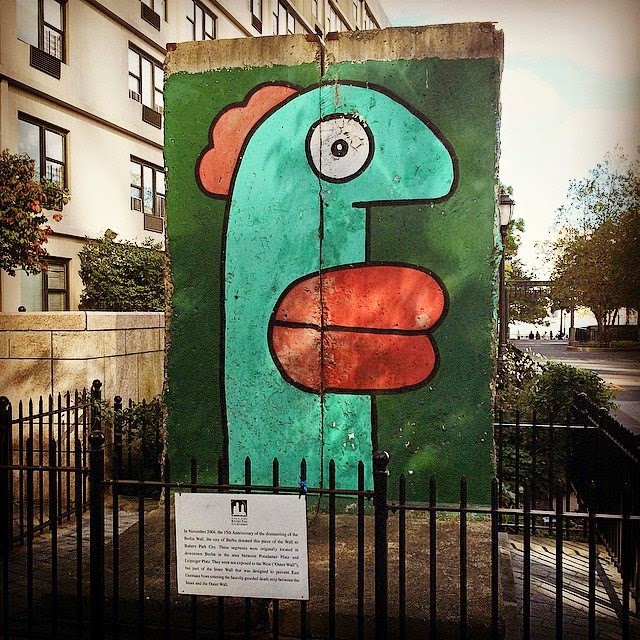
A section of the Berlin Wall in Manhattan, October 2014.
When Mary and I were in New York a couple of weekends ago, we happened upon two slabs of the Berlin Wall in the south end of Manhattan - the area that is recovering from the 9-11 attack and from Hurricane Sandy.  It was a good reminder of the triumph of the human spirit - that there are so many things that we have, and we will, overcome.

Today is the 25th Anniversary of the day the Berlin Wall opened, at last allowing the people in East Berlin and West Berlin to openly cross the border.  

Me standing near a section of the Wall in May 2001.
It's an anniversary always leaves me a little conflicted about my memories of Berlin - my five years there were spent while it stood - as a fact, as a scar dividing the city - and I typically write about memories from those times, instead of how things are now, now that the wall is down.

And that's what is important - the reunification, the healing that continues, and the future.  

Still, in case anyone's interested, here are a few posts from my blog on the topic. 


Wednesday, November 5, 2014

Visiting the Glass House, Part 1

So far I've put up a couple of posts about our trip up to Connecticut a couple of weekends ago - I still have a few to go, starting with today's post about the portion of our trip up to CT.  Mary arranged it with the goal of joining some of her college classmates for a tour of the National Historic Trust's Glass House, designed by architect Phillip Johnson.  And so, the trip up from DC had us arriving finally in New Canaan, where the house is located.

We had a great hotel stay, and spent Friday evening visiting with friends over dinner.  The plan for Saturday was to meet up at a cafe in town, and then walk over to welcome center for the tour.

Mary has a few classmates that live in the DC area, and one of them was with the group at breakfast.  We spent some time catching up - she'd been on a few trips recently, and her husband was just getting ready to depart for two weeks in India.

The welcome center was typical of what you might expect - plenty of books to peruse, some pretty wonderful design objects - including the George Nelson clock I took a photo of here.  Soon our tour guide joined us for an overview of what we could expect on the tour.

There was a wall of small video screens continuously running clips behind where she spoke - and she would refer to the clips from time to time.  They showed some of the "follies" that Johnson had built on the property, as well as an image of a party or two, and then, a fascinating clip of a person flipping through Johnson's rolodex.

As I watched that, the anachronism wasn't lost on me...I remember changing jobs a couple of times during the late 1980's and early 1990's, making sure that the rolodex made it into the little box I packed as I departed.  Of course, Johnson's file included a card for Andy Warhol, and then surprisingly, David Childs, whom I mentioned the other day in the post about the new World Trade Center building - he was the architect for the new tower.

At last it was time for our tour to begin, so our guide concluded the overview and we headed out to the vans for the short drive over to the property.  It was a beautiful fall day - sunny, crisp, and blazing fall colors on the trees, just past their peak.

Monday, November 3, 2014

Manhattan Downtown Skyline

Here are a couple of additional photos I took from the hotel in Chelsea last week - one at night, and one that has been filtered with an app called "Tangled FX".


The World Trade Center Opens


Looking north as we walked down to the Battery.
“… when the 104-story One World Trade Center officially opens for business Monday – the tallest and most expensive building in the Western Hemisphere – it will have ushered in a rebirth of lower Manhattan as a vibrant, urban neighborhood where people live, shop and eat, rather than just hustle home from white collar jobs. – Washington Post (link)

Mary and I took a trip up to Connecticut and New York City a couple of weekends ago – I have plenty of material for a series of retrospective posts on the trip, but the Washington Post article linked above, about the prospective opening of the new World Trade Center caught my eye, so I thought I might open the series with some photos about our visit to the building’s environs.

Downtown skyline at sunset, from our hotel in Chelsea.

We’d planned Sunday as a sightseeing day.  We were staying in Chelsea, midway between Downtown and Midtown, but we did have a high floor with an unobstructed view south.  The skyline photo here was taken at sunset and it features the redeveloped WTC site.

As we approached the new tower from the subway.
Certainly, the events of September 11 were a tragedy; it’s not my intention to gloss over that fact, and I have written a number of posts on the topic previously.  I’d like instead to celebrate the new building and its likely impact to lower Manhattan here, which is the subject of the Post article.  

Also, Mary and I have a six degrees thing with the building:  she having worked with David Childs during her time at SOM, and I worked on AECOM, whose subsidiary Tishman was the construction manager for the building, so there was no avoiding frequent progress reports as it went up (even if you wanted to, which I did not!). 

One of the frequent complaints about the old development was how the pattern of blocks cut off the balance of Downtown from mixed use development.  That’s been remedied in the new plan and the results speak for themselves:

New WTC site plan, copied from Wikipedia.
“The population of Lower Manhattan has tripled, from 20,000 to 60,000, with thousands of residents living in newly built or renovated condominium towers. Another 2,200 units in 10 buildings are under construction, according to the Alliance for Downtown New York, an association of building owners. Media, advertising and technology companies began snapping up the discounted office space, bringing a more a creative workforce downtown.”

We spent an hour or two walking around the new development and the memorial, before heading on down to Battery Park – itself in the midst of redevelopment as well, after being ravished by Hurricane Sandy a few years back. 

All in all, what we experienced – and what this post is meant to celebrate – is the comeback story.  As Keith Richards said in his intro to Saltof the Earth, “…you know, I got a feeling this town’s gonna make it!”  

We’re looking forward to our next visit.


Monday, October 27, 2014

Fall Weekender

A group of Mary's classmates organized a fall trip to New Canaan, CT and I tagged along.  We caught the Northeast Regional from Alexandria - the station in Old Town is close enough to the house that we can walk there - and then road without changing trains all the way to Stamford.  It was a nice journey with fall colors just coming into view along the way.

Our destination for the first part of the weekend was Phillip Johnson's Glass House in New Canaan.  I'll post more about that this week, but the foliage pictures here were taken on the grounds.

There's always plenty to look at from the window of a train, even though the tracks do pass through some neighborhoods that have seen better times in Baltimore, Philadelphia, and New York.  We had a full train pretty much from BWI to the City, but even so it was a relaxing enough trip.

We switched to a local for the last part, and were met by Mary's classmate Val at the station in New Canaan.  Val had organized the trip, and she and her husband generously invited us to their house for dinner that night.  We stayed at the Roger Sherman Inn up there - and received a brief history lesson while we were at it...Sherman was the only person to sign the Continental Association, Declaration of Independence (he was on the committee that drafted it), the Articles of Confederation, and the Constitution.

Just a quick post today - we're headed to the station for the trip home and wanted to get the series started.

Wednesday, October 22, 2014

Sunday Brew Chores

Dryhopping the Honey Porter with
frozen Willamette hops.
It's atypical for me to have more than one batch of beer going at any given time, but these days I am in a hurry to use my fresh hops. I remain very worried about how they are stored - I didn't have time to oast them, so I simply froze them fresh.  They are very perishable, so I am worried about the impact to them from this unusual handling - there is a photo below.

I have fresh hops from a couple of sources this year - there is the harvest that Bill gave me, which consists of six batches' worth of Cascades, and there is the small amount of Willamettes that Mary picked from our backyard plant.  

I've been using the Cascades in a series of Black IPA brews, as I've posted in the "Brewing with Fresh Cascades" series.  My plan was to dryhop my latest batch of Honey Porter with the Willamettes.

Here's how the Willamettes looked
coming out of the freezer.  I had to use
them quickly!


The two batches going on right now are a Honey Porter, which is one of my go-to brews, and the Black Widow IPA, which is the recipe I have been using with the frozen Cascades hops.  On Sunday, the Honey Porter had been in primary for just about two weeks, and the Black Widow had been in primary for a week.  My chore was to move them both into secondary.

It's not a difficult process - but process is the key word here.  There is a ton of sanitizing that has to be done, and then careful siphoning between carboys.  A key step is taking a sample to measure fermentation progress - this is done with a thermometer and hydrometer - and record-keeping.

For the Honey Porter batch, since fermentation had progressed pretty far already, I will probably only leave it in secondary for a few days.  The Black Widow will stay in for about two weeks before I bottle it, which is the next step, in fact, washing and sanitizing bottles is another one of the chores I'll be doing today.

The brew record for the current batch
of Black Widow IPA - sitting at about
7.10% ABV on 10/18.
This is the record for the Honey Porter
batch - it's at 5.78% ABV.
Closing the post, here are photos of my records for the two batches, showing both the brew cycle and progress through Sunday.  At bottling time, a final measurement of gravity and temperature takes place, and the I calculate the estimated alcohol by volume, or ABV, for each batch.


Monday, October 20, 2014

Battle of the Species: More Snakes at Work

Back in 2009 or so, I was sampling one of neighbor Dan's harvest brews in October, and I remarked that it seemed like it had been a while since I had seen a snake around Hawksbill Cabin.  Dan said that if it was going to happen that year, it would be right around this time, because, "...the snakes are on the move."

Last Friday I wrote about the little brown snake that we'd seen moving along the sidewalk out front of the office.  That little critter, at no more than five inches long, was barely noticeable - he was even smaller than the ring neck snakes I've seen sometimes at the cabin (that link will take you to a post about them, with a couple of photos)...however, he was the precursor to the monster we found laying across the threshold to our building on Friday - a four-foot black rat snake.

This encounter was typical of my experience with black rat snakes, which are nonvenomous and very common.  The colleague who discovered it didn't even notice the snake as he stepped into the building - he only noticed after he had opened the sliding glass door and it closed behind him, which put the snake on alert.  The raised head and kinked body position seen in the photo above are part of the snake's defensive posture - they won't generally bite, but they will fight by striking and biting if cornered, and that is the next step after the pose seen here.

Since I have a well-earned reputation for chronicling encounters with snakes, my friend came in to tell me about the snake.  We went back out to have a closer look, which resulted in the photo above (readers should understand the photo was taken from at least six feet away and has been enhanced with an iPhone app, lol).

It wasn't long afterwards that the snake figured it had gotten enough attention, and it slithered away.  Eventually it climbed the brick wall near the door, over behind a downspout - headed for some of the vents up there or perhaps to the roof.

Our building is close to the property boundary and some of the adjoining land is owned by the National Park Service - so nature can go pretty wild back there.  That's what I attribute our reptilian population to, anyhow.  This is the fourth time I've seen a snake somewhere in the building, between the brown snake, this black rat snake, and garter snakes on two separate occasions a few years back.

If any of my coworkers are reading this, I'd like to reassure them that all four of the snakes I have seen around were nonvenomous, so really there isn't much to fear, and that is a good explanation for why we don't have rats or mice.  A second important thing to think about is this:  I've seen four snakes...just imagine how many of them we haven't seen and don't know about that are crawling around the place.

Friday, October 17, 2014

The Little Brown Snake

My current workplace is located in a residential neighborhood up in Bethesda.  We back up to a plot of National Park Service land, so sometimes we benefit from a unique proximity to wild life.

And so it was that last Thursday I was outside the building making a phone call when I caught some movement out of the corner of my eye.  Looking closer, I found a little brownish colored snake, only about four or five inches long.

The coloring made me look closely - there's a pattern of black dots.  My first worry was that maybe I was looking at a baby copperhead, but further research proved that wrong.

This is a brown snake. There's a link below to the Peterson First Guides book on reptiles and amphibians, where I found this description of the little snake:

This is a small, secretive snake, brown and usually with two parallel rows of blackish spots down its back,  Young ones have a conspicuous yellowish collar and are generally darker than adults...brown snakes frequently turned up in parks, cemeteries, empty lots...they are such good hiders that few people are familiar with them..."

From the description, this tiny little snake is an adult, since the markings behind its head are tan and not yellow.  My photo has it straddling a sidewalk crack, to give a sense of the scale.  The guidebook says they are are often from 9-21 inches in length.

Here's a link to the guidebook I used:

Wednesday, October 15, 2014

One for the Berliners - Brewing Memories

While I was busy brewing on Sunday, Mary took Tessie out for a walk.  As it happened, that was during the boil – when the wort begins to give off those wonderful smells mixed in with the steam evaporating from the kettle.  My brewing enterprise is still small scale enough that I can do it in the kitchen, and when I do, I turn on the vent fan over the stove.

Mary came back from the walk and told me that the neighborhood smelled like a brewery.  That was delightful to hear…and of course, it brought back a fond memory of my USAF time at Tempelhof Airport in Berlin – there had been a small Schultheiss brewery nearby, and in the morning we frequently would be greeted by the smell of boiling wort.

Google Earth map of Tempelhof Airport environs, in Berlin, Germany

After a little bit of sleuthing, I came up with additional information from the Google about the little brewery…I was surprised by this first link (note, it is a link to a preview page of the book “Last Flight from Tempelhof” – written by an Air Force friend), coming up as result number 3, which mentions the smell of the nearby brewery.

Here's a photo from Google Earth of the old brewery.
As I navigated the area on Google Earth, I found a few photos of the old brewery.  I remember when I first discovered it when I lived there – on spring mornings I would walk back to Tempelhof from the Mehringdam U-bahn station through the Kruezberg park, and I found the old brewery back there along the cobblestone sidewalk. 

Another Google Earth photo, showing the operations and
trades shops for the brewery.


According to this Wikipedia article, the brewery ceased operations in 1994.  Schultheiss now has a larger modern facility in what used to be East Berlin, actually to the northeast of the old site and Tempelhof field.     


From Google Earth "streetview," here is a photo
of the old Schultheiss malt factory.
Another link I found outlined a walking tour of the Tempelhof District.  That one mentions an old malting factory that was west of the airfield, and south of the brewery.  The presence of this facility was news to me, and I am glad that there was a street view photo of it!

Thus, another connection to brewing is discovered, I guess!

Tuesday, October 14, 2014

Brewing with Fresh Cascades - Chapter 2

When brewing with "leaf" hops I use poly muslin bags to minimize the
need to filter stray flowers in later stages of brewing.
They say home brewers are creative, and I guess that’s why I consider each batch of beer that I brew with the Cascade hops Bill grew in his backyard an experiment.  The theory is only confirmed by a conversation I had with Dan recently after he told me he planned to use some honey that his dad collected in Alaska and stored years ago in a brown ale.  That batch will be all grain – pretty advanced stuff – in addition to crafty…I’m looking forward to a sample.


Meanwhile, my investigations are moving in parallel, focused on perfecting a couple of different brews so that I can experiment with different hops to see what I get.  So far, I’m on my third batch of Black IPA – which I’ve named the Black Widow series:  

  1. Black Widow IPA #1 – this was brewed according to the Northern Brewer recipe, including Magnum, Chinook, and Centennial hops, then dry hopped with some of Bills Cascade from last year’s crop;
  2.  Black Widow IPA #2 – this was the first batch I brewed with the fresh hops we picked at Bill’s place in August (check out the links at the end of this post), which is dry hopped in secondary with packaged Cascades; and
  3. Here's the first pour of Black Widow IPA #2.
  4. Black Widow IPA #3 – this batch was a weekend project just brewed on Sunday, and currently in primary – the recipe is the same but the difference between batch 2 and batch 3 will be the storage time I had the fresh hops frozen, as I used the hops in batch 2 within three weeks of picking them and in batch 3 about two months afterwards.


Batch 2 has been in conditioned the bottle long enough that I tasted it over the weekend. These batches are fresh hop brews, which reminds me of the efforts by the Old Dominion Hops Co-op to establish a hops industry in Virginia.  Those guys recommend starting small, and since the harvest doesn’t yet have the scale to merit some post-harvest processing, the focus is on selling the fresh hops to local brewers who will use them right away in a seasonal brew.

These are the spent hops from Black Widow IPA #3.
Here’s a quote from an article earlier this year in the Richmond Times-Dispatch:

"While brewers want to be supportive of the local product, quality and price are business considerations. Hops straight from the bines, or “wet hops,” must be used quickly — a good thing in capturing flavor and aroma for special brews. But for year-round beers, pellet hops purchased in bulk with analysis of acids and oils go a long way toward ensuring consistency and control costs."


I guess the Black Widow series is my own small-scale experiment with the concept. 


Here are links to those earlier posts about Bill’s hops.