Ramble On

Showing posts with label SoCal2017. Show all posts

Thursday, September 14, 2017

Day Trip to Joshua Tree National Park - part 3


After a half day or so of driving north through Joshua Tree National Park, I was nearly at the end of the road.  I had decided that my final destination was going to be Hidden Valley, which promised to give me a good look at the unique granite formations and the Joshua Trees that are the hallmark of the Mojave side of the park.  Here’s the description of the trail, from the Best Easy Day Hikes book (book linked below):

  • Hidden Valley – For good reason this is one of the park’s most heavily visited trails.  The enchanting valley is surrounded by mounds of monzogranite and attracts climbers as well as more casual explorers. 

Except for the little side trip to the rock arch, none of the walks I had taken in this park could be classified as hikes.  Even this one, which was about a mile long and took around a half mile, was on an easy trail over granite and sand, with a few stone stairways thrown in where the slight elevation required it.  Still, I managed to “hike” two or three miles out there in the desert heat – and that heat was definitely the reason I took it so easy!


Before I left Palm Desert, I had stocked up on water, buying four one-liter bottles to carry with me.  Taking stock before setting out in Hidden Valley, I had already consumed two liters; when I returned to the car afterwards I drank another half-liter.  I finished that third bottle during the drive to Coachella Valley Brewing after I exited the park.


From the Hidden Valley parking lot, the trail winds gently upward through the boulders, until finally cresting a small rise and descending into the valley.  There are interpretive signs all along the trail, and in the first part the subject matter relates Native American life in the valley, and then stories of cattle ranching there.  There are even stories of rustlers that used the valley as a hideout.

The star of the show these days are the incredible Monzonite granite boulders.  While the harsh desert sun tends to wash out the color from a distance, when you get close you can see that they are mostly a beautiful pink shade.  It’s probably a magical experience to be among these formations at sunset.

Since my drive back to the southern exit followed the route of the trip I had made 10 years ago, I started to recognize some of the features I had encountered on that trip.  I was struck by the seasonal changes as I drove through the Pinto Basin – when I had visited before, in the winter, plant life was abundant and verdant, given the desert conditions.  Here in the summer, the general sense was of dusty, dry ground, with the plants all clinging to life from their water stores or from some unseen, deep underground moisture.

My day trip to Joshua Tree was a success – I’d managed to experience, and learn, about the desert ecosystem.  I had not encountered much wildlife to speak of, just the honeybees and a few crows, but everything else remained sensibly out of sight.  There were relatively few tourists, so I had most of the sightseeing activities to myself – except for a German family that was also staying at the hotel in Palm Desert, whom I encountered twice in the park.

All that was left on my agenda for the day was to head over to Coachella Valley Brewing, which I posted on last week, and then find something for dinner.  The next day was set aside for a few brewery chores in the hotel in the morning, and then the drive into LA to get ready for the reunion at USC.  Those will be my next topics.

Wednesday, September 13, 2017

Day Trip to Joshua Tree National Park - part 2

In my first post about my day trip to Joshua Tree National Park, I mentioned an earlier trip I had made in December 2006.  That time, I only had the NPS guide to the park, which I picked up from the ranger at the entrance station.  I loosely followed it as I drove through the park from north to south.

That plan had worked well enough, but there was one point where I decided I wanted to take a walk towards some of the unique rock formations that highlight the Mojave side of Joshua Tree.  The distance I was going was only a quarter mile, but it wasn’t long before the landscape’s undulations left the rental car out of site, and I turned back for fear of getting lost.  Even so, I had time to experience the amazing diversity of desert plants that can be found here, and I even encountered a small arch that had been carved into the terrain.


This time, I had picked up a copy of the Best Day Hikes book for Joshua Tree National Park, and picked out a few destinations that looked worthy of a stop.  Most of these were short side trips, no more than a third of a mile round trip to the destination; I've also listed Cottonwood Spring even though I didn't visit it this time - the ranger at the welcome station suggested it, and I visited it the first time I visited the park.  

I’ve included the introductory description from the little day hikes guide (which I have once again linked at the end of this post): 

  • Cottonwood Spring (1.6 miles, sandy trail) – This nature trail provides not only identifications of desert plants but also describes their uses by Native Americans.  A stroll farther down the wash from Cottonwood Spring allows you to see another use of the desert at Moorten’s Mill.
  • Cholla Cactus Garden (0.25 miles, asphalt trail) – An unusually dense stand of cholla cactus rises in a cluster above the vast Pinto Basin.  The plants are as captivating as the views of the desert and the mountain ranges that surround the trail.
  • Arch Rock (0.3 miles, granite and sand loop trail)– A short nature trail winds around fascinating White Tank granite formations and features appropriate geology lessons.
  • Keys View (0.25 asphalt trail) – Keys View offers spectacular views of the south-central area of the park.  An interpretive sign provides information on the serious problem of air pollution in Joshua Tree.

The biggest surprise I encountered on the short walks I visited were the honey bees, hard at work despite the 100-degree temperatures.  There is even a sign warning about them at the Cholla Garden – and they were so omnipresent and curious, I didn’t even walk on that trail.  At the Keys View parking area, they were attracted to the sugar on the parking lot, residue from so many sweet drinks that had poured out there – I parked a long way out in the parking lot in an area that didn’t seem highly trafficked.
I visited Keys View on my previous trip, a clear winter day, so that I could see the Salton Sea in the distance to the south.  This time, the field of view was obscured by haze, and the interpretive sign directed me to look west in the direction of Palm Springs.  The entry to Coachella Valley is there, but a haze obscured the details of the geology – not only automobile emissions over the freeway, but everything else American society might put into the air in the Los Angeles basin. 

These short hikes – or more accurately, walks – were informative and offered a perspective on this beautiful landscape.  I’ve saved the highlight, Hidden Valley, for my last post about the visit to Joshua Tree.  For now, here’s that link to the Easy Day Hikes Book I used as a guide for my visit. 


Monday, September 11, 2017

Day Trip to Joshua Tree National Park - part 1

 Back in the winter of 2006 I was in Southern California on business.  My team had elected to stay over the weekend rather than flying back and forth to the east coast, so I took the rental car and made my first trip to Joshua Tree National Park during that trip.  I hadn’t planned my time well for that one; but the park is so fascinating I added it to the itinerary for the 2017 vacation.

A quick reference to the park’s website will provide an excellent overview, but I also picked up a copy of “Best Easy Day Hikes” in Joshua Tree (linked below).  I’ve used these guides in quite a few parks, including Acadia, Grand Canyon, Death Valley, and Shenandoah.  I reckon I have seven or eight of them – and at one point I had completed every day hike listed in the Shenandoah book!

With even this modest preparation, I already knew much more about the park then I did that first time I visited.  Joshua Tree is a desert place – but the park itself actually straddles the border of two North American deserts – the Mojave in the Northeast, and the Sonoran in the Southwest.  On that previous trip, I entered through the Mojave, but this time, I drove over from Palm Desert, through the Sonoran side.

The landscape character is clearly divided in two, with the Sonora an arid, rocky place, and the Mojave characterized by unique rocky formations and the Joshua Tree itself.  On the east coast, we are conditioned to think of deserts as a sandy place with very few plants, lifeless as far as the eye can see.  That is the experience you have in Death Valley, but here in Joshua Tree, specialized vegetation abounds – even though I was there in the summer, and the plants do everything they can to conserve water for themselves, there was green to be found in both deserts, and in one spot, the plants were even in bloom! 

Before getting much further into the Joshua Tree experience, I want to spend a moment or two talking about the eponymous trees.  It’s actually a type of yucca, and its range is not limited to this park – it is found in Nevada and Arizona as well, and south into Mexico.  Young trees are single stemmed and grow to around three or four feet tall.  Once a tree matures, flowers, and has seeds that germinate, it is likely to branch.  They can live to be older than 150 years and reach heights of 40 feet in the park, but as the trees get older they begin to fade back to a single stem before they die.

Interpretive guides say that the trees host all sorts of wildlife, including orioles, small mammals, insects, and reptiles.  Here I was out in the mid-day heat, and those animals, all smarter than me, were hidden in the shade!    


Wednesday, September 6, 2017

The Desert Breweries - Part 2

As my second day in Palm Desert began, I stepped outside to enjoy the moderate temperatures that settle in to the region overnight and to plan the trip over to Joshua Tree.  While a couple of posts about the park are still to come, we’ll fast forward to the evening when I sought out the other brewery in the area – Coachella Valley Brewing, which I visited on my way back to town after a day in the desert sun.  On their website, the brewery goes by the acronym CVB, which is the shorthand I’ll use in this post. 

To the west, 148 miles or so away, is Los Angeles.  In the city, the road is called “the 10” or “the Santa Monica freeway,” but here in the valley, the smog from the coast finds its destination on Interstate 10.  Freeway imagery is the theme at CVB, from the tap handles to the beer signs.  Calling upon Siri to navigate, I found the place pretty easily, including the twists and turns of the last mile when I arrived at the now ubiquitous office/industrial park that the brewery calls home.


CVB is the older of the two breweries I visited in the desert, and despite the suburban exterior there is a sense of place about the interior: you stroll through the barrel-aging program and find yourself in the taproom, where you’re greeted with an extensive tap list that is so exhaustive it’s displayed on two chalkboards.  With such a wide range of selections to choose from, it was challenging to put together a flight, but I began to decode all the offerings to pair them up properly with the experiences of the day.


I chose beers ranging in color from amber to golden at CVB.  They had a lager, which seemed appropriate for the 110+ degree temperatures I had been out in all day.  Then there were a couple of saisons, a style I like to add for a little variety.  Right in the middle of the board I had sat in front of was a list of several fruit beers – and those became the centerpiece of my flight.

This interest in fruit beers probably stems from Shiner’s Ruby Redbird I had a few summers ago – red grapefruit and ginger were used as adjuncts; and then DePeche Mode , which I tasted at Mother Bunch in Phoenix.  Since it was the summer, I’d already had a couple of peach beers during this trip, so the CVB offering was one of the four beers I chose in this flight.  I also tried one of their IPAs, which is table stakes for Southern California breweries.

It was a good selection of beers – I’ll highlight two of my choices with the description of the beers from the CVB website:


  • Phoenix Vienna Lager:  Phoenix dactylifera is the genus name for the date palm tree, long cultivated for its edible sweet fruit.  This beer is brewed with German Pilsner, Vienna, and Carapils malts, and locally-grown Medjoul dates, which are added to the boil.  Subtle German Noble hop bitterness provides balance and crisp flavor, with notes of toffee, dates, and figs shining through to the finish.  Phoenix is fermented which Mexican lager yeast, and lagered for an additional 60 days…a uniquely Coachella Valley flavor.
  • Windfarm Belgian Seasonal:  One of six core beers, this seasonal is named after the massive wind farms in the north end of the Palm Springs I-10 corridor stretching out towards Cabazon.  This beer accentuates big bubblegum flavors from the Belgian yeast strain and equally robust and tropical flavors from the large hop additions during the boil – and even more after fermentation – giving the Windfarm a huge aromatic zestiness.
As I enjoyed my flight, I realized that there was a steady happy hour crowd building at the brewery, it was really hot there, so it’s natural that you could build a good following with some air conditioning and decent beer served cold.  However, the pours these folks were ordering were unusual, so I asked about them.

They were served in those large 22-ounce pedestal lager glasses, like you get at west coast public golf course clubhouses.  They were rimmed with red margarita salt, and then the beer was mixed in with Clamato juice.  At this point, I don’t remember the name of this concoction – but they must have served six of them while I sat there. 

The one local I was chatting with – an anesthesiologist from Las Vegas who spent his week here in Palm Desert, flying home on the weekends – raved about it as he enjoyed one.  He and the bar staff were interested in what we were doing at Hawksbill Brewing and then filled me in on the history of the place and their local beer culture.  A good chat and a great experience, much as I’d enjoyed at all the breweries so far.

Soon enough, it was time for me to head on out to find some dinner, so I walked out into that blazing sun and was soon on my way.  

Tuesday, September 5, 2017

The Desert Breweries - part 1

After checking in to the hotel in Palm Desert (and setting the room temperature on the thermostat), I began gathering thoughts for some things I might like to do out here.  I had a plan to spend a day at Joshua Tree National Park – those posts are coming up later this week – but I also was thinking ahead to Friday in LA when I would give a presentation to my MBA reunion.  I decided to go find a haircut, and then to find a local brewery afterwards. 

Except for the face-melting heat in the desert, the haircut was unremarkable.  My next stop was LaQuinta Brewery, which is the newer of the two breweries in the area, founded in 2013.  When I arrived, I noticed a barrel-aging program – but even the beers that had been laid up in casks were older than Hawksbill Brewing!

During these brewery visits in San Diego and now the desert, I had begun to notice how the locals interact with the business – the local trade is very important to our brewery as well, and we are starting to understand what that will mean to our culture and to our success.  Here at La Quinta, the website promises a “laid-back, desert style” and I wanted to know what that was like.

It wasn’t the Eagles (here I could throw in my line from The Big Lebowski, mind the f-bomb, of course); instead the music in the background had a pop-metal sort of vibe.  Behind the bar were the guys who had dialed that sound in, so I struck up a conversation, telling them about my story and listening to them tell me theirs – how they started, how they built the business and menu.  There was a decent crowd of 20 or so folks in, it being around the happy hour.  

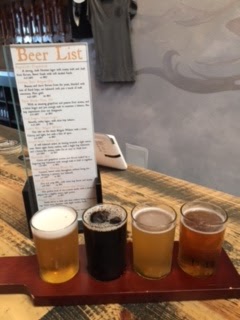
For beers, as the photo shows, I kept to a monochromatic selection, mainly due to the desert heat.  I also tried to stay with a session idea, ABVs between 5-6%, although I made an exception with the IPA it tried there (these descriptions are from their web site):   
  • Heatwave Amber:  Toasty malt character with a hint of caramel, this bee is slightly darker than your typical amber ale.  Generous amounts of Warrior hops provide the bitterness while Centennial and Chinook hops provide aroma.
  • Bloody Hot Summer (Seasonal):  Nothing beats this beer on a scorching hot day in the Coachella Valley.  We’ve infused a pale wheat ale with just the right amount of blood oranges, producing a fantastic thirst quenching beer.  This brew is seasonal, so it dries up with the temperatures drop!
  • Poolside Blonde:  A light maltiness provided by the Pilsner and Vienna malts.  Light straw in color, it has a moderately bitter finish.  A true palate cleansing ale.
  • Even Par IPA:  This India Pale Ale is brewed with three of the most sought-after hops in brewing – Citra, Simcoe, and Mosaic.  The result is an explosion of floral, tropical, and fruity flavors.  While this “aiming fluid” may not help you shoot even par, it will certainly make you feel like you did!

The Even Par IPA advertised an IBU of 85 based on the high alpha/aromatic qualities of that hop bill.  At Hawksbill, we designed our IPA to be around 55 IBU, significantly lower than this to emphasize our malt-forward style, but we do use Citra as part of the hop recipe.  Despite the added bitterness, theirs was refreshing and on-point, but ours held up by comparison as well; both meet the objectives of the requirement to have an IPA on tap.


After finishing my flight, I drove back to the neighborhood near the hotel for dinner.  I began to understand something about the community – Palm Springs and Palm Desert are winter playgrounds, but here I was, in the middle of it, in July.  At least after dinner, around 7:30, the temperature had already cooled off – to 106!

Friday, September 1, 2017

The Drive into the Desert

After visiting friends in San Diego, and visiting four breweries out of their 140-plus establishments, it was time for me to get on the road to my next stop, Palm Desert, which I’d planned to use as a base for a day-trip into Joshua Tree National Park.  As a bucket list item, I decided to drive along the eastern edge of the Salton Sea – I was rewarded with being able to check that one off my list, but I couldn’t call it a major highlight of the vacation.

The Taco Shop stop.
When I looked at my route, I discovered I’d be driving through Alpine, California, the location of that little brewery that Green Flash had bought.  I decided I might stop there for lunch and see if I could get a flight, but it was Monday and they weren’t open.  There was a little taco stand that reminded me of one I’d visited in Fresno, so I stopped there instead. 

I asked the lady behind the counter which she preferred – chicken or beef – the answer was beef.  Truth be told, I was a little afraid of potential digestive turmoil from the meal, but happily, there is nothing to report from this stage of the visit.

As it turns out, Monday was the day one of our brewery reports was due to the state, and I’d had some technical problems filing via their on-line system.  The representative called me while I was on the drive, just as I was getting out into the eastern part of San Diego County – the desert.  Signal was sparse, and I wasn’t able to reconnect for an hour or so; eventually we took care of this business and I was free to enjoy the rest of the drive.

The Salton Sea is a legend that is worth checking out – here is a Wikipedia link – I read about the boom and bust story in a National Geographic, so that’s how it got on my bucket list (which also included walking across the Golden Gate Bridge, and hiking to the summit of the Half Dome, both complete). 

The Roadrunner.
If you decide to make a trip like this, be advised that “visitor center” is something of a term of art in these public lands.  I'd planned to make a stop at the Sonny Bono visitor center, but it wasn't worth the stop the day I drove through.  In any case, the view from the highway was quite nice.  There are a few lingering campsites and state parks that provide plenty of better opportunities to check out the lake.

One incident that struck me as worthwhile to post – out there in the desert, there was a place where ICE had set up a detour requiring all vehicles to pull through for an agent inspection.  It’s isolated so there weren’t many cars on the road during my drive and I was the only one in the station when I arrived there.  The agent verbally challenged me, some mix of a greeting and an attempt to find out if I was illegal, but the old, six-five white guy who said he was on the way to Joshua Tree didn’t raise suspicions, and I drove on, through the date palm groves and other typical farms, eventually making it to the Palm Desert Hampton Inn.


Sometime during my Hampton stay, I encountered this road runner bird hanging around the pool – actually there were two of them.  Nature is everywhere.

Wednesday, August 30, 2017

San Diego Breweries - part 2

Continuing today with a couple of the breweries I visited in July during my Southern California vacation.  After spending Saturday evening with Mark and Nancy, my plan for Sunday was to look up Tony and Elizabeth, who live up in the north part of the city.  I mapped a route to their place and found two breweries on the way, with the plan to wrap up the second one and head directly to their house – even though our plans changed and we met in San Diego’s Little Italy instead.

Longship Flight and beer list.
My first stop was a new brewery, Longship Brewery, less than one-year old.  The brewery uses a Viking theme to emphasize their exploration with flavors and ingredients, and there is a lot of Viking paraphernalia around.  Like many of our Northern Virginia establishments, this one was located in an office park - it was a little hard to find, but they had plenty of space to operate a 20-barrel brewery.   

I tried a flight of four there, but enough time has passed that I don’t remember all of them.  I do remember two, however; in line with their spirit of exploration, they were two beers I might not have chosen otherwise (these descriptions are from their web page):

  • Funeral Pyre Smoked Porter – smokey and spiced, this dry porter has a sweet smoke aroma and flavor.  Like all our beers, the flavor is pronounced, but not overpowering.  Brewed with allspice, this porter is a unique blend of smoke, malt, and spice.
  • Topaz SMASH – this juicy, hazy IPA is our first expedition with the new Topaz hop.  With an amazing grapefruit and passion fruit aroma, and a bitter linger with just enough malt to maintain a balance, this hop experiment does not disappoint.

I wore my Hawksbill Hopyards polo shirt during these visits, and it was a conversation piece at both of the breweries I visited.  In San Diego, they acknowledge the brewery community whenever they have visitors from other operations.  At Longship, they gave me a tour of the place – and we spent a few minutes talking about the Topaz SMASH and why they tried it, acknowledging that it was a work in progress.

Tasting room at Green Flash San Diego
For my next stop, I had decided to make a stop at Green Flash Brewing.  Now that’s a recognizable name to Virginia craft beer fans, because Green Flash was one of the first California operations to open on the East Coast, in the Hampton Roads/Virginia Beach area.  Others have joined them now – Stone in Richmond is among the first to come to mind – it’s a topic I may have more to write about in the future, but for now we’ll get back to the Southern California vacation.

Scale of ops at Green Flash - 1 of 4 rows.
Like Longship, Green Flash is in an industrial park, but they have a much larger space, and they need it due to the scale of the operation.  There were several food trucks outside, and plentiful space for picnics.  The overall arrival experience reminded me of Kansas City’s Boulevard a few years ago (blog post here) – and I’m not even sure if I went in the main entry, as I had to navigate some corridors to get back to the tasting area.


Once I was inside, I took in all the offerings, which were plentiful; eventually I figured out that having 15 or more beers on tap was table stakes for all these breweries!  I made my selections for a flight of four, and settled in for the tasting.  My hopyards Polo came up in conversation again, and the tap room manager offered me their new East Coast IPA as a sample. 
The Green Flash flight -
coincidentally monochromatic.

There was a lot about the business to take in at Green Flash, maybe a few thoughts that we could take away and use to guide how Hawksbill Brewing will develop over the years.  
  1. There is a clear benefit from longevity, these 10-year-old plus breweries are all holding their own and expanding – if we make it that long, that might be an option for us.
  2. Green Flash bought Alpine Brewery, another operation in San Diego County, but they kept the recipes and branding separate – this is another expansion model that could come into play, should we be so lucky.  
  3. I was still not sure what to make of the fact that there are 140 breweries in San Diego (3-million population), and several of them have the same scale as Green Flash – that’s one brewery per 22,000 people (approximately Page County’s population), so maybe we got that part right, who knows?

Clearly, I was immersed in thinking about the business, but it was time to get on the road to meet Tony and Elizabeth.  I asked for my check, but found that I had received an industry comp.  That was a nice touch, Green Flash!

Monday, August 28, 2017

San Diego Breweries - part 1

Thorn Street Tap List
In the months since we opened Hawksbill Brewing, I’ve had a couple of road trips.  Now that I own a brewery, I’m taking the time to check out the local action in the places I visit.  Although I didn’t post on my May trip to Columbus, Ohio, there are 34 breweries there, and I went to four.

That’s an abundance of breweries, but it doesn’t compare to what’s happening in towns on the West Coast.  The industry continues to explode there, and even the brewery visits Mary and I made during our last Northern California vacation couldn’t prepare me for what I found in San Diego.  According to this list from San Diego.org, there are 140 breweries in San Diego county, give or take!

I knew that my friends Mark and Nancy had a couple of breweries within an easy walk of their place.  In fact, there was one right next door – Thorn St. Brewery, so after our catch-up conversation and the tour of their new place, we took a walk over to check the place out.  Dogs are welcome in a lot of these places, so we took Dax with us – he’s a good boy and knows the ropes.

As we arrived, there was a food truck outside, so we grabbed a bite and went in to find a place to sit, ending up in the back room where the brewery infrastructure is.  We paused to check out the offerings and put together a flight of eight to share – enough time has passed that I can’t remember all the selections, but I’m pretty sure the three below were included (descriptions from the brewery’s page):

  • Cocomotive Coconut Porter – This robust porter tastes like a fresh macaroon dipped in a delicious malty beer.  The base recipe is a smooth strong porter, slightly less roasty than a stout but with plenty of chocolate overtones.  Organic coconut is oven roasted and steeped in the finished beer.
  • Red Headed Hop Child – This west coast style is a complex blend of rich toasted malts whose sweetness pairs well with the citrus, pine, and tropical notes from the Centennial and Simcoe hops.
  • Thorn Street Pale Ale – A sessionable classic American Pale Ale that strikes a balance between its 2-row barley and caramel malts with the bitterness of the super high alpha acid Warrior hop.  Late addition of Cascade and an additional Cascade dry hop rounds it out very nicely.

Mark and Nancy live in the North Park neighborhood of San Diego.  It seemed to have been developed as an early 20th Century suburb, with many bungalow-style homes, some California contemporaries, garden apartments, and in-fills.  With so many breweries in town, it was an easy walk through the neighborhood to Modern Times North Park tasting room, where we enjoyed the scene and more beers (I'm pretty sure I had the Farmhouse Saison), before calling it an evening.

There’s one final takeaway from the too-short visit to North Park:  a few thoughts about neighborhood brewing from the Thorn St. web site.  They describe North Park as a neighborhood where “…folks pride themselves on walking or riding their bike to get locally produced food, where people devote large parts of their property to growing their own edibles, where people love gardening, fishing, and of course, brewing their own beers…Reduce your carbon footprint, eat local, buy local, produce something local, be self-sufficient as much as you can, smile, and please try to leave the world a little better than you found it…”


That’s not too far from what we’re trying to do at Hawksbill Brewing, come to think of it.

Wednesday, August 23, 2017

San Diego Arrival


After arriving at LAX, I drove down to San Diego with the goal of visiting friends.  I guess I’ve gotten to know the 405 and the 5 well enough by now to have my own landmarks along the way; one thing I was on the lookout for was an easily accessible In-and-Out Burger stand like the one I had visited a few years ago in Ontario.  I was successful, and even having a friendly little chat with a UCLA alum while waiting for our burgers didn’t hurt the experience of this pit stop!

Finally, I arrived in San Diego, and firmed up plans for the evening’s visit with Mark and Nancy.  They’ve appeared in the blog before, when they stopped by Hawksbill Cabin during their cross-country trip in their RV – there’s a post about their visit here.  Our goal was to reconnect, have some beers at one of the numerous local breweries in San Diego – but most importantly, to check out their very cool house, which Mark designed and they built over the last year or so.

We’ve been friends with Mark and Nancy for years – they lived in DC a long time ago before moving to Santa Barbara, and then five years ago they moved down to San Diego.  During that time, besides the cross-country trip, architecture, and personal training, they’ve been keeping busy doing real estate projects.  On this trip out, I got to visit them in the latest one, which I think showcases some excellent urban living design.

They found the lot by chance, it had been part of a three-lot parcel that had housed a service station.  The service station went out of business and the three lots were broken apart; this particular one was deep but only 25 feet wide.  They went through the process of deeding the property and then rezoning so that it would be reclassified to something where they could build a house – settling on mixed use commercial/residential.

The city required a 12-foot set back from the lot line, so that left them with 13 feet to build on – that’s where the urban design comes in.  They came up with a 2-bedroom, 2-bath home with excellent amenities and plentiful outdoor spaces to enjoy the wonderful San Diego weather.  Plus, they’re only a half block away from one of the many San Diego breweries – I’ll post on a few of them next time – and they overlook a thriving street scene.


Good design always gets me thinking about my own potential projects. While we may never do it, I’d love to rework the addition to Hawksbill Cabin, and if we did, I’d like to try and adapt the grade beam foundation approach they used in San Diego, and we might apply some of the same materials to the exterior.  I think they’re flexible enough to look good back here in the hollow, too!

Monday, August 21, 2017

July California Trip

Between the brewery and my day job, the pace of life these days seems to have conspired against my blogging hobby.  I’ve missed it, and although I don’t think I can get back into the habit of posting as often as I used to – eight to 12 times per month – I do intend to make a go of getting a few posts up a month, maybe along the lines of four to six times per month.  I still want to write up all the excitement of those last few months of getting the brewery up and running, and that will come, but for now I thought I might start with a few posts about the Southern California trip I did back in July…so here goes.

Orth, with coffee (repositioned to hide
the abundant intellectual property).
Mary and I had been planning for this year’s vacation to be centered around a talk I was invited to give at USC, during the 40th anniversary celebration for the MBA program I attended there.  The USC portion of the trip was certainly a highlight, but it came at the end of the trip, so those posts will come up later in this tale.   There’s one other caveat I need to add:  due to a last-minute family logistics issue, Mary wasn’t able to join me for this week-long adventure – I wish we had been able to work this out, because these experiences are some I would have loved to share with her.

The itinerary I’d planned involved was a three-legged journey.  After flying in to LAX, I would drive down to San Diego for a few days, then head out to Palm Desert to tour Joshua Tree National Park, and finally come back to LA for the USC event.  These chronological posts will follow that itinerary.

One of the friends I’d planned to check in with in San Diego was my Air Force buddy, Tony.  He and his wife Elizabeth are scientists out there, and have been working in the field for nearly 20 years.  At first, we planned to meet at their house for a cook-out, but they offered an alternative to meet in San Diego’s Little Italy District (who knew there was one in San Diego?), so we had a wonderful dinner catching up on life’s events. 

They have two kids who are growing up too fast, and one of them just graduated from high school.  Mary and I had sent a gift, and during part of the evening I was given a thank you card – well, I’ve inherited my grandfather’s old habit of tearing up at any event like this, and that instinct didn’t let me down when I read the card.

The next day, I’d planned to get on the road over to Palm Desert, but Tony suggested I come by to see his work place in La Jolla – it was on the way, so that was a no-brainer.  We toured the lab where he works, and I learned a little bit about the science they’re doing, along with some of the methods. 

Over coffee, he invited a colleague of his down.  It turns out this colleague had done some work around brewer’s yeast, and not only that – he’s an award-winning brewer.  We spent some time talking about a scientific paper they’d done on the topic, which was very educational and rewarding for me. 

Soon enough, I took my leave and was on my way to Palm Desert.  I’ll get to that part of the trip next week, but my next post will go back to day one, to close the loop on those activities.