Ramble On

Monday, May 4, 2015

@hawksbillhops - Final Prep Day

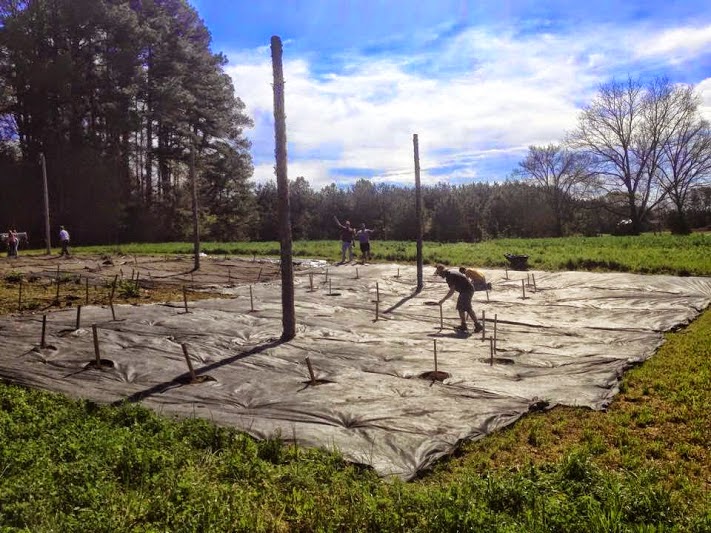
The view from the hoop house - where the raspberries grow!
On Wednesday afternoon I received a text message from David with some photos - he and Eric had completed the trellis and now everything was set for planting.  This thing was all set to come off!


I had made plans to be at the farm on Friday to help with final preparation for our planting event on May 2.  Of course there was a drenching spring rain on Thursday, giving us one more thing to worry about - would the ground be too wet to plant, or too muddy to let people out there in anything but boots?


Like he has done several times already on this journey, David reassured me that that time would be on our side, and things would take care of themselves.  There's an old saying, "Luck is where preparation meets opportunity" - maybe Hawskbill Hop Yards is going to be a case study for that one.
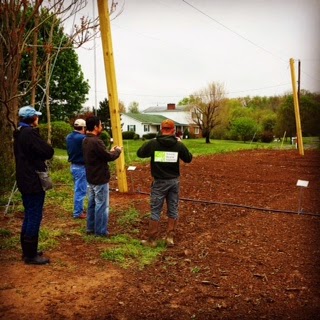
The field visit with VT.

One of several reasons we planned to meet on Friday morning was an expected meeting with some folks from Virginia Tech - since hops are still a nascent crop in Virginia, albeit a fast growing one with an increasing number of farms every year, this team wanted to come by and have a look at our set up.


We met for about an hour talking about the crop and about the experiences we're already hearing about from the other farmers, comparing hops to grapes as a crop - getting down to the science of the plants, and confirming or developing strategies for dealing with known threats, such as mildews and pests.

We're not shy about the fact that we're not going to be organic on this farm, it seems the crop is too susceptible to issues once you get to this scale (we'll have 800 plants on one acre this year), so we have a number of strategies all set for fungicides and pesticides which we will use at the appearance of these threats (although in the case of the mildews, we're going to be proactive).

A final look at our preparations - ready to plant!

Following a lunch break, I came back to the farm, and worked with David to mark out the rows.  We planned to put the plants on 3-foot centers; we ended up with 13 rows and we can have up to 66 plants per row.  One row was to be left empty bordering the two rows of the CTZ, to provide air flow on both sides of those, and we put the Goldings on the far west row so it has air as well (both are mildew susceptible).  

So with all the rows marked out, all we had left to do was double check our logistics, hope that heavy rains would hold off, and send out a final note about the field.

On Saturday, May 2, we'd put in the 800 plants and at last we'd be a hop yard!

Friday, May 1, 2015

The @HawksbillHops Press Release

This post is going up on May 1, which - whatever the weather holds - is the day before we're planning to have a rhizomes planting event at the farm.  While we're all (hopefully) looking forward to enjoying our day, I thought I might go ahead and put up the text of our first press release, which went out last week.  It follows:


Press Release

April 28, 2015
FOR IMMEDIATE RELEASE

LURAY HOPS FARM WILL SERVE VIRGINIA’S GROWING CRAFT BEER INDUSTRY

Following the growth of Virginia’s craft beer industry to include more than 100 breweries across the state, and an emerging interest in the use of locally-grown ingredients, Page County is also joining the trend with the establishment of Hawksbill Hop Yards LLC, a two-acre hops farm starting up just north of Luray. 

Hops are an essential ingredient in beer, and the growing interest in craft brewing has led to a surge in demand for them.  According to a Wikipedia article about hops, “They are the female flowers … of the hop plant, Humulus lupulis.  They are used primarily as a flavoring and stability agent in beer, to which they impart a bitter, tangy flavor, though hops are also used for various purposes in other beverages and herbal medicine.”

Hawksbill Hop Yards LLC has leased two acres from Public House Produce and has plans to establish 800 plants during the spring of 2015.  Activities completed or underway include preparing the ground and building the 16-foot tall trellis.  Also, on May 2, the farm plans to hold a volunteer spring planting event to establish the rhizomes, which will include six varieties of hops:  Cascade, Centennial, Chinook, CTZ, Fuggles, and Goldings.

Founder Jim Turner, also known by his Twitter handle “Cabin Jim,” said, “There’s already a vibrant community of brewers in Page County, and some of them even grow their own hops in their gardens.  I took some inspiration from that and looked for ways to bring an innovative commercial crop to the community, something that would serve to plug us in to a statewide trend.”

He added that a commercial hop yard may be just the first step to other craft brewing ventures in Page County, which could include anything from essential processing and distribution activities to the actual establishment of a craft brewery.  “There’s a lot of interest in having a local brewery in Page County,” Turner said, “and now that we have a hops grower here, it would be great to see some energy focused on building a local customer for our hops!”

For further information, contact Jim Turner via email at HawksbillHops@gmail.com, or by cell phone at (703) 981-XXXX; one can also follow the hops yard on Twitter at @HawksbillHops.

-30-  

In Which @hawksbillhops Makes the Local News

The Harrisonburg TV station WHSV came out for interviews earlier this week, and then posted a story on Wednesday afternoon - there is a link here:

http://www.whsv.com/home/headlines/Hops-Yard-Opening-in-Page-County-301741191.html

Now, in case sometime in the future, the video isn't available anymore, here is the short article that accompanied the video footage, written by Emily Sporn:

PAGE COUNTY, Va. (WHSV) -- Page County is taking a step toward expanding its agritourism.
Hawksbill Hop Yards will soon be growing crops to bring more business to the Valley.
The new hops yard is located on Liberty Bell Lane in Page County.
The farm will soon have 800 small rhizomes in it.
Jim Turner and David Sours met at a farmers market. Turner, a project manager from Alexandria, and Sours, a farmer who owns Public House Produce in Luray, are now going into business together.
They're using their combined skills in marketing and farming to build a hops yard in the Valley.
They also hope to bring more agritourism to Page County.
Starting out their first year, with one acre of land, they eventually hope to expand their production to 10 acres.
"Agriculture is the number one industry in Page County. It's who we are. So I think any advance, or diversification in agriculture is low-hanging fruit, said Sours. "So this could be an opportunity for economic development and job creation within the county."
Hawksbill Hops hopes to partner with Valley breweries once its crop has grown.

Tuesday, April 28, 2015

More Saturday Progress @HawksbillHops

This is Delilah, who supervised me while I was
goofing off in the barn.
With Eric and David making their way about the trellis, I was given an assignment to tinker a bit with some of the irrigation connections.  It wasn't challenging intellectually or physically, but it was my first time so I spent a few minutes on the learning curve, to ensure I didn't mess things up.

This involved a trip to the barn, where David's goats Delilah and Buttercup have a stall.  They were very curious about what I was doing there, so I went over to pay them a visit.

Then it was back to the task at hand.  I was going to make connections between some of the black 1-inch hose and the blue 3-inch lay-flat.  Accessories required for the assignment included a blowtorch, petroleum jelly, rubber cement, a flat head screwdriver, and a socket wrench.

Thinking back on it, I think I went to some USAF parties that required the same accessories.

Here's one of the valves I connected to the supply lines.
The route from the well over to the hop yards is a couple of hundred yards, with five or six 90-degree turns.  These bends also happen to be where the water will flow through the lay-flat and then transition to the black pipe, so those were the connections I was putting together.  Kind of glad to have an opportunity to build a part of the whole thing.

Meanwhile, David and Eric were really making hay stringing cable.  They managed to get all of the cross runs done, and got three of the lengthwise interior cables in place and connected on the north end.  After they connect these to the south end and take the slack out, there are only six more cables to run and the trellis will be finished.

Meanwhile, David and Eric continued their work
on the trellis.


That's great news - it means that if the weather holds, we'll have a completed trellis by the time of our planting event on Saturday May 2.  Hoping to see a few of my followers there...starts at 9am and the hop  yard is across the street from Public House Produce (click on the link for the address).  


Monday, April 27, 2015

Saturday Work Day @HawksbillHops

On Saturday I had planned to get an early start and drive out to the hop yard to see where I could contribute something more than just talk.  I rolled in at a few minutes after 9am, just as things were getting started.  Logistics being what they were, I had asked a few questions on my way in, e.g., 

  • Should I bring my muck boots?
  • Would you like some donuts?
Apparently, when you are going to work on the farm in the morning, question one will get you a sideways look and subject you to constant scrutiny for the remainder of the day, despite the infallible logic of asking good questions in the first place.  In my case, with regard to the first question, this was completely unmerited since (1) I was wearing boots, (2) I was really asking about how much rain we'd had, as any farmer might, and (3) if it was too wet, I wanted to be in my muck boots because they are easier to clean.
 
Here's a pano of the hop yard condition on Saturday morning, after the donut run.
Now, as far as the second question goes, I asked it purely rhetorically, with every intention of picking up some donuts from Luray's famous Fairview Grocery, where they make them fresh every Saturday morning.  The real problem was, since I was running a few minutes late, rather than making the detour on the way and risk being even more tardy, I went straight to the farm to check in first.

It turns out I was in a no-win situation - I was in for ridicule for asking if they wanted donuts in the first place, which I could have made up for by bringing the donuts; or I could arrive late, which would only confirm the unfounded prejudice about city folks' punctuality, although the presence of donuts might have offset some of this ire.  Individualist that I am, I chose a third path, to both arrive late and without donuts - I figured that if you are in for abuse, it really doesn't matter how much of it there is.    

I quickly developed a mitigation plan, in any case.  As soon as I arrived, I checked in and then asked, "Well, what kind of donuts do you like?  I'll go get them now."  It was the perfect recovery, allowing my colleagues to quickly move on to other observations about my capabilities and performance.   
.
By the start of Saturday, all of the poles were guyed and the perimeter cables were strung - David and Eric were going to move on to the connector cables between the poles, and if time permitted, they were going to string some of the matrix cables, which run above the rows between the poles.

Meanwhile David had a few tasks lined up for me as well - I'll put them up in the next post from the hop yard.

Thursday, April 23, 2015

Looking Ahead - Hops Growing Season

I liked the photo that David sent along the other day - it shows him and Eric up in the lift running the cables between the poles of our trellis.  The long runs will connect all of the posts, and essentially will complete the structure of the trellis.  Along with the irrigation system and all the work that has gone into preparing the field, we'll finally arrive at our next stage, which will be to plant the hops rhizomes (in my post on Monday, I wrote about their arrival last week).  

So we're just about all set to get started with this thing, and just as David and Eric seem to be looking ahead from the trellis, our thoughts need to move on to what's next - how to take care of the plants once they're planted, and what happens between now and the summer solstice.  For that, I took a look back at one of the spring photos from Dan's hop yard, after he had gotten finished with his spring cleaning.


Dan had strung twine from the top wires down to each of the hops crowns in his garden, and that is essentially what we will need to do after we have the rhizomes planted.  So my work on the project this week was to learn how this is done at our small but commercial scale, and then source the twine and other materials that we will need for this stage of the project.

At the conference last month we talked about some of the equipment and supplies that are needed.  I wrote back to one of my colleagues and he pointed me to Growers Supply in Washington state - I was able to identify my requirements for the coir twine we will use, the clips that fasten the twine to the ground, and a tool that is designed especially for that purpose, and I placed an order for this stuff.  

What I still hadn't figured out was how all of that process works.  So I wrote another grower colleague, and also made a query to the folks at Grower's Supply - and they sent me a link to the video below, which provides a demonstration of the tying process at a large farm in the PNW.  The workers are quite skilled and can really move through the farm at a pace we'll never achieve, but at least this gives a solid overview of what we have to do!  

With that stage of planning done, now we'll move on to getting ready for our planting event on May 2.  I hope that some of my readers can join us!  Leave a comment if you would like directions!


Wednesday, April 22, 2015

First Guyed Trellis Poles

On Saturday I drove over to Hawksbill Hop Yards to check in on how the construction of our trellis was going.  Earlier last week, David and Eric, both in the first photo here, had set the poles up.  Now the work moves on to getting the cables strung to support the hops when they start growing.

We've used some guidelines we found on the University of Vermont web site for a lot of our design and concepts, with some insight drawn from the hops conference I went to in March and through networking with the other Virginia growers.  So we chose 5/16" steel cable for much of the support, and the first step in the installation is to get these poles on the outside of the trellis matrix set with guy wires.


The corner ones will have two wires, one on the north-south axis and one on the east-west axis.  The middle poles, such as the one shown here, will only have one wire on either the north-south or east-west.  

They had a great weather day for this work and managed to set all the anchors.  It was something of a learning process for the cabling part, but with two down, we're on our way to getting the whole shebang strung!

Monday, April 20, 2015

Hopyard in a Sack

The bag of Cascade rhizomes.
Over the last two weeks or so I've been posting a lot about our progress building Hawksbill Hop Yards out in Luray.  I am very excited about the prospect, and really appreciate the enthusiastic feedback we're getting from around town.

However, I will take a break today from posting about the construction - I have a post coming along for later in the week - and will talk for a minute about something that is just as important: the hops plants themselves.  The rhizomes arrived in two shipments, from two suppliers, last Friday, and they are comfortably resting in their dormancy in the cooler at Public House Produce.

Partial shipment of Cascade, Chinook, and Goldings.
In a post last week, I mentioned the planting schedule of varieties:


  • 300 Cascade
  • 180 Chinook
  • 150 Columbus
  • 50 Fuggles
  • 120 Goldings
It turns out, we weren't able to get the full order of Goldings, so I only have 70.  Due to this, I think I am going to take Dan up on the offer of 30 Centennials, and make a row with the extra Columbus (I'm planning for the rows to be 60 plants, although we have room for 66).  I'll just split a row between those two varieties, leaving enough space so that they do not entwine at the top of the trellis.

The CTZ Hops.
Note on the bag that this variety is labeled "CTZ" - this is what was shipped instead of "Columbus."  When it was first brought to market, the Columbus hops were called "Tomahawk," and subsequently a third variety called Zeus was identified as being similar to them both, if not genetically identical.  In any case, here in Virginia, I've heard that people have mixed results with them, so they are more of an experiment at Hawksbill Hop Yards.

Just as the Goldings are, by the way.  I really hope that we can make a go with all the varieties, but especially the Goldings.  We'd be unique with them if we can get them to grow and produce!

Friday, April 17, 2015

More Trellising

Seems like every day I am getting some very interesting text messages with incredible photos attached, as the farm team continues to build the trellis for Hawksbill Hop Yards.  Yesterday was no different, as

David sent along some shots of Eric and himself doing some final prep work on our poles.  We started with 20' 6x6 treated pine posts, which are set 4' in the ground, leaving our system at around 16' tall.

However, when some of the posts were set, we encountered stone part way down, so the guys had to go up and level them off with a chain saw. The photo here shows the measuring part of the action.

Now a word about the rig they are using for this operation.  It is made from a recycled caged water container - an ingenious idea that was sourced from the excellent series of how-to videos put together by the University of Vermont.  It has been constructed so that it can be raised on the fork lift attachment to the tractor (here's a highlight video of that tractor in "creep" mode).

Yesterday the first 600 of our rhizomes arrived as well, by way of Stan from HootnHollerHops, and the remaining 200 are coming in today via UPS from Wisconsin.  So it won't be long now until we need to start planting, once the cabling is installed on the trellis.

A reminder that our rhizome planting event is set for 5/2/2015 - we could use the volunteer help, so leave a comment if you're interested and I'll send the details.

Wednesday, April 15, 2015

The Backyard Willamette

Two weeks ago, in this post, I was just beginning to consider how my backyard hops were faring.  I have a potted Willamette, which is the subject of photos today and in that previous post, as well as two potted Goldings.

While the Goldings are in a spot that doesn't get good sun until just about now, the Willamette is further out in the yard and the shade from the house retreats early.  So there is early growth from that plant, which happens to be three years old - it should be in full yield mode this harvest.

Last year we got a couple of ounces of fresh hops from it - the trellis situation is not optimal since we have a fairly low power line nearby, and I don't let it grow over seven feet - hops optimally want to get above 15 feet or so, but we just can't do it here.  The Goldings are in a spot where I can grow them to ten feet.

I pruned the Willamette back to just five or six of those shoots on Sunday afternoon, and I strung some jute twine for it to begin climbing.  I fell like it's too early to be at this stage already, but the plant is doing really well and I'm going to let it run.  The plant will grow vertically until the summer equinox, and then it will begin pushing out side branches before it flowers.

The three potted hops plants were part of my pilot for the Hawksbill Hop Yards venture - one of three experiments with growing that have resulted in the project out in Luray.  Now we're up to 800 plants there...with a plan to go to 1,600 next year.  Maybe we bit off more than we can chew - sometimes I wonder!

Tuesday, April 14, 2015

Hops Trellis Update

Setting a trellis pole.
Yesterday I wrote a short post about a hop yard in New Jersey after being alerted to it from one of my Google+ friends.  There they are using a central pole technique to grow about 90 plants that will serve local brewers who are part of their club - it is a great example of community supported agriculture, and I was glad to learn about it.

Of course, I set out on my own journey this year to grow hops commercially.  I have a great partner on the farm (Public House Produce - click on the link for more details about David and his efforts) - which we're calling Hawksbill Hop Yards.  And it's not ironic at all that on the same day I wrote that other post I would get news from my own team that they set poles for our new trellising last night!
Arrival of the poles in the field.


They were working near dusk so I've applied Instagram filters to these to bring out the action.  We are using a matrix system for the trellis, which consists of poles with cable stretched between them crosswise and lengthwise in the field.  We'll have 12 rows of 60-70 plants in a field that is just about one square acre in area - and we have plans to duplicate that field for next year.

This caught me by surprise, because David said they'd planned to spend the day putting in broccoli and onions yesterday.  He told me that they set 5,000 onions yesterday, and 1,200 broccoli plants - all that before they went to work on the trellis!


Moving into position - don't try this at home!
Meanwhile there is other progress to report.  I'm getting emails from both of my commercial suppliers that our initial rhizome orders are in - since we pulled the trigger on building a full acre trellis, I need to add some - so we should see the rhizomes begin to arrive at the farm soon, in time for our 5/2/2015 planting event.

I think I have this right - the final schedule of our rhizomes by variety:


  • 300 Cascade
  • 180 Chinook
  • 120 Columbus
  • 50 Fuggles
  • 120 Goldings


Parting shot, with the poles in position.

I have 30 extra Columbus, and Neighbor Dan has offered me up to 30 Centennial, depending on if they fit into the rows I may add them.  If not, we may just find some open ground and plant them for a year, then move them into the new ground next year.

Next step for the crew on the farm will be to begin stringing cable.  Rain has come in, so this work may wait a few days - and there is always something else to do now that planting season is here!


Monday, April 13, 2015

Alternative Styles of Hop Yards

In one of the communities I follow over on Google+, I came across this photo of a hop yard in New Jersey.  My connection Brad (this is his photo) was highlighting the addition of two new poles, for a total of six poles, which are surrounded by a circle of 15 plants each.

The land is on a hillside, part of a county-owned farm there.  Brad says they are growing Cascade, Chinook, Nugget, and Mt. Hood, although there may be one more variety in the mix.  Most of the production will go to brewing club members.

When we were first conceptualizing Hawksbill Hop Yards, we considered this traditional arrangement of the plants.  You can get pretty good density with this approach, which would allow you to get to commercial production levels.  However, once we started having a look at the scale we were going for - a full acre with expansion to a second acre, this arrangement didn't work anymore, since it would make laying the irrigation system difficult, and operating machines in there would be a challenge.

The other system we looked at, but didn't adopt, is the in-line system shown in the photo of a model one of the vendors brought to the hops conference in North Carolina last month.  Neighbor Dan also uses this type of system in his hop yard, supporting his Beaver Run Brewery operation.  This approach simplifies the irrigation and equipment problems, but it is costly if you don't have a ready and cheap supply of poles - because you are using poles on every row to support the trellis cables.  

Our system, which I'll be showing off soon - we're digging holes for the poles right now- is a matrix, with poles every four rows.  The system is stabilized through the combination of lengthwise and crosswise cables that are all anchored on the exterior.

In any of these arrangements, despite the challenges each presents, a hops farmer can get densities of up to 1,000 plants per acre.  We're planting Hawksbill Hop Yards on a less dense approach, since we're in a learning stage and don't want to add stress to the plants.

I could be convinced to put in a couple of central pole set-ups, but they would be for non-production plants.  We could use them for rhizome cultivation, educational outreach, or ceremonially.  I like the looks of it, so I'll keep it in mind.

Wednesday, April 8, 2015

My Hops Mentor


For frequent readers, there's no secret about my main inspiration for starting Hawksbill Hop Yards:  my neighbor Dan's small hop yard that supplies his "Beaver Run Brewery" endeavor.  Dan keeps between 20 and 30 plants up there - and he has seven or eight varieties.

Part of his property includes a two-acre forest of cedars that grow straight and tall, which are the source of some of his poles.  The lines are strung at 10 feet so he can reach them with a ladder, and since many of these plants are more than five years old, they yield quite well.  By the end of May, they'll have reached the top of the trellis

While Mary and I were at the vineyard on Saturday, Dan texted that he was working out in the hop yard cleaning up and stringing for this year's growing season.  I stopped by on Sunday to have a look - everything is neat and clean, and many of the hills are already sprouting growth.  This one here has some sprouts that look ready to take off, even though it is only April.

Looks like it will be a solid year for him and Beaver Run Brewery!

Monday, April 6, 2015

Spring at Last


Mary and I trekked out to Hawksbill Cabin looking forward at last to a weekend where the temps are getting up to spring time altitude.  Since I was out last weekend, I'd had a glimpse of what to expect, even though the temperatures had gotten into the teens (!) last weekend.

I knew, for example, that our daffodils would likely be in bloom - except for the ones the deer dug up, that is - and of course, the forsythia was ready to bust out.  It certainly did not disappoint.

Along with a couple of spring errands, we were able to meet up with old friends at the vineyard, where we took a group walk out to Little Hawksbill Creek.  It was great to see everyone coming out of hibernation - there's a lot to look forward to in these parts this year.

We also decided to head over to the Mimslyn for their deluxe brunch on Easter Sunday.  It's almost exactly what you might expect for a small Virginia town: everyone coming out in their fine clothes, ladies with hats - and the feast was very good.  We enjoyed some lamb and roast beef (we skipped the ham, in honor of Kevin Bacon, lol).

Afterwards, back at Hawksbill Cabin, Mary made some calls to the New Jersey family while I came out to the brick terrace to write some blog posts.  I wanted something appropriate to the season for background music, and found just what I wanted deep in the CD box:  Copland's Appalachian Spring.  Then I set to post, with that composition and the peepers in the background.

Friday, April 3, 2015

Here and There Hops


David texted the other night with an update on progress at Hawksbill Hop Yards - most of the materials for the trellis has been ordered, and the field is now staked to mark out where the installation will happen.  We'll take a look at everything this weekend to check it out.

On that account, the poles have arrived at the co-op and they're being stored on the trailer, so all that has to be done is to go pick them up.  We're waiting for the other supplies to arrive to consolidated trips.

Also, with spring arriving, I am keeping an eye on the three "crowns" I have in my backyard in Alexandria - two Goldings and a Willamette.  The photo here is the Willamette - you can see a half dozen or more little red shoots coming up on this plant, which is now getting started on its third year.

Both of the Goldings plants also have shoots, but not nearly so many.  They are in a shadier spot in the backyard so they'll just run a little later.

One of the Goldings is also three years old, but was damaged during transplanting last year so it didn't do very well - hopefully it has recovered this year.  The other plant was in its first year last year, so this will be the year to see good bine growth and maybe some cones.

Everything needs fertilizer - the soil probably needs a pH treatment as well.  I'll get right on that.

Tuesday, March 31, 2015

Hawksbill Hop Yards - Location Hint

While we have been making solid progress on the hop  yards these last few months, we haven't exactly let on yet where it is located.  On Saturday afternoon I took a drive over to get a photo of the yards from a distance - to give a bit more of a locational perspective.

In the photo here, the yards is the cleared area in the middle ground.  That's Kennedy Peak on the Massanutten ridge in the background.  Of course, we are just north of Luray and probably about a mile from the Caverns.

That's about all we're prepared to reveal for now, but there will be more news soon enough.

On another note, David told me that our irrigation is in last week - we posted some photos of that as well.  Last weekend the temps dipped to 19 degrees - quite a surprise for March, by the way - so he turned the water on at a trickle overnight to protect the set-up.

The pretty little icy scene at right was the result, but everything was fine overnight.

I hope our friends at Wisteria fared as well in the frost - I'll get by to check in with them next weekend.


Monday, March 30, 2015

A Visit to Atlas Brew Works

After taking care of a little business at Hawksbill Hop Yards this weekend - more on that tomorrow - I came back to Alexandria early to join Mary at a birthday happy hour for our friend Kathy over at Atlas Brew Works, in SE DC.  This was to be my first visit at this brewery, web site here, and I was looking forward to it.    

Thanks to Siri's directions, we arrived with almost no hitches, although the convenient location of this brewery makes it easy enough to find.  They'd set up a little party area for us off to the side of the bar in the tasting area - some snacks, and quick and easy access to the taps.

For myself, I had the Rowdy, described as a hop forward Rye at 6.2%.  Checking the ingredients - I see Bravo, Zythos, and Centennial hops...Bravo is a high alpha bittering hops and is probably the biggest contributor to the hoppiness of this beer, while Zythos and Centennial are more medium alpha varieties, complementing the Bravo for flavor and less bitterness.  Of course, the rye malt offsets some of the alpha strength of the combo.

I have to admit, now that the hop yards is in progress, I am paying more attention to the ingredients and brewing craft in these breweries.  In fact, I did a quick scan of the list of hops on the menu and didn't see any of Hawksbill Hop Yards varieties - and thought to myself that maybe from now on every brewery visit will become market research.  Such is life.


The brewery is housed in an old industrial building, where they have made good use of the loading dock and open warehouse space for the 40BBL brewery and supporting functions.  This was probably the 10th brewery I've visited since last May (the Northern California Beer Pilgrimage/Marathon, as Mary likes to call it) - so I'm getting to know my way around.  We had a great time checking things out.

And the beer was really good, so it will be one I keep an eye out for when we're out and about, especially since they've recently gotten distribution into Virginia.  It was a nice affair for Kathy's birthday - a great idea for a place to celebrate, and a great way to conclude the weekend.

Friday, March 27, 2015

Spring and Hops

Last weekend we made it back our to Hawksbill Cabin for the first time in a few weeks.  Along with errands, high on our list of things to do was a stop at the Hop Yards.

Our field has come a long way since we first began this project in January - Mary and David are in the cleared field in the first photo, but back in January, it was a lot different when Dan and David walked along the road in front of it (link here).


The other big development for the weekend was the arrival of irrigation to the field - David put in a few hours Saturday to connect it up.  Hops need water, and now we have the source and distribution.

I guess all we need now is a trellis.  And some hops.

Thursday, March 26, 2015

Black Helicopters at SBUX

Yesterday morning as I was walking over to my neighborhood Starbucks in Bethesda, I heard the sound of approaching helicopters.  Because of our perch on the palisades over the Potomac, it's not unusual to have a executive sortie flyby, or even larger, squadron-sized groups pass overhead using the river as a navigation guide.

What struck me about these three are the large auxiliary fuel tanks they were carrying - obviously they were setting out on a long range voyage.

I decided to make the rest of the day tactical as a result.  I think I was a success.

Tuesday, March 24, 2015

First Spring Visit to Wisteria

The vines are gathering their strength for the year.  The
mountain behind is in Shenandoah National Park.
There was still a crisp edge to the spring mornings this weekend, but both days were sunny and pleasant.  On Sunday after a few errands we decided to make a stop by our neighbors Sue and Moussa at Wisteria Vineyards - we had a wine club selection to pick up, and we decided we might make a picnic lunch to enjoy there for a break.

We learned that a photographer had been around researching a shoot later that day, and Sue invited us back in the afternoon so that there would be a few people around in case he needed subjects in the photos.  So we took care of a few more errands and returned, just as the sunlight was turning golden, low in the sky.  I took advantage of it myself for the Instagram photos accompanying this post.

The sheep were a little perturbed by all the people in the pasture,
but they got over it once they made their way to the rations.


There was a good crowd of old friends and acquaintances when we arrived at around 5:30, and the photographer was out in the fields setting up his location.  Just then the sun hit a perfect angle, bathing the entire scene in a golden light, and ten or so of us headed out for the shoot.

Wisteria features a charming little road that runs through the vineyard to Little Hawksbill Creek.  It dips and rises over uneven ground and is marked off from the vines with a plank fence made from cedars that were cleared from the property.  This formed the setting for the photography.

After a few minutes of waiting, the sun was exactly right, and the photographer called us to walk down the road in pairs and threes.

We had a preview of some of the shots - there's no doubt he has a publishable one in the mix.  The results of his work are due to appear in Wine Speculator in June, and some of the other Valley venues will be there, too.  He said he'd likely take in DuCard over in Sperryville and the Copper Fox Distillery in order to complement the work he'd done at Wisteria.

Just another Valley weekend though, when you get down to it - there's always a pleasant adventure out there if you keep your eyes open for it!

Friday, March 20, 2015

Hawksbill Hop Yards - Progress Report

There is a lot going on at the hop yards these days - David sent along a report on Thursday evening showing the clear ground.  That's just about the end of our current stage of activities, just a couple of steps to go - rolling a disc through the soil to break it up, and then soil amendments.

To get that part right, we'll be looking at pH, which should be between 6.0 and 6.5 - and if needed we'll boost with lime.  For potassium and phosphorous, he plans to spread chicken litter.  Of course, N is important as well, especially for hops, and that is the final one of the "big three" we'll be getting a look at.

To be sure we get it right, there have been a few conversations with the extension agent.  There's good interest from the state in this crop and we know they will be there to support.

In the first photo above, the view is looking at the yards from the northwest - in the background, you can see the Blue Ridge in Shenandoah National Park.  The second peak from the right is Hawksbill Mountain, the highest point in the park, and the namesake of the hop yards - also the namesake of a bunch of other stuff in Page County and Luray!

The second photo was taken a few days ago, just after the clocks were adjusted forward.  With the extra daylight, David took a photo in the fields at dusk.  In addition to the hop yards, this new ground is going to be planted with more of those wonderful Public House Produce vegetables - and that's something we can all look forward to!

Summer's not far away at all, people!

Monday, March 16, 2015

The NC-VA Regional Hops Conference

Photo of the sold-out crowd on Saturday, yours truly visible in
the light blue shirt to the far right.
This weekend I was at the first ever hops growers' conference, put on by NC State University down in Winston-Salem.  The conference was the finale of a four year hops research and extension project - much of the knowledge gained is on the web at this link.

There was a Friday session for beginning growers - that one certainly attracted my attention; and a Saturday session that went into more detail.  I ended up attending both sessions, which provided an opportunity to meet with a couple of the folks from the Old Dominion Hops Co-operative, but also Facebook friend Marty, who was stationed in Berlin when I was there and went on to complete a very successful USAF career before settling into the Piedmont area of NC, convenient to the location of the conference.

Among the topics covered were:


Sponsorships rounded out the experience, with several of the sponsors providing displays including the one above, of an in-line trellis system.  These folks included Fertrell, The Lupulin Exchange, Sierra Nevada, Cumberland Sales Company, Haas, NCSU, Blue Mountain Brewery, Fullsteam Brewery, Hoot'n Holler Hops, and the Old Dominion Hops Co-op.

There was plenty to learn and I'll probably be spending the next two weeks trying to assimilate it all.  Meanwhile, next weekend will be my first trip back to Hawksbill Hop Yards since the log chopping visit of a few weeks back.  I'll check in with David to see how the clearing is going - and to plan for a few of our spring milestones, including planting!

Tuesday, March 10, 2015

"Relax, and Have a Home Brew" - Advice for Beginner Brewers


Three or four times now I've been asked by friends and acquaintances for advice about how to get started home brewing.  Now, I've only been doing this myself for four years, so I'm still very much a newbie - but I'm humbled by the requests, and glad to offer my insights to help get other enthusiasts started.  So today's post is a snippet of the advice I typically give on the topic.

My journey started with sitting sidesaddle with a couple of more experienced brewers - namely neighbor Dan and my friends Brendan and Stan.  After watching them, and helping them, with a batch each, I moved on to doing a series of one-gallon small batches, with the goal of progressing through all the steps on my own so I would know if I liked it well enough to progress to larger batches.

Here's a page with one gallon kits, as an example:

One Gallon Beer Kits

I ended up doing five one gallon batches (mostly from Brooklyn Brew Shop, which is represented on the page above along with others), so I really began to understand the process.  It underscored the importance of cleaning an sanitation, which should be drilled into everyone's head as often as possible when starting out.  Also, in reality, one gallon ends up taking the same amount of time as five gallons due to the accessory chores, which is another reason it's good to start small.

From there, I moved up to a five gallon set up.  I bought mine at a local home brew shop in Falls Church, Virginia, but there are tons of other resources for this, including two vendors I often use for ingredients:

http://www.northernbrewer.com (I tend to go to this one first)
http://www.midwestsupplies.com

Both of these have starter sets of all the equipment you need for a 5 gallon brew.

As a home brewer builds experience, there are two additional things he or she can look into: joining a local home brew club, and investing in some recipe books.  On the local home brew club, I'm a member of Blue Ridge Brewers Association, which meets in Luray (there's a link to the blog in my blog list on the right).  We meet three or four times a year to exchange information of interest to the brewers, to share recipes, and to do tastings of whatever new batches that our brewers bring along.

For recipe books, there are several I can recommend - with Amazon links below:


  • Anything by Charlie Papazian is a good read.  I quoted him in the title of this post - "Relax, and have a home brew." You can find older editions with plenty of references to the 1970's, which are a hoot, but here's a more recent one: 

The Complete Joy of Homebrewing Fourth Edition: Fully Revised and Updated


  • Also, there are tons of good recipe books, such as "Designing Great Beers" by Ray Daniels, or Dave Miller's "Homebrewing Guide."


  • Finally, if the hobby leads you to totally geek out, as it has for me, now that I am starting Hawksbill Hop Yards, you can dig into specific ingredients by checking out books like "For the Love of Hops" by Stan Hieronymus.  Obviously this is the direction I'm headed now...


I hope this info is useful to those getting started.  I'm happy to answer any additional questions via the comments to this post.  Happy Home Brewing!

Wednesday, March 4, 2015

Meanwhile the Snow

While the weather has things in a waiting stage, I've kept working on "back office" stuff for the new Hawksbill Hop Yards venture.  David told me that most of the brush had been cleared before the snow fell, but that he still needed to run the tractor over the ground to till and level.  Still, it looks good under that layer of snow!

I sent out an announcement of the hop yards to about 100 Virginia and Mid-Atlantic brewers - there's been a satisfying and rewarding response.  We have a couple of prospects for both wet and dried hops, and I'll be working on follow-ups with them.

Meanwhile, I had some business cards made, and I am planning to attend the regional hops conference in Winston-Salem next week as a "New Hops Farmer."  That should be a good time, I know there is a lot to learn.

We've worked on the social media accounts recently to get them up to speed.  In addition to the Facebook page for Hawksbill Hop Yards, we have a Google+ account (hawksbillhops@gmail.com) and a Twitter feed (@hawksbillhops).  

But there's a never ending list of to do items.  I couldn't do it without some excellent business partners.  I'm just happy to be here.

Monday, March 2, 2015

On Frozen C&O Canal

My commute these days, and for the past couple of years, actually, takes me over Chain Bridge to Bethesda.  Generally there are two or three stops due to traffic lights while I am on the bridge, so I often have a moment to look out the window and enjoy the view of the scenic Potomac gorge just below Little Falls, or as I did last week, the historic C&O Canal (this link takes you to a Wikipedia article; the link to the National Park Service C&O article is very worthwhile and here).    

Since I was at the light, I reached for the phone to take a quick snap.  The canal has been frozen over for most of February in this area, and there are places where the snow has been scraped clear.  My guess is somebody ice skates on it down there, although I have never seen anyone actually doing it - and it may be illegal.

The scene is very different from last summer, when I had the opportunity to walk down there and have a close look at the construction of the canal and the impacts from all the development along it since it was built (see this post).  In any case the canal is a milestone on my commute - at this point I'm less than 10 minutes away from work, and I'm starting to think about what's ahead for the work day...generally good stuff, reliably rewarding.

Later this month I have some meetings in Frederick, MD.  If I'm able, I may take a few extra minutes while I am there to stop and take a few photos of the canal in that area.  The scenery is less bucolic there - but you can really get a sense of the economic and industrial impacts that the designers envisioned as you pass by it.  The story of how the technology of railroads eclipsed the technology of canals is also a very interesting part of the C&O history - even when I'm down there checking out stormwater issues, I can't help but stop and think about it.