Ramble On

Wednesday, November 28, 2012

Whatever Happened to Flughafen Tempelhof? Part 4

Here's an image of the planned park at Tempelhof, from the Frietheit Tempelhof website (linked in post).

Since the publication of my friend’s book Last Flight from Tempelhof  (mentioned in the post yesterday with an accompanying link to Amazon), I have tried to keep an eye out for new press about the plans for redeveloping the old airport, and for what it might become.  Even though the airport was reopened as a park in 2010, the news had been pretty hard to come by – at least until I started searching for some information last month.

The first item I found was a small posting that summarized the award of a contract to two Scottish design firms for planning.  The text of that post and similar press releases outlined that the contract was valued at 60M Euros and due for completion in 2017.  The firms were identified as Gross Max and Sutherland Hussey.
 
Here's the proposed map of the park.  Honestly - it doesn't look much different than it did in my days there - 1981-1986.
All the posts highlighted a desire to keep the airfield as open space, with plenty of opportunities for recreation; even retaining the old runways.  It’s as if the architects recognize how unique and important their assignment is – after all, the airfield has a significant history.

I was fascinated to find that there was a group of people who were against any future use of the airfield in this way.  There is a link here, which claims that all veterans of the airlift were against it: 


Having been stationed there, as I mentioned, for five years, I find this position hard to believe.  The property is an incredible resource for the city of Berlin, and its reuse in this way will be very respectful of what went on there before.


Here's a reminder of the events that were held there in the old days.  I was part of the crowd in the center back of the apron here, where the cluster of little white rooftops show where we would sell snacks for fundraisers.

Possibly the best resource of all the links I found is the homepage of the new park – that is at:


Especially of interest there is the information offered about the plan for the new park:

The present form of the open space is a transitional stage and starting-point for what will be an ongoing development process. From this space, once used only for airport operations, publicly developed, multi-use, structured urban parkland will gradually arise.

The organization of the International Horticultural Exhibition Berlin 2017 will be a particular milestone on the way to creation of the new park landscape, and will be an important engine in the overall development of "Tempelhofer Freiheit".

There are a number of tabs on the page with information about the plan, and renderings of how the new park might look when it is complete.  I’ve pasted some images from there into this post, in fact.  It also list the six themes for the park's reuse,all of which honor the place's history - in my opinion, anyway:

  • Stage for the new
  • Clean future technologies
  • Knowledge and learning
  • Sports and health
  • Dialog of religions
  • Neighborhood integration

When I read about the plan for the Horticultural Exhibition – I told Mary about it.  As a result, I’ve started planning my next visit back for that event in 2017.  If we don’t go back sooner, that is!

I’ll close this series for now with a final link to a 2011 article that appeared in Der Spiegel magazine about the park.  There are also some images in a slideshow that accompanies this article: 

Tuesday, November 27, 2012

Whatever Happened to Flughafen Tempelhof? Part 3

Aerial of the airport in its heyday. If you know the origin
of this or any of the photos I've used, let me know,
I'd love to give the photographers due credit.

As I’ve been doing the research for this series of posts, I’ve come across quite a few links that outline the history of Tempelhof Airport – some of which I was familiar with, and some information that is new to me.  For example, I knew that the root of its name was a hint that the Templars had encamped here in the early part of the millennium, and I also knew that the Wright Brothers had barnstormed the place in the early 20th Century, showing off their airplane.

Later, the National Socialists dreamed of Berlin as the capital of a unified Europe, where Tempelhof would become the modern central airport, designed on a grand scale.  That’s the legacy of the building that remains, although on an international scale these days we wouldn’t consider it so grand.  In the intervening years, post-War, it was first occupied by the Soviets, then we took it, and it has also been the location of German firms and municipal government functions – all in addition to being a working airport for much of its history.

One of the better links I found, focused on the technical analysis of the architecture of the place, is here:
Be sure and check out the slide show that accompanies that article.

Of course, the following search will take you to all of the posts I’ve put up here on the Hawksbill Cabin blog about Tempelhof:

Two of these are noteworthy to me today as I consider them:  the one that includes the YouTube video tour of the tunnels under the airport, and the one that makes note of my friend D. Mitchell Lindemann’s book Last Flight from Tempelhof.  In the book, the cemetery I pointed out in yesterday’s post takes a central dramatic role, as do the tunnels.

At the time that he was writing Last Flight from Tempelhof, the future of the airport was very much in play.  In fact, Lindemann talks about one of the plans to turn the place into an amusement park, and goes into some detail about what that might be like.  (I’m including an Amazon link to the Kindle version of the book here for reference:  Last Flight from Tempelhof)

So tomorrow’s post will finally turn to what’s to become of Tempelhof – thanks for hanging with me so far!

Monday, November 26, 2012

Whatever Happened to Flughafen Tempelhof - Part 2


Since I started the Hawksbill Cabin blog, I’ve written about Tempelhof Central Airport (we called it TCA or Tempelhof for short, in German it was Flughafen Tempelhof) in Berlin a few times – including in my last blog post.  Looking back over the old posts, I’ve included some notes about the airport itself – I can never look at the aerial view of it without seeing the image of the eagle that it was designed to symbolize – along with some fond memories of the time that I lived there from 1981 to 1986. 


I intend for my next post to be about the current plans for the redevelopment of the old airport, so I have a nostalgic purpose for the post today, inspired by the Google Earth photo I put up in my last post and repeat here today.  There are minor changes – for today’s post I’ve traced a favorite running route (in orange) out along the perimeter, and designated some of the areas that I mention in the post.

I suppose I could measure the distance on this route if I took the time, but as I recall, this route would be something in the neighborhood of seven miles or so round trip, very flat for the most part.  Most of my runs were about four miles or so, out and back.  That distance would take you past the end of the building, along a little road there that led to the Candy Bomber, softball fields, and picnic grounds.  Then you made a sharp left at the end of a brick wall, and ran past some technical buildings related to the airport operation, and finally to a place where a neighborhood bordered the airfield.

Along part of this route, there were some old fuel storage bunkers where I would cut off of the road and get in some small hills – Berlin’s terrain is very flat and I was always desperate for the variation in the routine.  The first time I did this I was listening to my JVC “Walkman-style” cassette player with Talking Heads More Songs About Buildings and Food playing.  The song Big Country is forever linked in my memory to looking across the brick wall at the neighboring cemetery garden, assuming that is what it was, and hoping that I wasn’t visible enough to disturb anyone in there. 

Finally, further along the fence, there was an old neighborhood that looked down into the airfield, where the edge of the base gave a stark impression.  Not just the contrast of the military lifestyle that defined the inside of the fence with the urban vibrancy that was outside – there was more to it, because you knew that during the Berlin Airlift that impossible frequency of planes coming in to land or taking off here put those buildings in constant danger of a collision.

On longer runs, getting out past the apartments took you to the end of the other runway.  Outside the fence you could see tower lights that guided the planes to the runway, and you definitely had the feeling of being in right the middle of where the airlift had happened.  Those areas were strewn with small rubble piles and it was easy to imagine that this was the scene for those famous Candy Bomber scenes.

This was also the runway where those Polish Lot hijacks from the early 1980’s came in to land – more about these in a future post, because I’ll need to do some research to refresh my memory. 

Past the runway, there was a curve off to the right, and then you came to a couple of surprises: a barn where an enterprising farmer had arranged to keep sheep on the airfield property, and then some vegetable plots that many Air Force folks kept up.  I ran into a friend named Steve Hulsey there a few times, driving his VW microbus around out there to pick up some tomatoes – and the porta-john was a welcome relief on my longer runs more than once. The sheep were pretty famous among my friends, but I doubt many of them ever saw the piles of hay and manure that I encountered out here on my runs!

Right in this area, on the other side of the fence there were some soccer fields, and in the afternoon sometimes I would here the kids playing there.  I enjoyed the juxtaposition of those fields with the quiet gardens and old metal fabrication plants on our side of the fence, with all kinds of scrap and industrial flotsam and jetsam scattered around in overgrown patches of grass.

Finally, at the backside of the airfield, the southern limits, there was a long gentle curve with a view back towards the airport building.  Outside the fence, there was an industrial-scaled Bahlesen bakery where the smell of Prinzen-Rollen cookies would waft over me during my run – I still love these cookies and get a pleasant flashback when I buy them.  Then, soon enough, you’d reach the end of the perimeter road where it intersected with the other end of the runway.  Since the road ended here, I would always turn back.

Someone once told me – this was probably Steve Hulsey, who’d spent most of his adult life assigned there – that earlier generations of Air Force service people assigned to Tempelhof would have found an outdoor pool available.  There wasn’t a trace of it in my day, and I found it hard to believe that something like that was ever there.  But this was my turn-around point on the longer runs – as I prepared for the 1983 Berlin Marathon, I was running this route two or three times a week, sometimes cobbling on another two or three miles to get a ten-miler in.

So today’s post is a set-up for the one I intend to write next, about the proposed redevelopment of the old airfield.  Certainly I feel some nostalgia for the place I lived so long, but times have changed and that building and surrounding acreage is an incredible asset for the people of Berlin.  I hope to visit it a few more times and watch its transformation.

Friday, November 23, 2012

Whatever Happened to Flughafen Tempelhof?

Under the Berlin-Cold War Memories label, at the end of this post and over in the right hand column, you can find a number of posts that reference the airport I was stationed at while I was there from 1981-1986.

A few years back, Tempelhof closed as an airport.  The city was left with no real plan beyond basic concepts about what to do with such a large swath of real estate suddenly available.  Here's an article from 2008 that covered a bit of the story heading up to the closing.

http://www.nytimes.com/2008/05/20/arts/design/20tempelhof.html?adxnnl=1&adxnnlx=1353672644-sjgy6Sg2ab3ey554EWaTmQ

(As long as the link still works, there was an accompanying slide show with some good photos of the airport that is worthwhile.)

A competition for redevelopment plans went out - now that it has been a few years since all of that, there is a new plan for what will happen going forward.  As I understand it, several of the perimeter areas will be dedicated to new housing and office parks, but the main building, the runways, and the central part of the airfield will be preserved for historical purposes and made into a recreation area.

Next week I will get another post or two put up on these new developments - they appear to give a good reason to get back and check out the old homestead by 2017, if not sooner.

Tuesday, November 20, 2012

Green Chile Mac & Cheese

About ten years ago I went to Albuquerque on business for the first time. The advice I was given was to try and make it down to a diner style place on Route 66 and have a green chile cheeseburger.  I did it and the memory stuck with me - I think there are also still traces of that meal in my arteries.

So when it came time to choose something to make for the office pot luck this week, I remembered that there was a recipe for green chile mac and cheese in an issue of Grit magazine a couple of years ago, and that is what I decided to bring.  I've had some requests for the recipe, which was submitted by K.C. Compton, editor in chief of Grit at the time.

Ingredients

  • 1 pound macaroni (elbow, bowtie or shell)
  • 1 teaspoon olive oil
  • 3-4 cloves of minced or pressed garlic
  • salt and pepper to taste
  • 2 tablespoons unsalted butter
  • 1 cup chopped onion
  • 4 tablespoons unbleached flour
  • 4 cups whole milk
  • 1 teaspoon paprika
  • 2 cups grated cheese
  • 4 to 6 large green chiles - roasted, peeled, seeded, and chopped (I used canned)
Process
  1. Heat oven to 350 degrees, butter 2 quart baking dish and set aside.
  2. Cook pasta, drain, toss with olive oil and part of the garlic. Salt and pepper lightly.
  3. Simultaneously prepare the sauce.  Melt butter in a sauce pan, add onion and cook until onions are translucent.  Add flour and stir quickly, add garlic. Add 1 cup of milk, whisking to prevent lumps.  Add remaining milk and paprika, then additional salt and pepper if desired.  Jim note: I added 1/2 teaspoon of crushed red pepper here for a little bite, the recipes suggests jalapenos as a garnish instead.  When the sauce is hot sprinkle in half of the cheese and stir until it melts.
  4. Toss the macaroni with the green chiles.  Place half the macaroni in the dish and spoon over half the sauce, sprinkling with half of the remaining cheese. Make a second layer of mac and repeat.
  5. Cover with foil and bake for about 40 minutes.  You might use cooking spray on the foil cover to keep the cheese from sticking.
I glad I typed this up this morning - I sampled what I made - a double quantity - and see that I didn't use enough milk.  This would be extra creamy using the recipe above.  Also, I tend to go light on salt while cooking, so you might sample a few times along the way to be sure yours suits you.

Even with the mistake - I think that they'll eat all of it.


Monday, November 19, 2012

Minding the Que

While fall is upon us, it doesn't mean I've quit barbecuing for the season.  On the contrary, I really like to cook out during this time of year - I just won't be doing as much of it given the shorter days.

I was looking through some iPhone pictures from the last six weeks or so and saw that I'd done some grilling a couple of times.  Here's a photo of the little unit out at the cabin lit up and smoking - I was making a brisket on that day.  The leaves are still green, and it looks like there was a gentle fall rain even.

Here's the money shot of that brisket once it was finished:


Since the contest last September, I've been working on this grilled oregano chicken recipe.  I have one more small tweak to make on it, where I will be adding some honey to the marinade.

It's quite good already - it includes oil, lemon juice and oregano - since it is a Greek originated recipe that I was inspired to find by the old ladies up at Saint Sophia's and their famous semi-annual fest.  I think the honey will be the last touch to this, adding a sweetness that justifies the name "Glekas" - which was what they called it.

So until my next post on cooking out, there you have it.

Friday, November 16, 2012

T-berg, Revisited

I saw that one of the blogs I've been following had a post about Teufelsberg, which was one of the places I worked at periodically when I was in Berlin.  I was not permanently assigned there, but worked for a while on a research and development project that took me over for a visit and orientation to the mission there.

Since the operation was shut down in the early 1990's, the place had been left to go to ruins.  Of course everything inside the buildings is gone, and they are left as basic shells, or even less, these days.

It makes for a good tourist location - lots of urban explorers make their way up there to enjoy the Cold War vibe.  The "mountain" is actually a rubble heap of World War II debris, but it is one of the highest points in the city and offers some great views.

So the blogger had heard about some roughnecks patrolling the site and charging people to get in.  His full post is here -
http://www.abandonedberlin.com/2012/11/teufelsberg-update-beware-devils-on.html?utm_source=feedburner&utm_medium=feed&utm_campaign=Feed%3A+AbandonedBerlin+%28Abandoned+Berlin%29

I suppose you can get lucky and head up there sometime not finding them.  I'm not sure what I would do here - as long as they weren't charging much I might just pay them, on the chance they might have an interesting story to tell.  In any case, the other blog has some great photos of the place in its current condition.

Incidentally, I posted about this place before at:
http://hawksbillcabin.blogspot.com/2011/10/tuefelsberg-berlins-devils-mountain.html

Thursday, November 15, 2012

Sunday Drive: Meems Bottom Covered Bridge

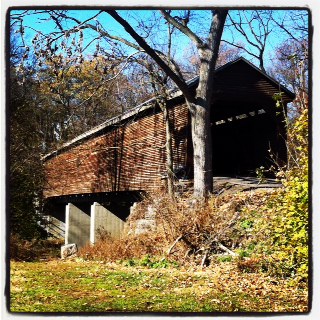
After breakfast at the Southern Kitchen in New Market, Mary and I decided to take a little drive north on Route 11 to Mount Jackson so that we could have a look at the Meems Bottom Covered Bridge there.

I'm pretty sure I've posted on it before - we go there now and then since we discovered it.  It's on the way to Edinburg, which has a restaurant we enjoy and another gap to drive over the Massanutten ridge line.

The "Virginia is for Lovers" web site says the bridge was built in the 1890's. From reading about it elsewhere I remember that it is one of four covered bridges still in use in the state.

There was a fire here in the late 1970's and the bridge was rendered unusable.  However, they were able to recover many of the structural timbers and it was reconstructed so that it can carry traffic to this day.

It spans more than 200 feet over the North Branch of the Shenandoah River.  It's worth the drive to check it out sometime.

Here's a link for more info and directions:
http://www.virginia.org/Listings/OutdoorsAndSports/HistoricMeemsBottomCoveredBridge/

Wisteria's Harvest Celebration

In the style of my so-called "agribusiness internships," Mary and I volunteered at Wisteria Vineyards a couple of times this fall to help with the harvest.  I've posted on it a couple of times here on the blog - Mary and I really enjoyed our time there working with Sue and Moussa, learning about how the grapes are grown, and then helping with the first steps of making the wines.

By the way, Wisteria keeps a blog on events too - a link is here:
http://www.wisteriavineyard.com/7701.html)

Sue shared this photo of Mary and our friend Nina out in the vines - I took a photo of a photo here, so it's not the clearest.  But I think you can tell somebody's having fun!

That work was pretty much completed by mid-October, when the Valley is already having frosty mornings from time to time.  Sue and Moussa then planned a little harvest celebration for the volunteers and they invited us.  The event was planned for the weekend before Halloween, but with Superstorm Sandy coming up, it was postponed until the first weekend in November.

The second shot here is of the group of volunteers sitting around the fire pit and enjoying our memories of the harvest.  The highlight was a barbecue that Sue and Moussa put on featuring shish kabob and some other specialties, such as baba ghanoush and hummus- followed by a selection of delicious baklava.  The meal itself was enough of a reason to volunteer next year, to say nothing of the wines!


Monday, November 12, 2012

The Pigs are Alright

It had been a few weeks since I stopped by to check out the pigs, so I sent David a note and he said, "Help Yourself!" and Mary and I trekked over there.

We happened to catch him at home so he came out for a visit.  He told me one of the pigs had fallen ill, and pointed to the one in the back with the droopy ears.  Who knew that pigs had a health indicator like that?

On another note, since there'd been a break in the weather and it had gotten pretty cold in the Valley, he'd installed a heat lamp in the stall.  They're all sleeping under it here.

The goats had to be banished out of there while it is hung up.  Those knuckleheads were butting it around, and in typical goat fashion, mouthing it.  They'd have knocked it down and probably electrocuted themselves. Dumbasses.

David had assessed that the pig had become dehydrated - or actually, had eaten too much salt in its feed.  So it had symptoms very much like a cold, although the poor animal was really putting up a fight.  David said, "Well, it's 50/50 right now, and we'll know within the next 48 hours."

As it turned out, the little fellow had a turn for the better starting that evening, and I guess everything is fine now.  Good news.

Friday, November 9, 2012

Snow on the Mountain

One of the things that made Hurricane Sandy such a devastating storm was the combination of two wintry systems with the tropical one.  While the full force of that storm was felt in New Jersey and New York, we had some impact in Virginia.

And as the news of the storm began to reach Mary and me in Alexandria, one story I saw was that as much as a foot of snow was getting dumped up in Shenandoah National Park.  Skyline Drive was closed, but in the typically beautiful weather that follows a storm like this one, the park was soon reopened.

I'd seen that there were major accumulations at Big Meadow, which is in the part of the park with the highest elevations.  The lodge there is only four miles away from Hawksbill Cabin - as the crow flies - and about 3,000 feet above us.  The story goes that before the trees grew in to our neighborhood, you could see it from the brick terrace.

So Mary and I took a drive up to the park, and I wasn't disappointed in my search for early season snow.  These first two photos are from the Jewell Hollow overlook, looking down into the Valley.  You can catch a glimpse of Lake Arrowhead to the west in one of them.

The final picture I'm sharing today is a view of the Big Meadow area from the nature center across Skyline Drive.  Sure enough, this is where the largest accumulations were - it was chilly enough up there for the snow to stay down.

While we didn't walk out into it, it was the inspiration for another treat: we went over to the camp store there and had a hot chocolate before we got back on the road home.

Friday, November 2, 2012

I Voted for President Obama


I’ve held off on making a political post on the blog so far this election season.  But now that the campaigns are almost over, I wanted to take a moment to outline the reasons I’m supporting President Obama for reelection.

I’ll make no excuses or attempts to hide my alignment with the Democratic Party – I have voted straight ticket since 1984, Mary and I met during the 1992 Clinton campaign, I was part of a veterans caravan for the 2004 Kerry campaign and helped the campaign on GOTV that year, I wrote letters for Clark during the primaries that year, and then supported Obama in 2008.  Just look at the “inauguration” label here on the blog, and you’ll see the enthusiasm for the promise that accompanied that election.

And I still believe in those things today.  We have come a long way since 2008 – despite the hurdles and obstacles that have been in the way.  President Obama’s record is one that on the whole makes me very proud to be an American.  He led the way to the passage of the Affordable Care Act, for one thing, and saw us through to the end of the war in Iraq, for another.  And he made good on his promise to hunt down Bin Ladin.

So many things are left to do, so I believe he has earned four more years.

There are many contrasts with the Republican candidate, Mitt Romney, and his running mate, Paul Ryan.  It is hard for me to find even one single common philosophy within the campaign they’ve run:

  • Romney has said that he would consider voucherizing veterans benefits, breaking the sacred trust with those who have served, and Paul Ryan included major cuts to those programs in his famous budget.  
  • Under the Romney Ryan plan we’d see a similar approach taken with so many other programs that are important to our society, and they’ve given no outline of how to compensate for the abrupt turbulence their proposals would create in the economy and the country at large – turbulence that would likely eventually evolve into something even more catastrophic for our economy.
  • Romney said his first goal in office is to repeal Obamacare – a step backwards on healthcare, rather than forward, and something that really outlines the whole premise of the campaign as far as I can tell…some kind of retrospective look at where the country should be.
  • Some argue that Romney’s business experience will be a great benefit to the country as we continue to struggle with a slow recovery.  Among the real reasons for the slow recovery is the Republican demand that we take a different approach with this one than we have in the past – a position established by and led by Mitch McConnell and John Boehner.  But consider the truth of Romney’s success in business:  he financed the purchase of business with loans and credit, and then tore them apart, selling toff he valuable pieces for a profit, leaving creditors holding the bag.  Jobs were destroyed or sent overseas in the process, and where there were some created, they were often low or minimum wage with poor benefits. These aren't the jobs that will lead to a faster economic recovery.
  • During the campaign, he’s outlined an approach that would add $7 trillion to our deficit.  He can’t offer any plan for offsetting this, except for perhaps $1 trillion in savings from the cuts I discussed above.  This alludes to that track record he’s running on – add to the debt, cherry pick the things of value, and then leave somebody else holding the bag.  That somebody else…well that would be the middle class in this case.
One of my fellow bloggers describes himself as being “one standard deviation left of the mean.”  I have never considered myself a liberal, but rather, more of a moderate – something that probably meets the definition my friend has provided.  And that means positions like these are diametrically opposed to what I see as the right direction for the country.   We just can’t get there with a Romney presidency.

So two weeks ago I cast my vote to reelect the President.  I’ll be proudly cheering for him during the election reporting next Tuesday.  

Tuesday, October 30, 2012

Mary's Chairs Project

The chairs - before.
A couple of springs ago, one of our neighbors put out some nice wooden chairs during "big trash day."  Mary spotted them and thought they would be worth the effort to recycle.  She even went and knocked on the neighbor's door to make sure that they were okay with that.

I should mention that Alexandria sends around a notice about big trash day about six months in advance.  There are folks who scavenge the night before, checking out the various piles of discards for something of value.  It's quite competitive, and for some reason our neighborhood gets a lot of traffic.

In the group house I lived in when I first moved to the DC area, my room mates had made a big score on big trash day over in the Westover neighborhood, near East Falls Church Metro.

They'd found an original, marked, Heywood Wakefield coffee table - but for some reason, when the house broke up, no one took it.  Now it sits in the living room at Hawksbill Cabin.

So the fact that Mary was able to score these chairs is really saying something.

The chairs - after.
The project lay idle for a couple of years, but she decided last spring to pull the chairs out of their storage area and check out what needed to be done.  It was a straightforward job of stripping of the old finish, which was peeling away, and was the reason they were tossed in the first place.

She also sanded them down and tightened the screws.  Then she painted them a flat white to match our other porch furniture, and there they sit.

Of course, with the hurricane on, none of us are going out there to check them out.  But I do fancy lighting up a stogie out there sometime this fall.

Monday, October 29, 2012

Fall Foliage Photos

The view from Balkamore Hill, just north of Stanley, VA.
Well, here we are hunkered down during Hurricane Sandy.  I was thumbing through the photos I have saved on my phone and realized I hadn't put up some of the foliage highlight shots I took last weekend when we were out at Hawksbill Cabin.  This weather is going to hasten the end of the foliage - as you can see by the Skyline Drive photo I've put in at the end of the post - but for now, it's good to remember it in the face of this week's apocalypse.

The first photo is the one from up on Balkamore Hill - where the bike races take place.  I often take that route as part of my drive back from the park with Tessie.  It was a nice view with the fall colors last weekend.

Back in the wood lot, looking up through hickories and oaks.
Another of our rituals during the fall and winter is a walk back into the wood lot.  I don't do this in the spring and summer when the snakes are on the move, even though Tessie will stand at the beginnings of the path and wait for me to come along.  We have a lot of hickories back in there, their golden color making a highlight.

Dogwoods and the still-green apple tree in the front yard.
In the front yard, we have some nice trees of species that are well known for their foliage, including a dogwood or two.  Here's a peak at them from the driveway, with the little patio off the main bedroom just in the view on the left.  The strong angle of the sun required me to stay in the shadow of the house.

It's a pity, but with the rain, wind, and possible wintry mix of precipitation, the leaves will be all but gone when we're next out.  But we'll see about that!

Closing out the post today, here's a photo I clipped earlier from the Internet.  It's from one of the Skyline Drive webcams, near Big Meadows (which is only four miles from Hawksbill Cabin as the crow flies, and about 3,000 feet above it).  As you can see, they're getting snow up there today - the forecast said anything above 1,500 feet would - and the drive has been closed.

Brr!  And it's not even winter yet!

Big Meadows in Shenandoah National Park, via webcam, 10/29/2012.

Wednesday, October 24, 2012

The Barn Cats

Sometime in the early summer we noticed this litter of kittens taking shelter around the shed, mostly under the lean-to where some old building materials are stored. Four of them, and sometimes when the mother showed up - barely more than a kitten herself - five.

They stuck around, and later we learned that the neighbors had been feeding the mother, so she stuck around the area and considered it home.

About a month later, I saw four more kittens in the front yard, emerging from under the pool deck.  It wasn't long before we saw the mother there, too, and we also learned that the mother was being fed by the neighbors.

Ten stray, un-neutered cats. Well, over the course of the first month or so, one of the kittens from the first batch, and another one or two from the second, had been killed off or died.  They're strays, and nobody is reliably taking care of them - we don't live there full time and have no intention of adding feline pets, certainly not seven or eight of them, to the family.

We started looking for sources of help with getting these guys adopted out or relocated to a place where they could be looked after.  We found out that there is a nonprofit called Cat's Cradle in the Valley - web site is http://www.catscradleva.org/ - that will catch, neuter, and release feral cats like this bunch.  Seven feral cats is a good start on 50, for Pete's sake after all.

So the adventure began - there was an evening of trap setting, and eventually everybody was caught.  Here's the first litter - having lost one of their siblings by this time.

It turns out that with the long hot summers we've been having, cats are having two heats a year - it's very important to get this under control.

We also caught the mothers of both litters, and some of the younger litter, who turned out to be too small for the operation just yet.

Now, they're all back.  They're free to live a feral life around the Hawksbill Cabin, although Mary feeds them on the weekend and the neighbors pitch in when they can.

I guess you could call them feral with emerging domesticated habits.  They know when they're going to get fed and they emerge from hiding places all over the place when they hear the food bag.  And they've started to interact with the humans around the place.

Sunday when I got back from errands I saw the little black striped one sitting up on a fence post near the shed.  I guess they are getting personalities too.

Monday, October 22, 2012

Local Brewers

Dan told me that a group of folks interested in brewing was organizing in the Page County area.  They've named the group The Blue Ridge Brewers Association - there's a blog, linked in my blogroll, and their doing lots of other things to organize.

Yesterday was the regular meeting.  There was serious business to cover:

1) a local effort to develop a local source of malt for brewing - a farmer has planted about 3/4 acre of two row barley for this purpose;
2) a visit from the folks over at Copper Fox Distillery over in Sperryville, where they are already engaged in crafting malts for their products, and for special orders nationwide; and
3) results from a tasting given at the Luray Downtown Initiative (LDI) and the prospect for another soon at the Luray Caverns CX.

As I mentioned, this is the first of the meetings I'd attended.  There was this obscure item on the agenda that I was especially curious about, called "Around The Cooler."  This ended up being the tasting section of the meeting - quite a few of the members had brought samples of their latest or a recent batch, or even a commercially available craft brew.

Although I had found a bottle of my recent Belgian Black on Saturday, I figured that one 22 oz. bottle wasn't enough to bring for this purpose.  I hope to have something to share in the future, however.

In any case, it was quite an educational program, as we progressed through a couple of items you wouldn't traditionally expect to find at a homebrewers' meeting:


  • Kabuchi - a fermented tea
  • A Marzen-style lager
  • A Belgian Chimay-style
  • An IPA
  • A porter
  • An Imperial Stout
  • Whisky from Copper Fox
We also had some very tasty sauerkraut and wursts...There's more to come from this group!

Friday, October 19, 2012

Next Batch: Chocolate Maple Porter

The mash of chocolate malts.
I'm not normally one to go in for strongly flavored beer.  I just like...beer.  But for some reason when I got started on this home brewing hobby, I bought a one gallon kit to make up a Chocolate Maple Porter - and I brewed the batch last weekend.

I just moved it to secondary fermentation last night, using an old Carlo Rossi Paisano gallon jug that I have pressed into service as a carboy.  Here are some photos - bottling will be next week.

Primary fermentation in my recycled wine bottle.
Now, I should note that the only flavoring added here is the maple syrup - I used some from that jug I bought in upstate NY last spring.  The roasting style of the malts imparts the chocolate flavor - there's nothing added to create it.


I'm finding brewing to be as interesting and relaxing as grilling has been, so I'm likely to keep going with this to build my skills.  I even took off to the homebrew store here in Alexandria last weekend to buy some supplies and check out the ingredients they have available.

I used the Gingered Vagabond Ale recipe from Papazian's "The New Complete Joy of Home Brewing" (Amazon link below) as a resource to shop with.  The store had all the requisite grains, yeasts and hops...so I'm good to proceed.

First, though, I've got to break out the five gallon mix of IPA that I've had stored in the basement - I want to try my hand with that one over the next few weeks.  I will be using some of Dan's Cascade hops in it, and also the packet of Calypso hops he gave me, substituting them for whatever's in the kit.

Also of interest, the home brewers' club out in Luray has a meeting this weekend, I hope to get by there to meet my fellow brewers.  They're also keeping a blog now:  http://blueridgebrewers.blogspot.com/.

More to follow, I'm sure!

Here is a link to the Papazian book, and another with some good recipes:


The New Complete Joy of Home Brewing


Monday, October 15, 2012

Wisteria Vineyards Harvest - A Wrap


Here's a view of Big Meadows Mountain in Shenandoah National Park,
as seen from some of the new vines at Wisteria.
 Mary and I had a great time during the late summer and early fall getting to know some of our neighbors as volunteer grape pickers at Wisteria Vineyard.  Each weekend morning as we went over to the vineyard, we joined a dozen or so friends from around town who’d come out to pick the Seyval, Traminette, Chardonnay, Merlot, and Norton grapes.

Here's an orientation of the vineyard - the harvest
progresses more or less from right to left.
Although the hour was a little more civilized and there weren’t any stalls to muck out, I’ll chalk up the experience as another “internship” – similar to the one I had last year working with David at Public House Produce, where I learned “up close and personal” about the craft of raising excellent local food and agricultural products.     

I posted about the experience in more detail a few weeks ago (http://hawksbillcabin.blogspot.com/2012/09/scenes-from-vineyard.html ), but as volunteers we helped during the early stages of the winemaking process.  We picked, then worked the destemming/crushing equipment, loaded the wine press and watched as the juice or early wine poured out and was loaded in the casks to complete fermentation.  Then we cleaned up – and there was a lot of that, but it was fun too. 

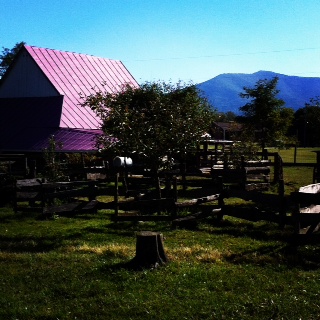
The barn, where the sheep and chickens reside, at Wisteria.
Behind is the Blue Ridge and Shenandoah National Park.
Just as I have learned with my new brewing hobby, cleaning up is a big part of the process for these crafts.  There are estimates that it takes 20 gallons or so of water to make a gallon of wine, because of all the cleaning.  In my home brewing experience, I’d say that I probably use five gallons for every gallon I make, although I may be more efficient when I start making five-gallon batches.  But all of this effort is meant to ensure you have a high-quality, safe, and tasty end product.

And that is definitely what you’ll find at Wisteria Vineyard. 

Red grapes, the last harvest at Wisteria.
For Hawksbill Cabin readers, if you happen to be coming out to visit the vineyard, give a yell – we’re only a half mile away, and maybe we can meet you there.

Thursday, October 11, 2012

Home Brewing

The Bruxelles Black - first tapping!


After so much encouragement from neighbor Dan, co-workers Tom and John, and friends Stan and Brendan, I decided to try my hand at homebrewing.  Stan’s been doing this forever, and then Dan has his hopyard out the back, so these things raised my curiosity.  Other friends have posted their process and experience on Facebook.  

Then Tom built himself a keg vault down in the basement; and I’ve been treated to watching them brew five-gallon batches – a wheat with Stan, a coriander-spiced Belgian with Brendan, and Dan’s Flat Tale IPA. 

The new brewers' association Dan helped to start.
The stakes keep getting raised.  Now Dan has formed the Blue Ridge Brewers Association, with regular meetings that are educational about the craft of brewing – with samples.  He also bought a 15-gallon set-up, and he’s had talks with local farmers about how to get a plot of barley suitable for brewing going, and then how to establish a malting operation.

Brewing with the one-gallon kit.
So I finally broke down and bought one of those beginner kits at Williams-Sonoma.  It included a one-gallon set-up with an IPA mix.  Before I even got started with this set, I also bought a five-gallon brew kit, although I haven’t yet broken that one out – I did upgrade to a brewer’s pot though, with six-gallon capacity.  I’m all set, if I ever get serious about it.

So far, my exploits have been to make three one-gallon batches.  The first was an IPA, and it was marginal.  For two reasons:  first, I was clumsy and wasted a lot of it during the bottling process, so we never got a good taste of it; and second, because I probably missed an instruction or two and didn’t end with the fullest, richest beer I might have.

My second batch was much better, a summer brew that was called Honey Grapefruit Ale – I managed to bottle almost the compete gallon in a set of 22 ouncers I have been saving up.  And the third, which has been sitting in bottles for the last 10 days, set for opening tonight, is a Belgian Black Ale, shown in the photos here. 

The bottled yield of the Bruxelles Black.
I opened the Belgian Black Ale with Dan last weekend, and we liked it.  It lived up to its appearance, and it is different enough that I could specialize in it and possibly end up with something really special.  So I am going to try it again soon.

I still have a one-gallon fall brew to go: a chocolate maple porter.  When I’m done with that one, I’m planning to move up to the five-gallon set up, since I’ll have been through the process a few times and feel pretty confident of it.   I have an IPA lined up for the first batch. 

Down the road, once I have a batch or two under my belt, I will probably substitute the hops provided in the kit with some of Dan’s homegrown Cascades and a pack of Calypso he gave me.  That’ll be a treat.

Monday, October 8, 2012

Visitors - and a Trip to Luray Caverns


The iconic bell tower at Luray Caverns, with Mary's Rock
in Shenandoah National Park in the background.
Last weekend our friends Kelly and Tom came out to Hawksbill Cabin for a visit – seven-year old daughter in tow.  The kinds of recreation we might have taken in during the old days aren’t available here, even if those were the choices we might have made for the weekend.  Fortunately, seven-year old Erin had come prepared with research.

A scene in the caverns - a small underground lake here.
High on her list were Luray Caverns, our most famous landmark here in Page County, and the corn maze up at Valley Star Farm, which I had sent along in a short list of things I thought might be fun to do.  To these we added a stop at Wisteria Vineyard for the “Music Under the Arbor” with Marcos Brown and the Sugartones, a trip to the Luray-Page Farmers Market to see some friends, and a cookout on Saturday night.

I have a few photos here of highlights in the Caverns, including one of Mary, Kelly and Erin with our tour guide Chad.  This may be the moment that Kelly asked if anyone had found the white sweater she lost during a school trip when she visited the Caverns in second grade, when she was seven.  Chad courteously directed her to the lost and found above ground. 

Getting our money's worth from tour guide Chad!
As far as the story of Luray Caverns goes, they were found in 1878 by some local farmers – there’s a little sign in the Caverns marking the spot where they first went underground.  The Wikipedia article on the Caverns offers a pretty colorful history on the development of the property as a commercial enterprise, but you can cut to the chase about modern day attractions on the website at www.luraycaverns.com .

We didn’t get to enjoy some of the other highlights there – including the museums that are included in the price of admission, or the two mazes that have been constructed on the grounds.  We’ll save them for another day.  

However, on Saturday, we had visited the corn maze and pumpkin patch at Valley Star Farm north of Luray. 

Another cavern scene, I think this formation
is called "The Fish Market."

Although Mary and I never go into the maze, the pumpkin patch is an annual stop for Mary and me, and we often bring visitors with us to this spot, which is as scenic as any here in the Valley.  Here’s a past post about one of our visits in 2008:  http://hawksbillcabin.blogspot.com/2008/09/valley-star-farm.html

Looking up at the caverns' ceiling, I found
the algae interesting.  Must grow due to the
combination of lighting and moisture.
Tom and Erin went into the corn maze, where there is something of a scavenger hunt set up for the kids to explore and learn about the farm.  When the scavenger hunt is over, the kids visit the little farm store to turn in a visitor card, earning the youngster a pumpkin from a special bin – followed by an ecstatic search for just the right one.

An unexpected theme of the weekend happened while we were at the pumpkin patch – seven year old Erin lost her sweater, just like Kelly did in that long ago school trip to Luray.  We searched all over for it, including the lost and found at the pumpkin patch.  

It’s gone to sweater heaven, maybe they’re even together now.